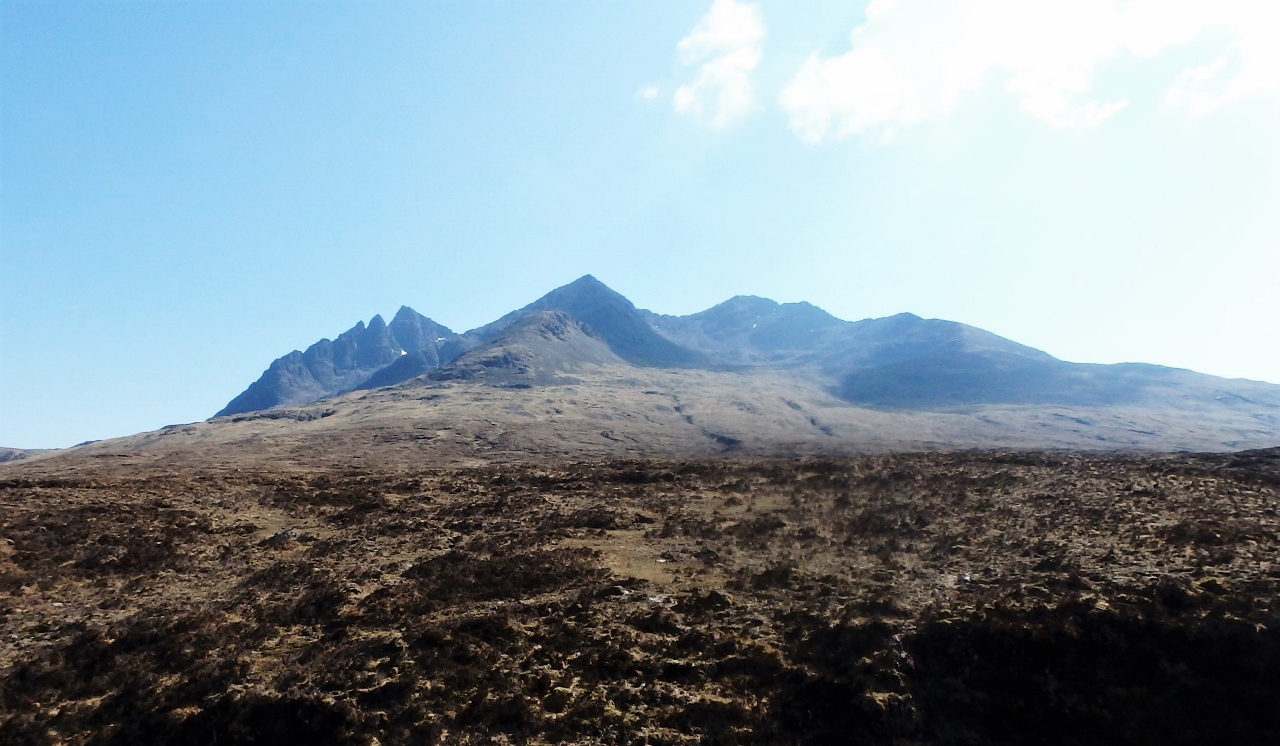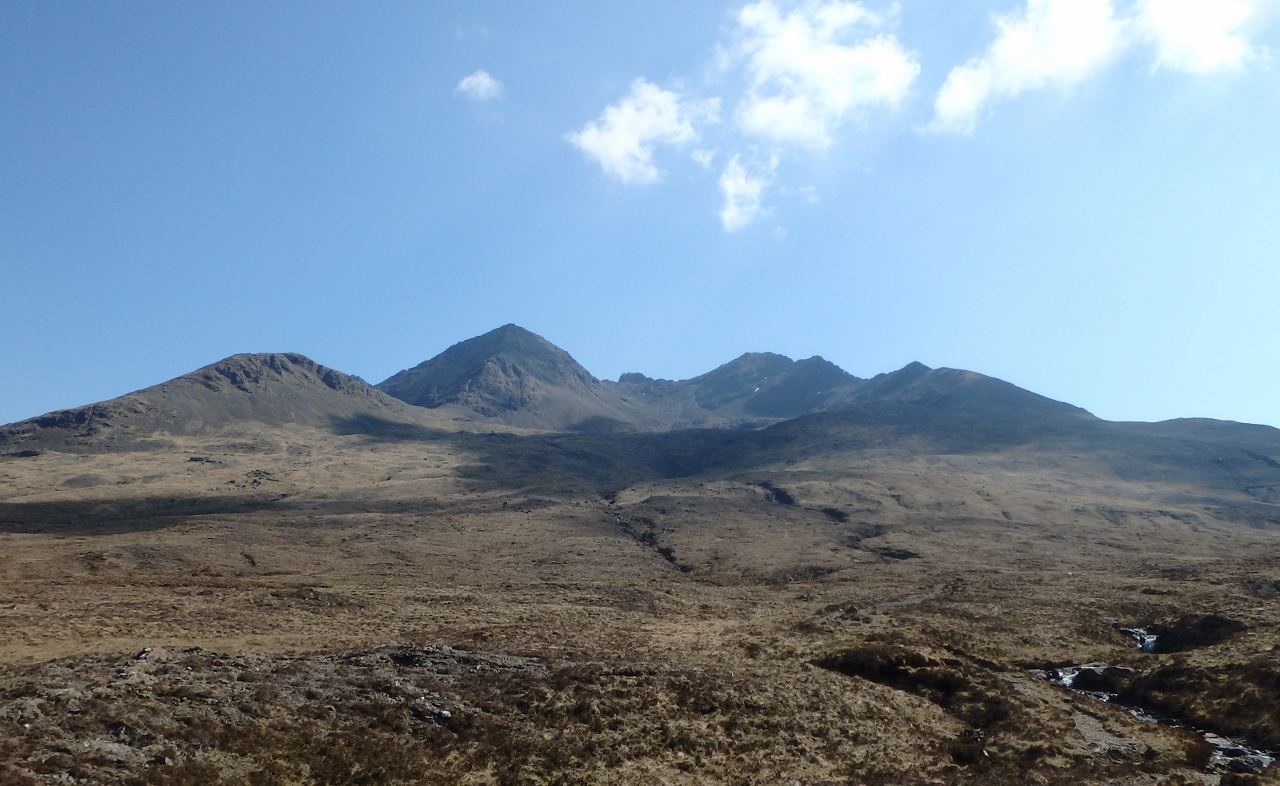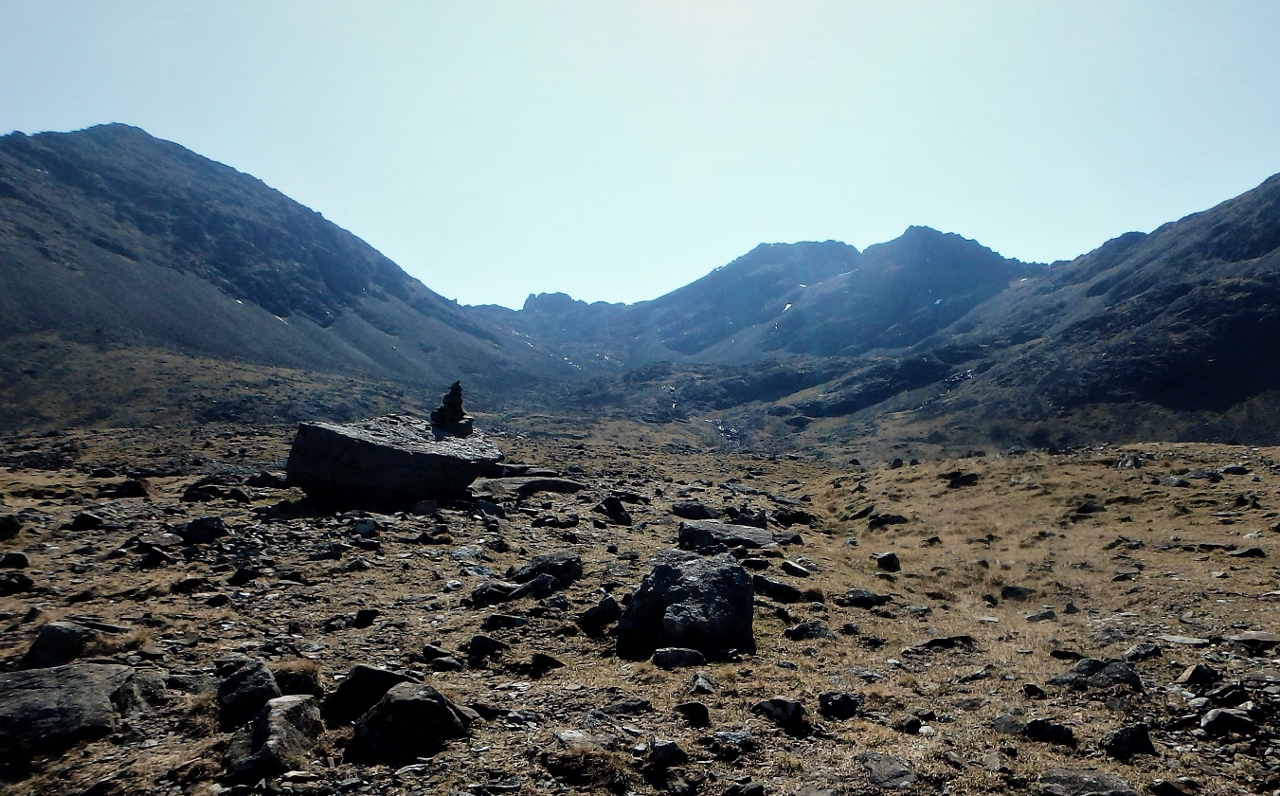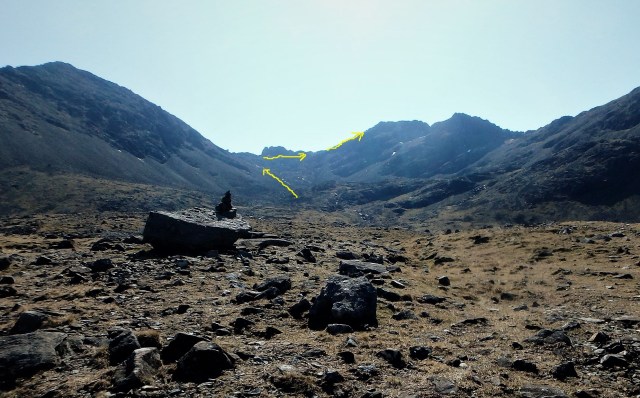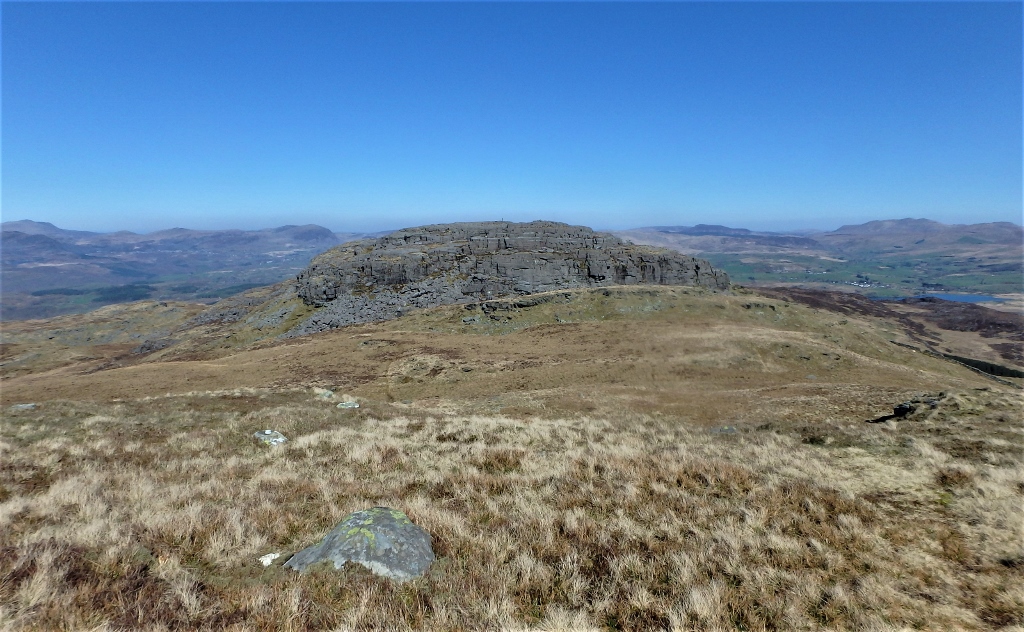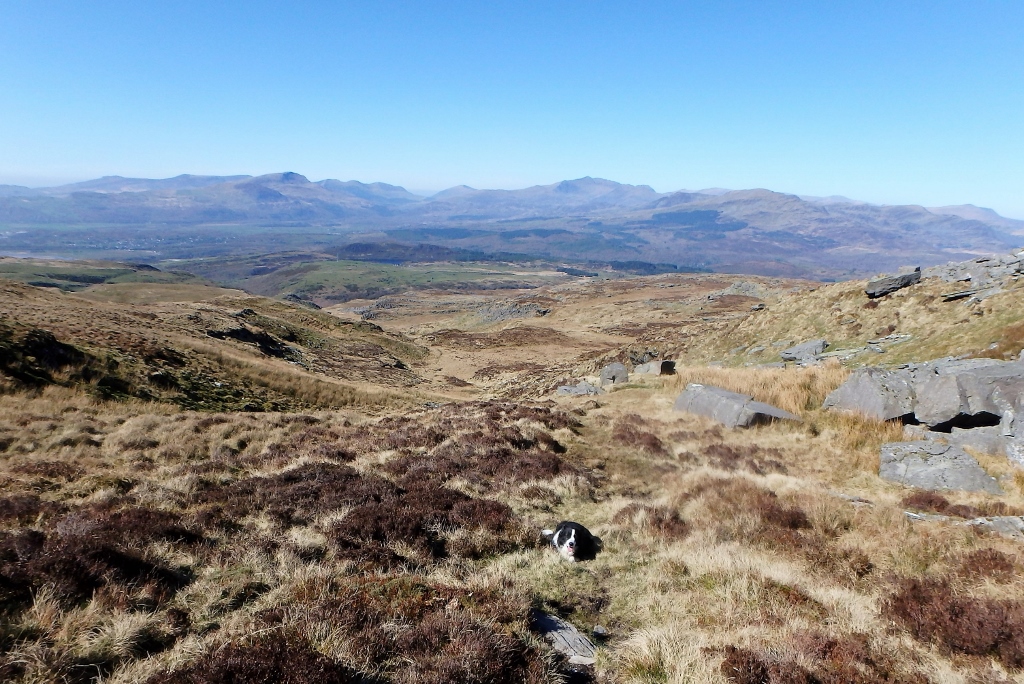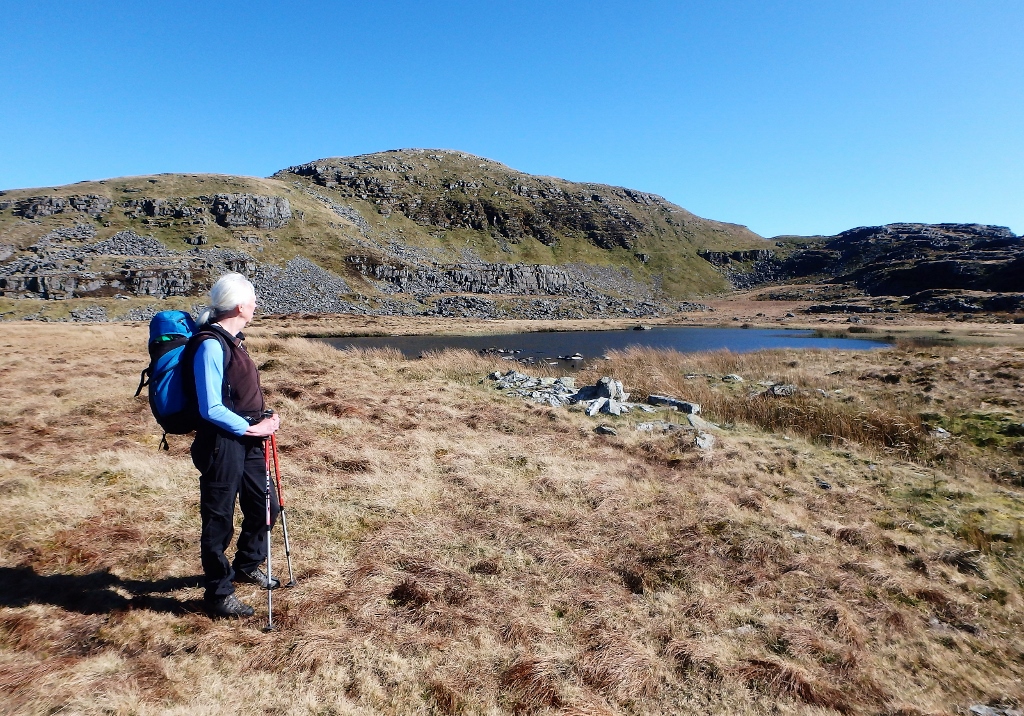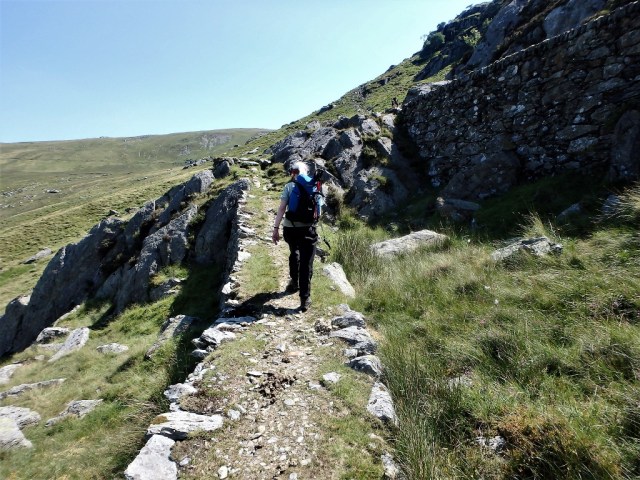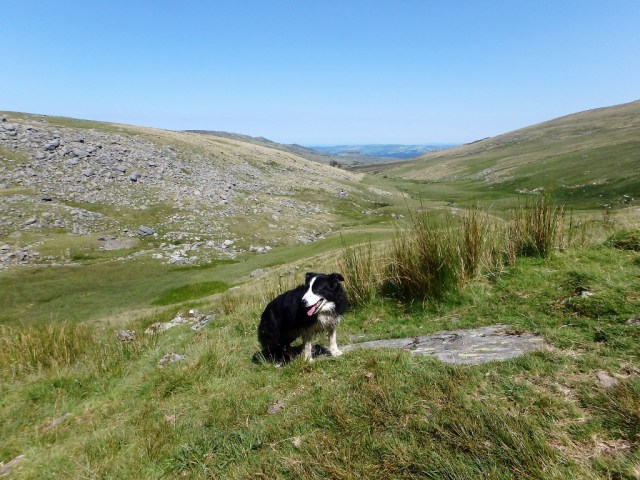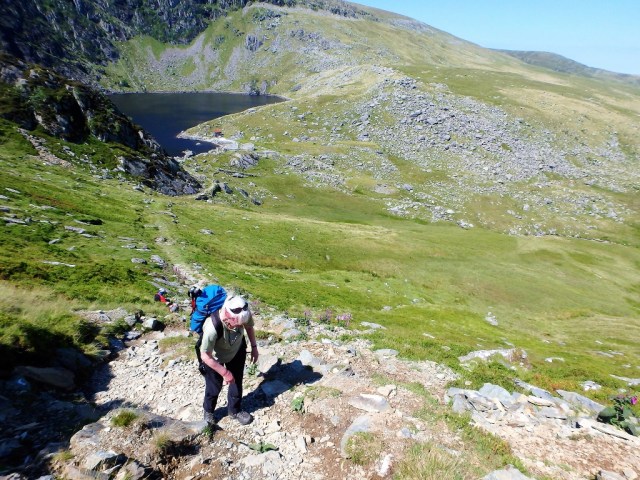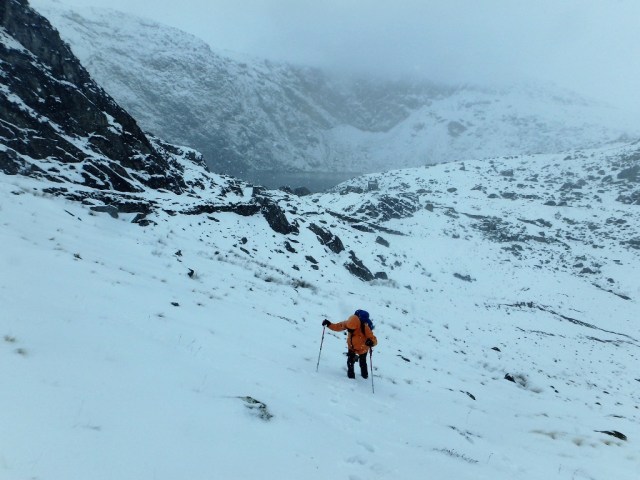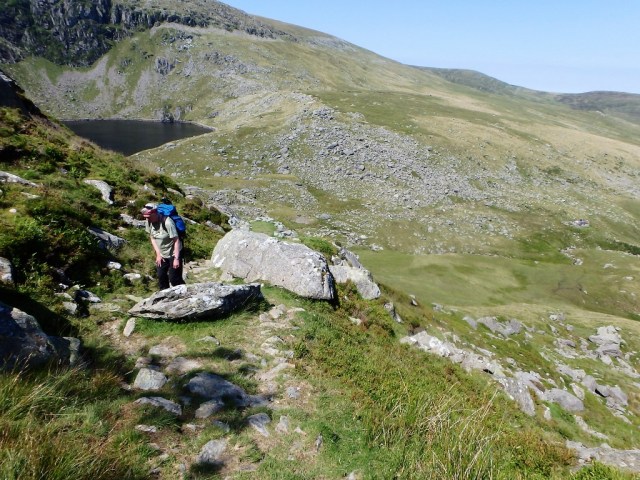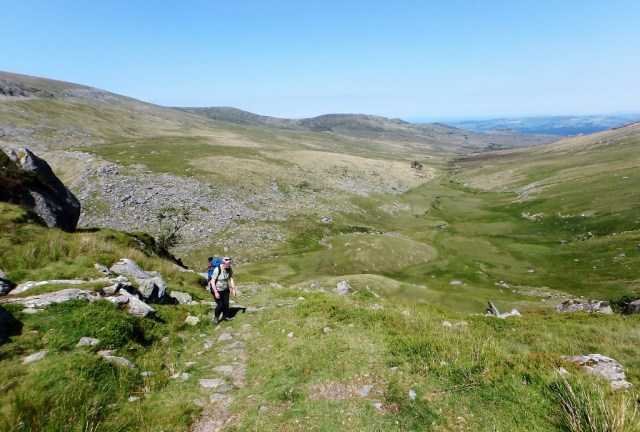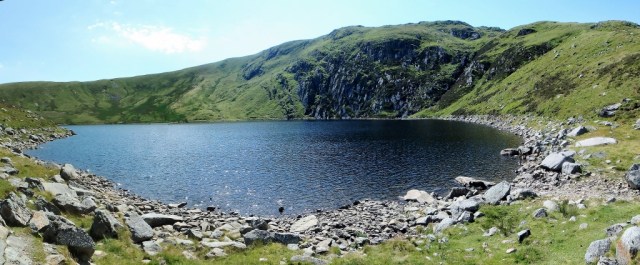
#227 – Coire Mhic Fhearchair and the Beinn Eighe air-crash, 1951

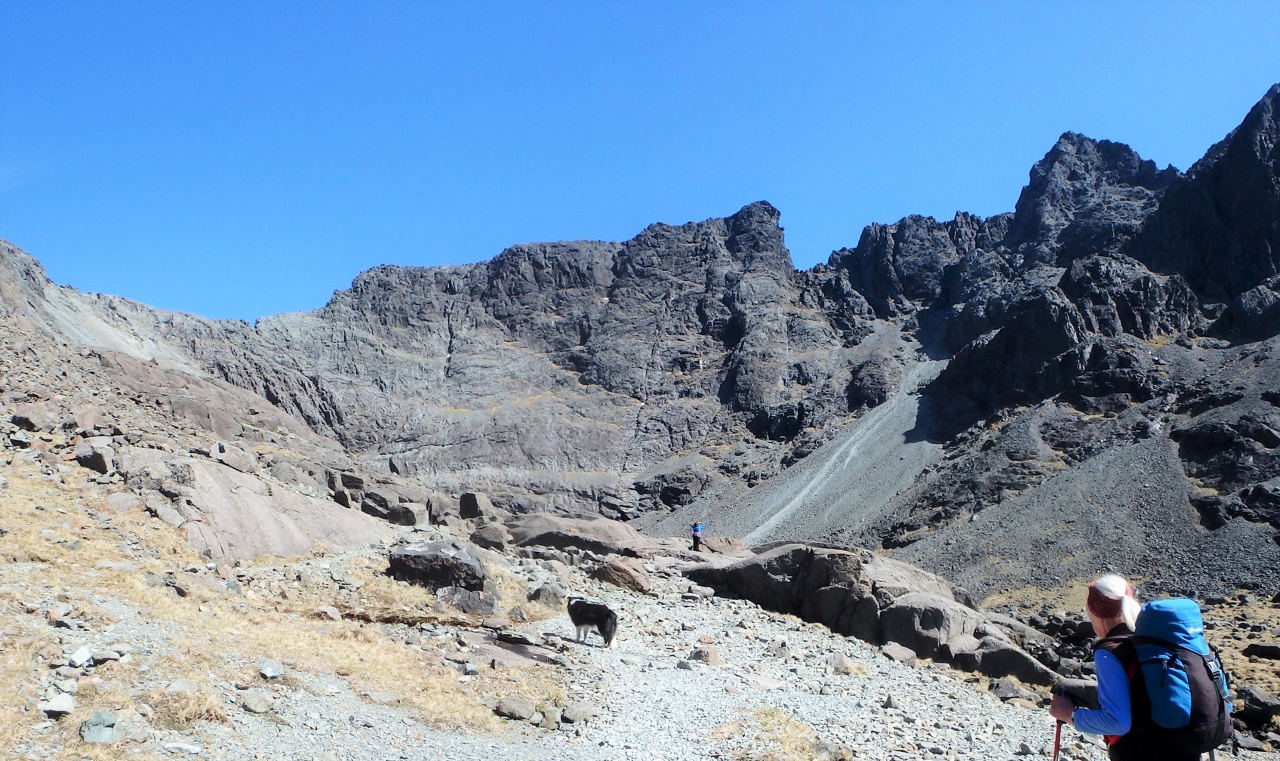
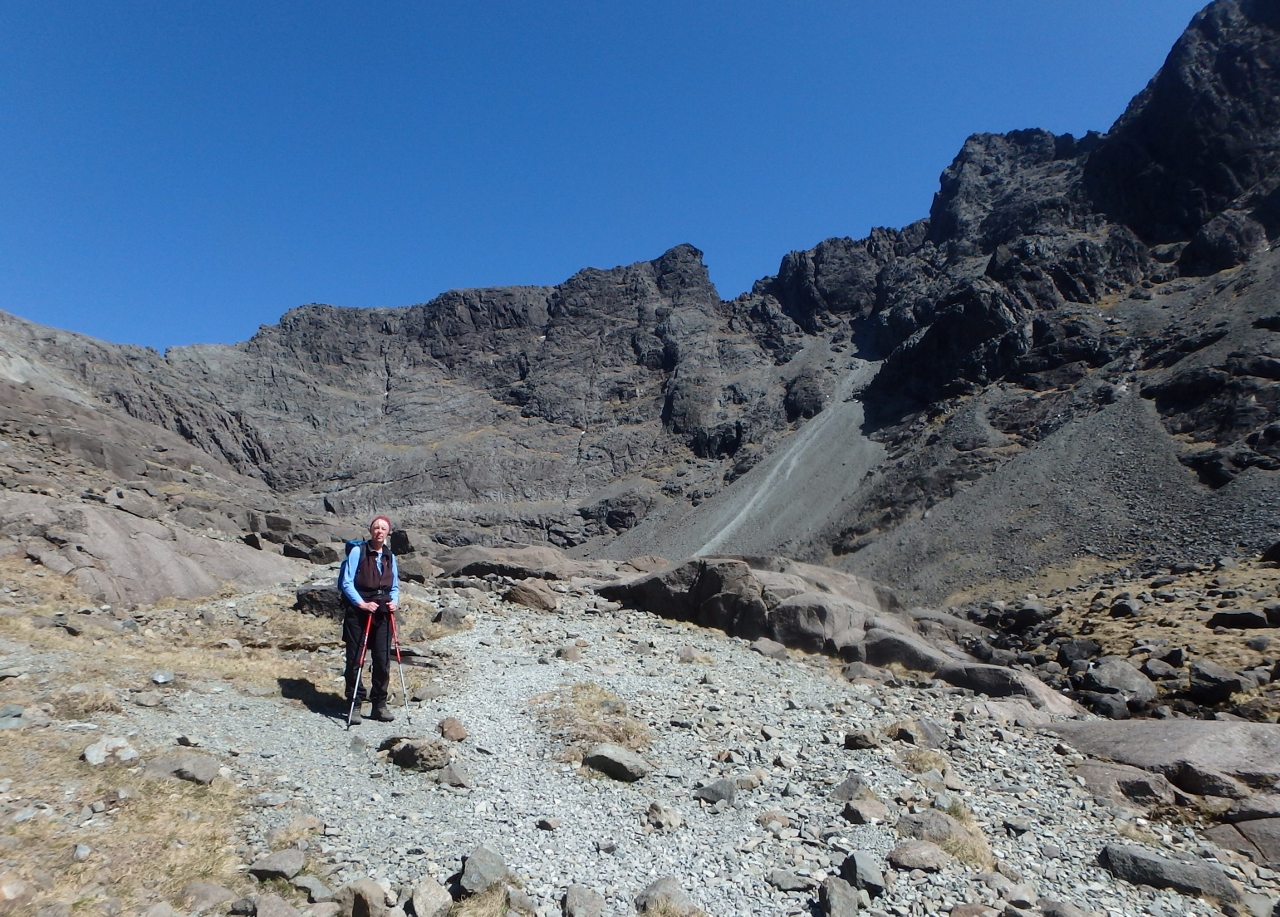
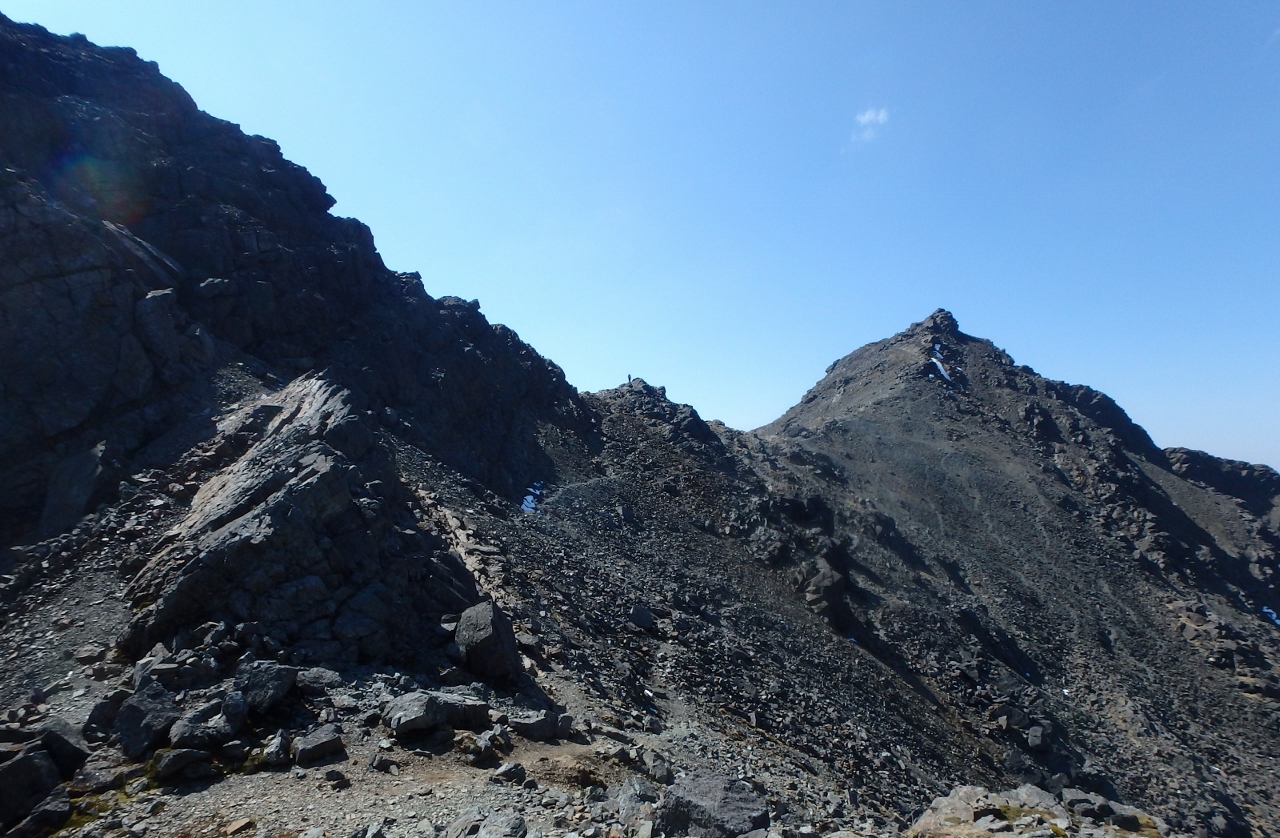
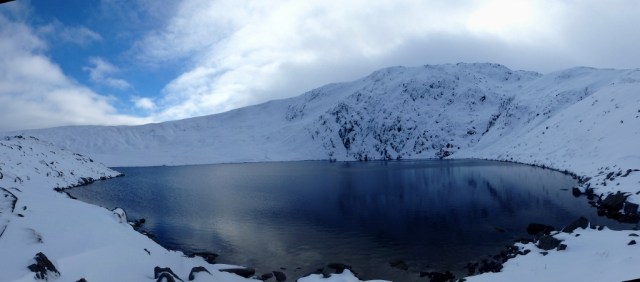
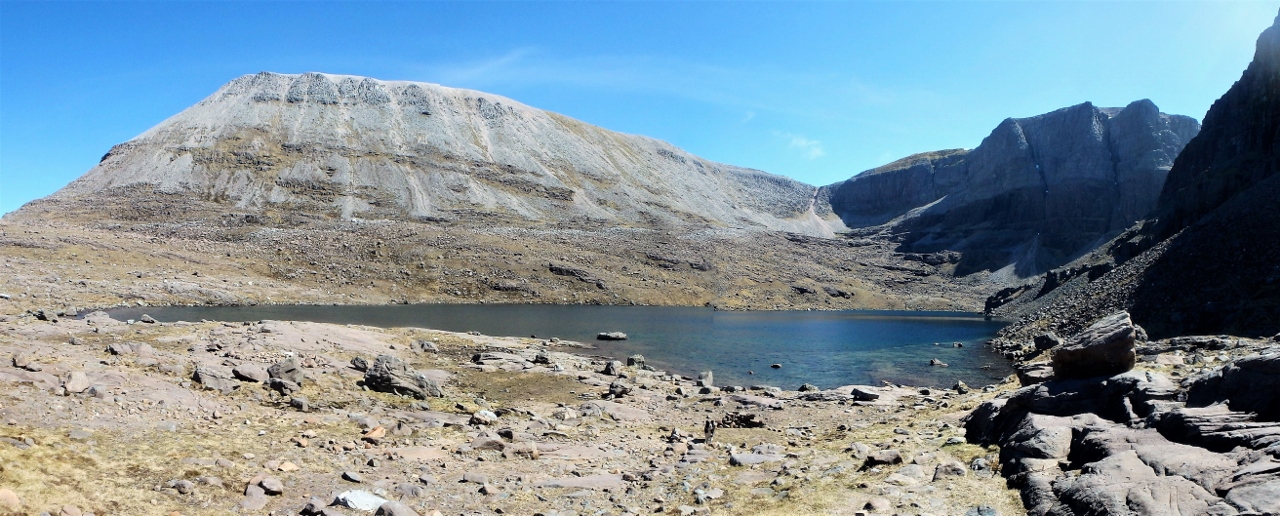
Coire Mhic Fhearchair with Triple Buttress on the right

(Some images will zoom – Left click to zoom in, use browser return arrow to go back)

Our Scottish trip had got off to a great start with bright sun and settled conditions most of the time, especially on Skye (see posts #223, #224, #225 and #226), but it was time to move on while the weather was still holding.    Chris and I have used Torridon as a stopover in the past, and it’s a short, convenient drive from Skye, so Torridon it was!

Our route into Coire Mhic Fhearchair – left click to zoom in

Torridon, showing Beinn Eighe and Liathach

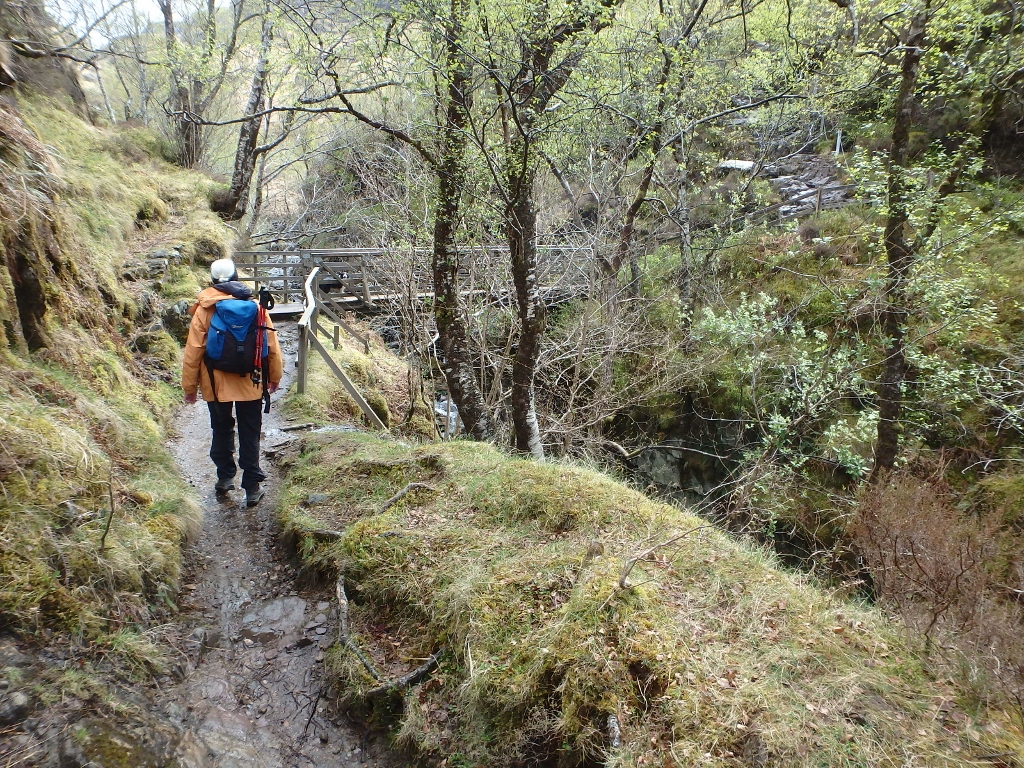
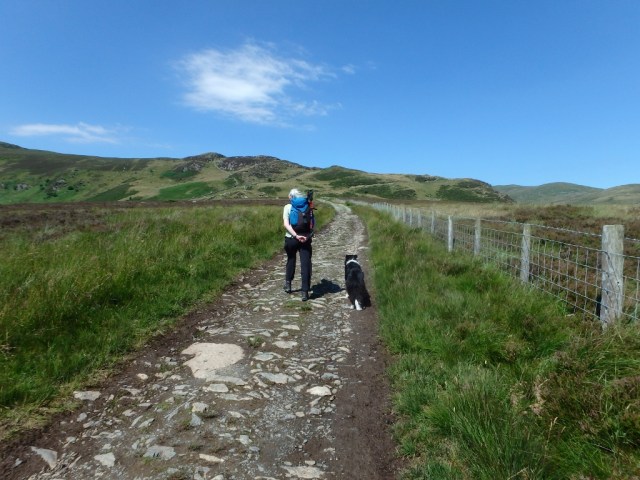
Setting out ….

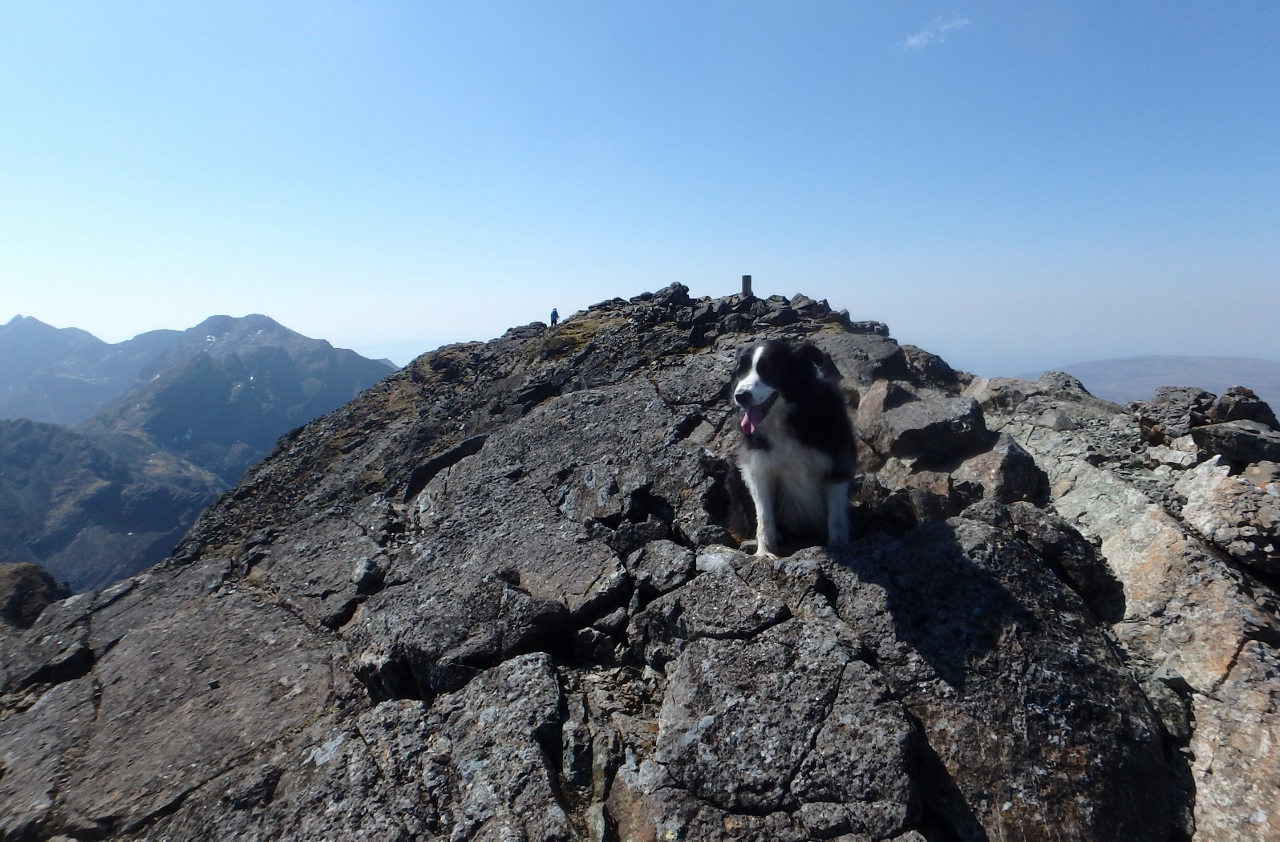
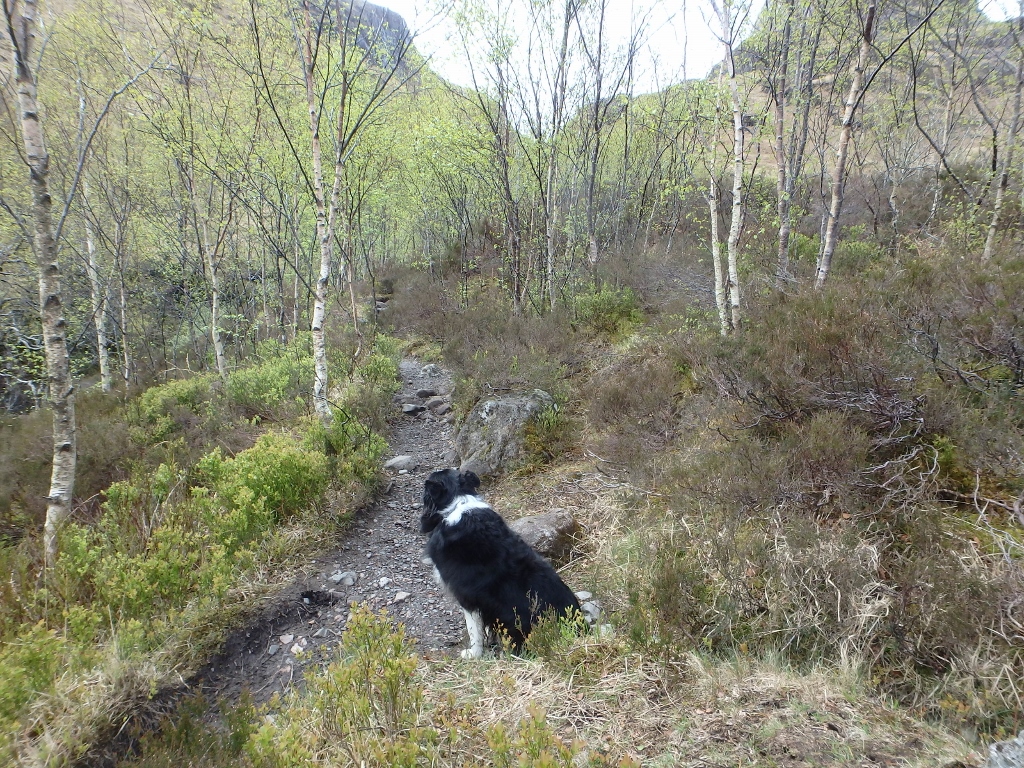
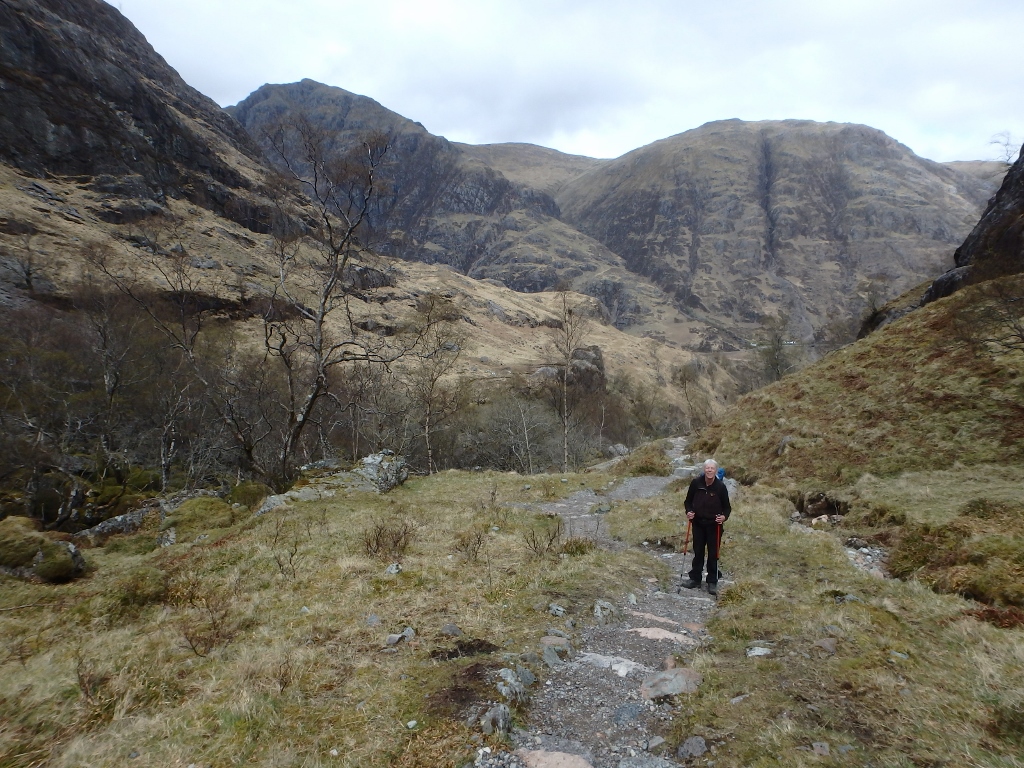
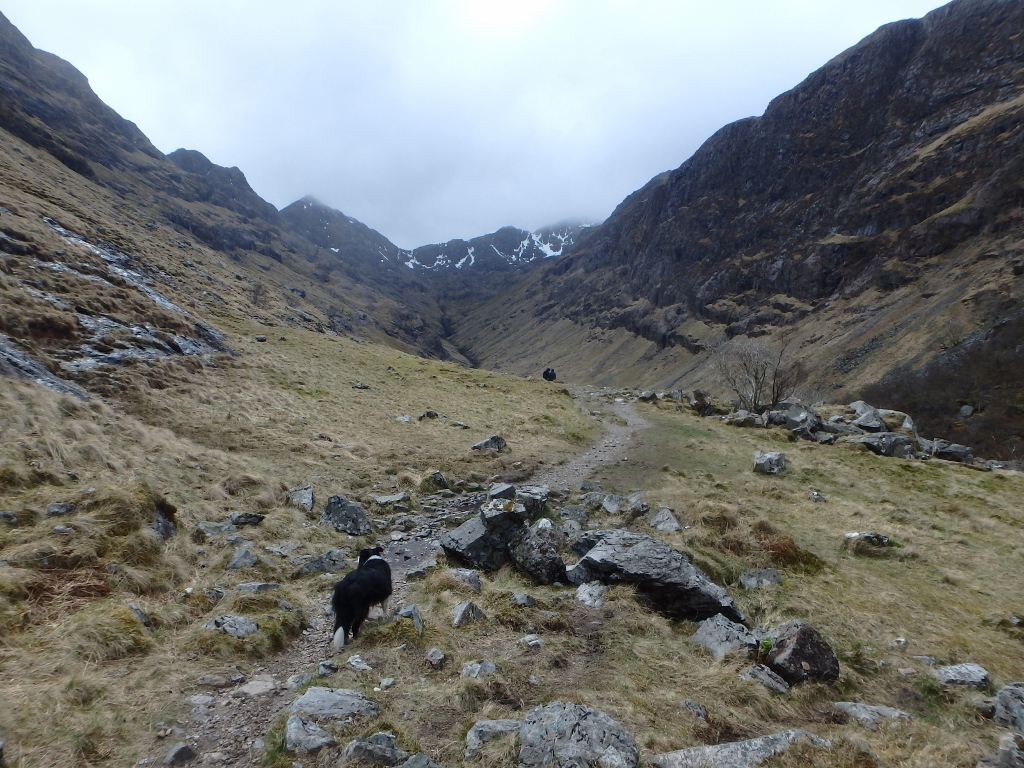
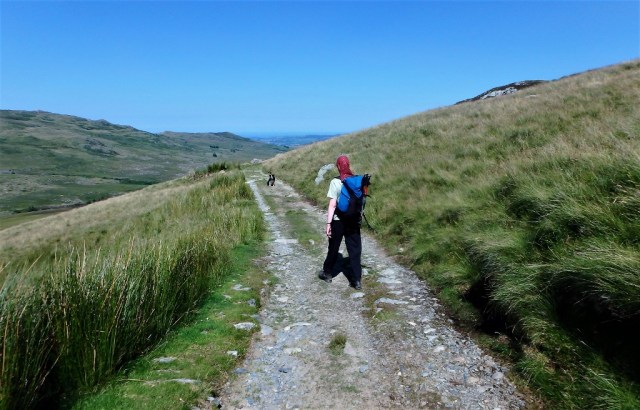
…. with Border Collie ‘Mist’ in the lead as usual

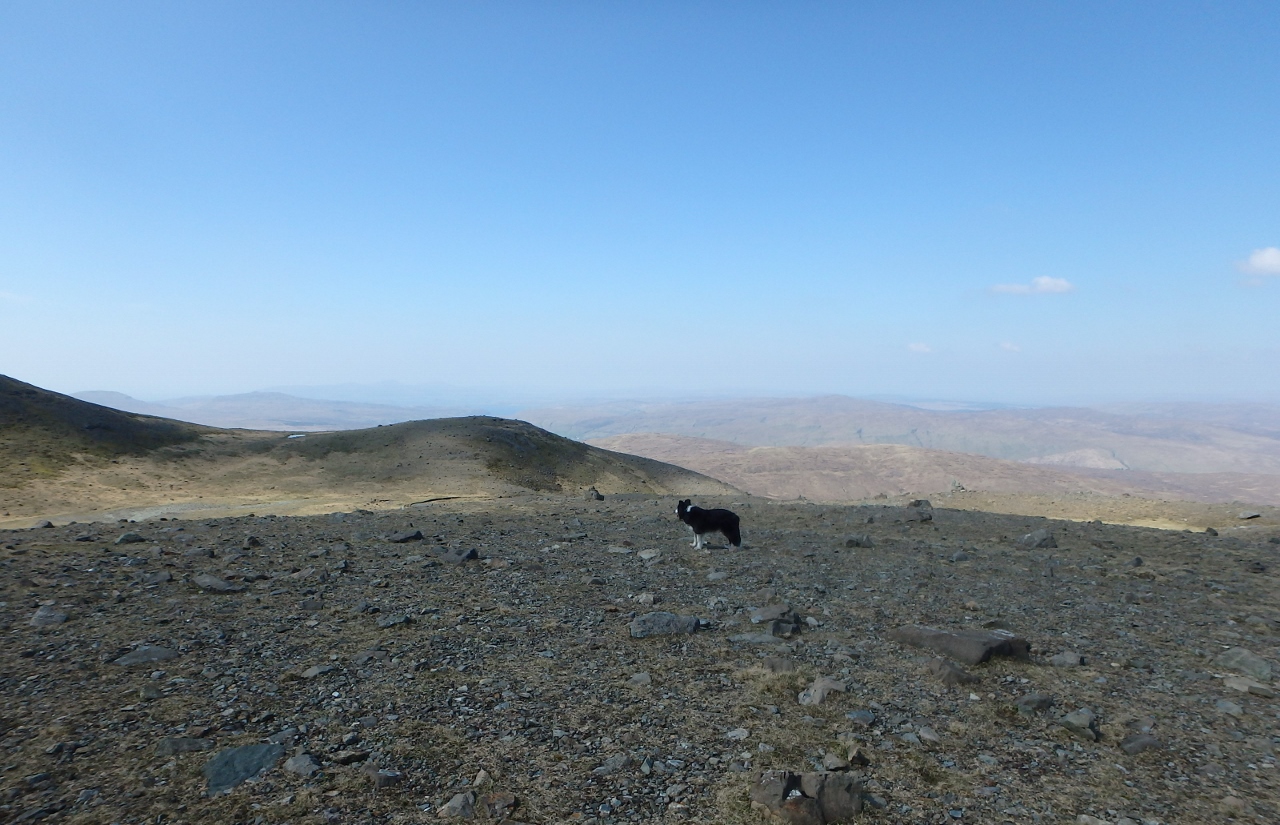
Border Collie ‘Mist’ has a very good internal clock, and she soon works out when it’s time for a walk (the same clock seems to work quite well for dinner time as well), and on the morning after we arrived at Torridon she was raring to go.    I had planned a walk out to Coire Mhic Fhearchair, one of the most dramatic corries in Scotland – there were no mountain summits on the trip, which didn’t bother Chris in the slightest, but a there was a promise of outstanding mountain scenery.
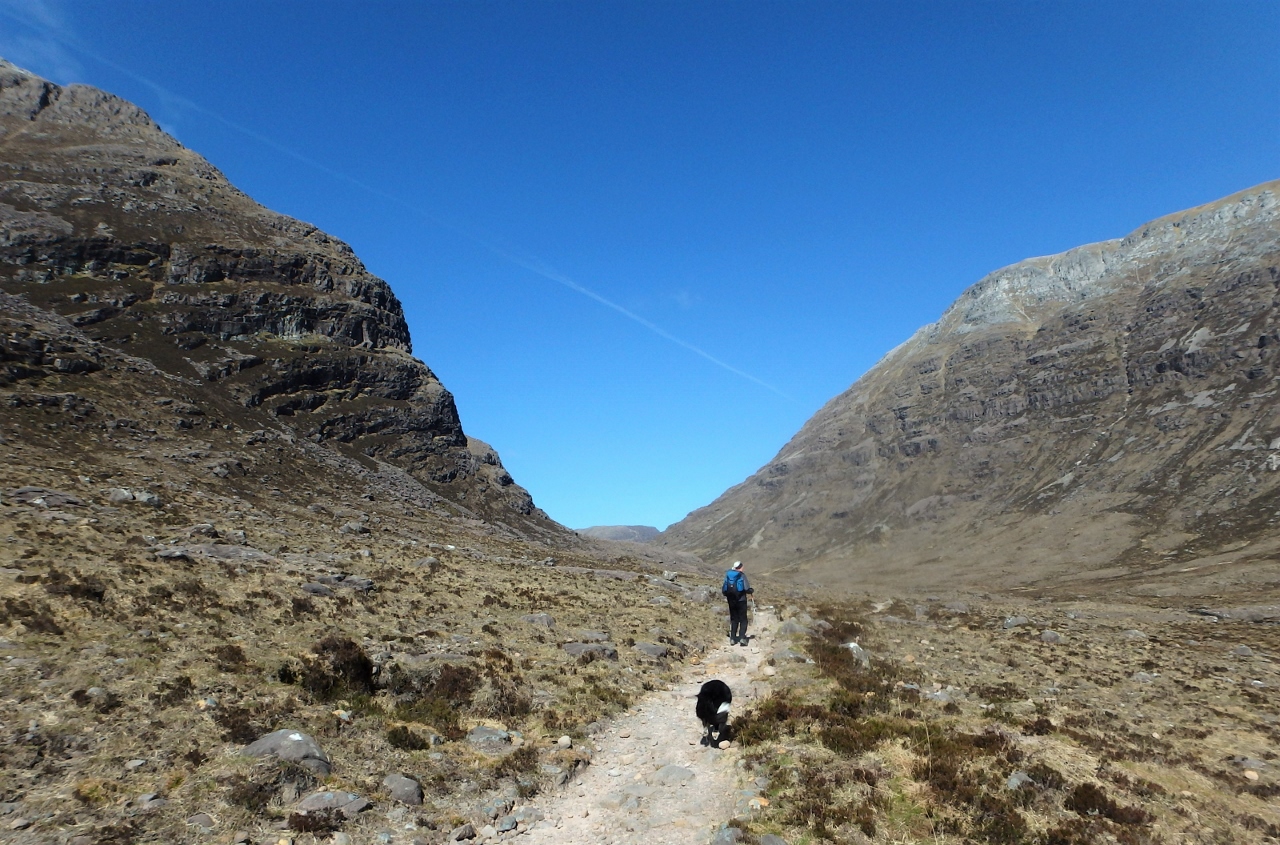
Coire Dubh Mor between the masses of Liathach and Beinn Eighe

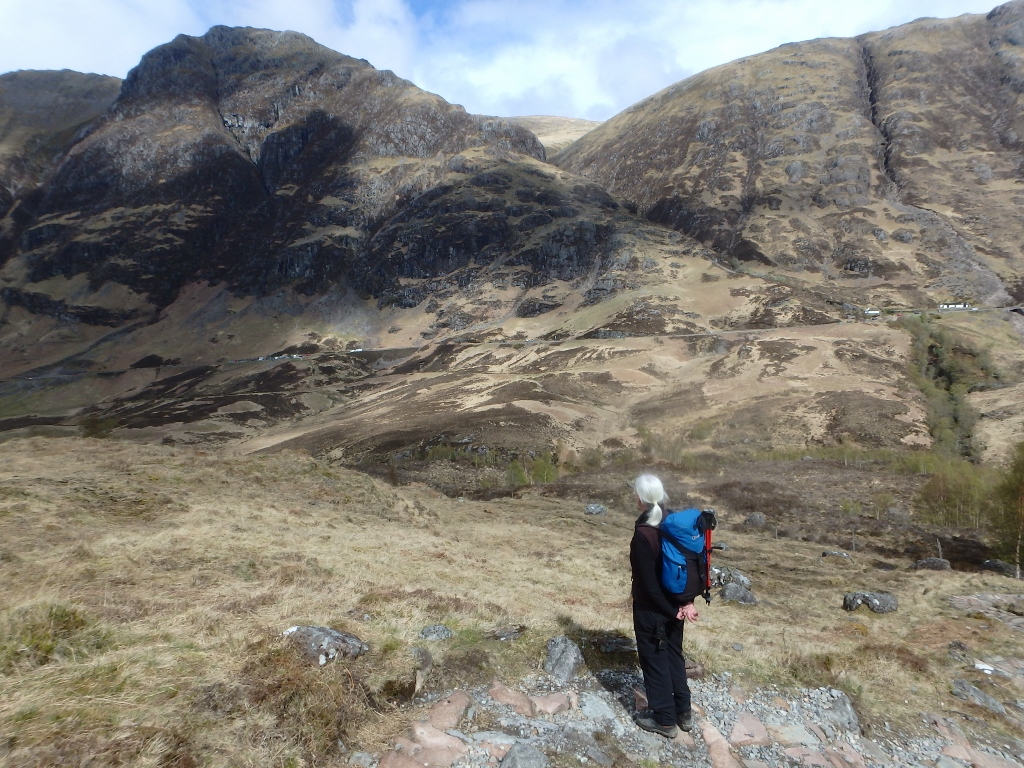
Still with a fair way to go
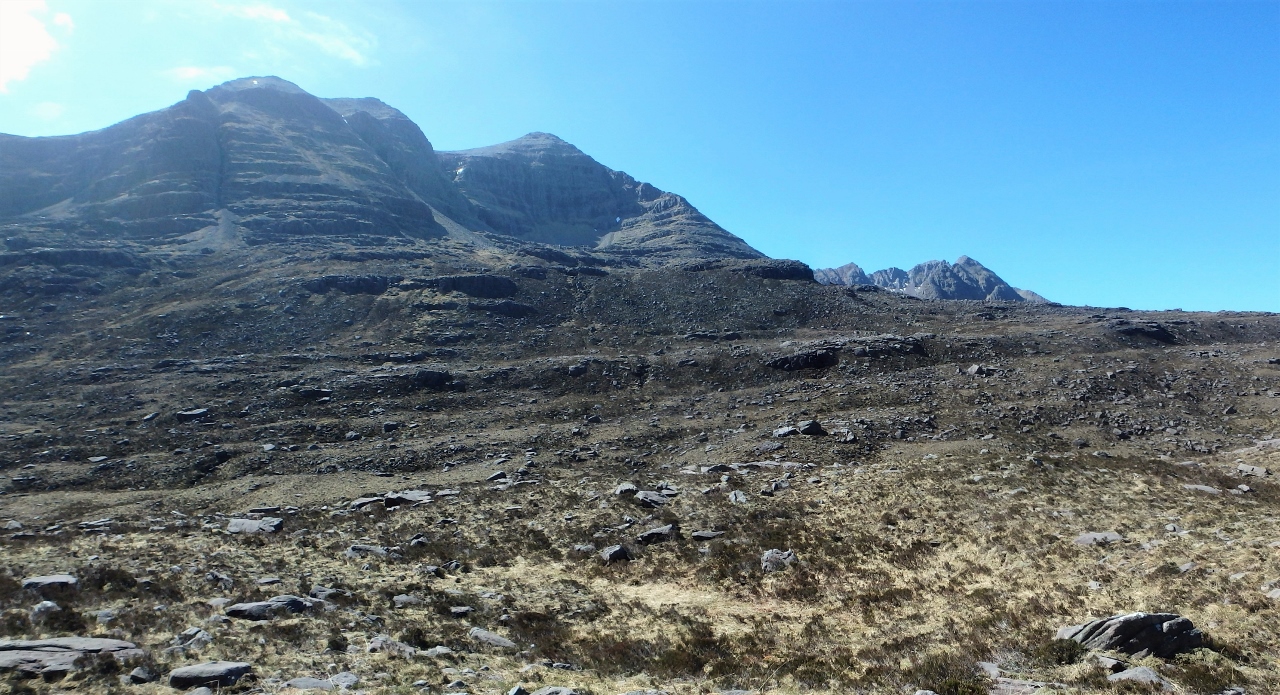
The view over to Liathach
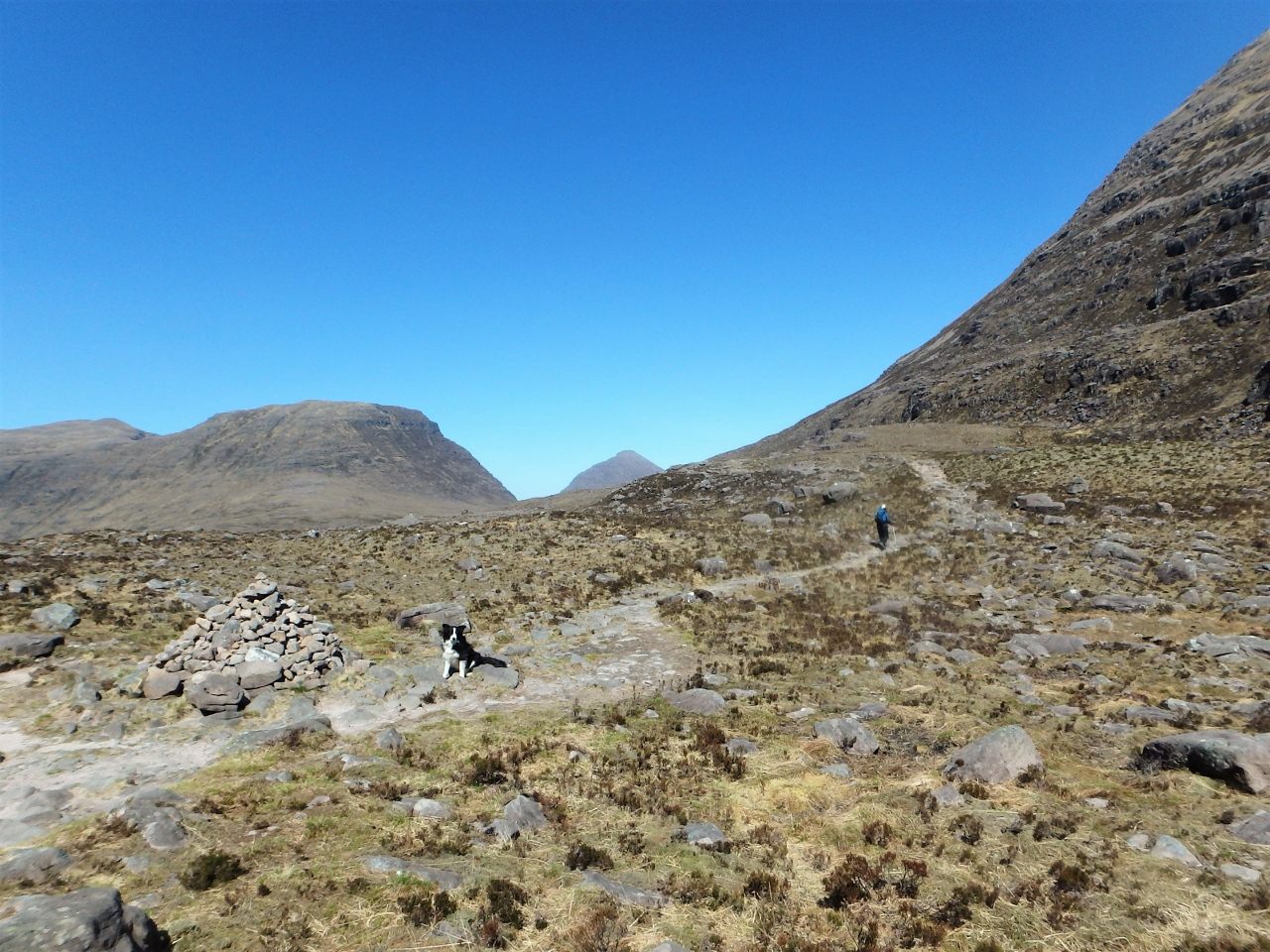
The turn off on the path, heading us round Sail Mhor ….
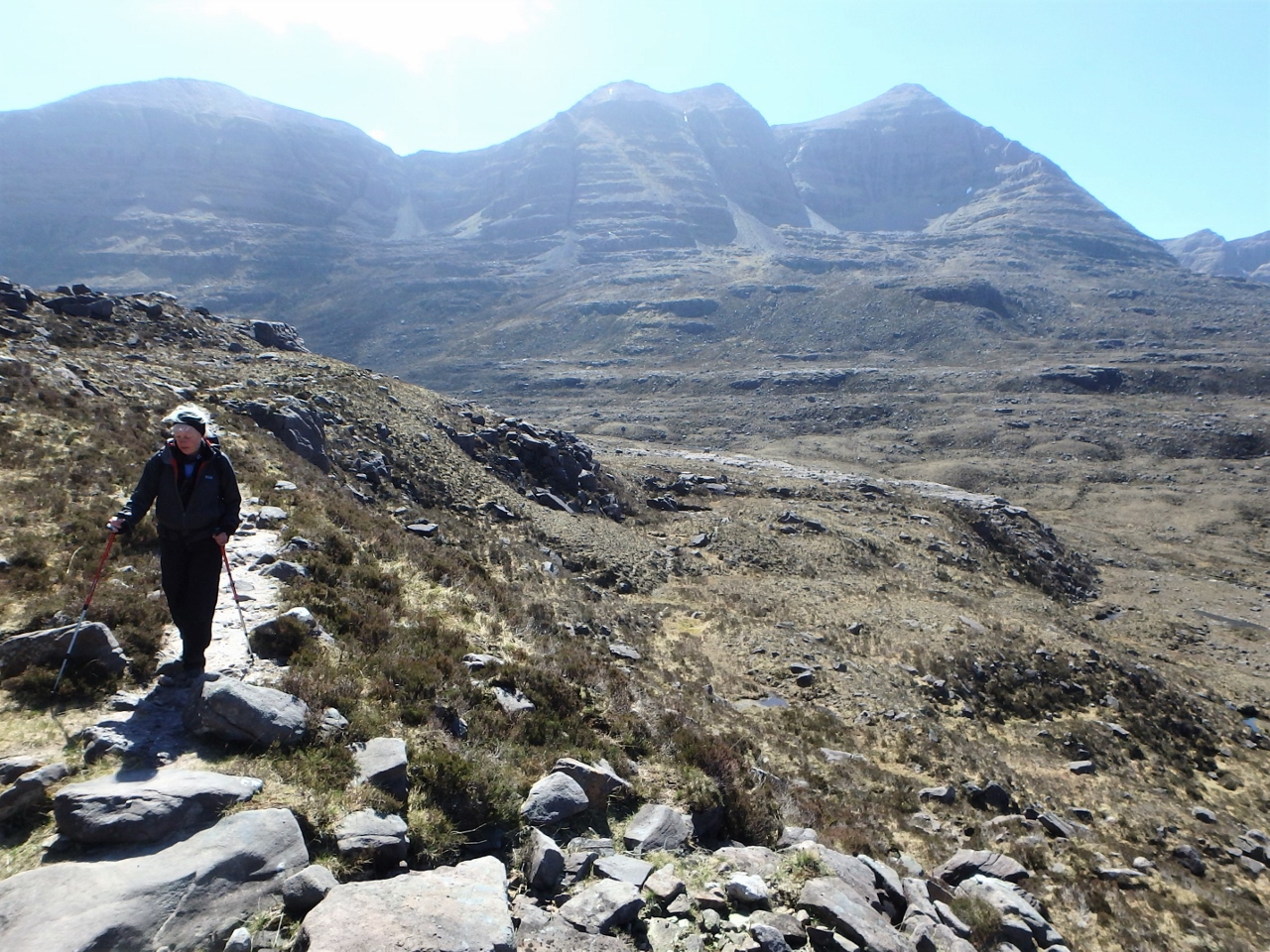
…. with Liathach now in the background

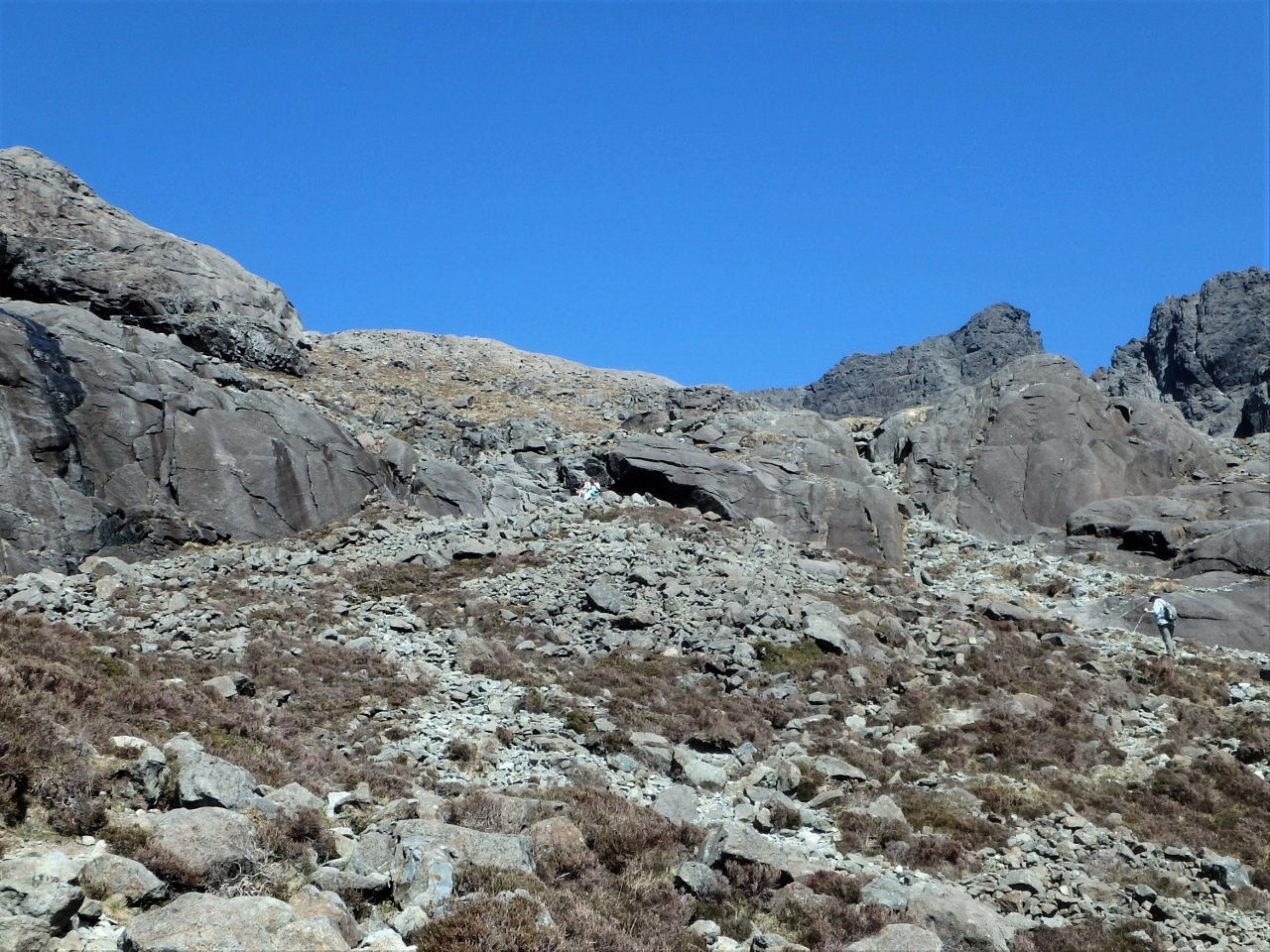
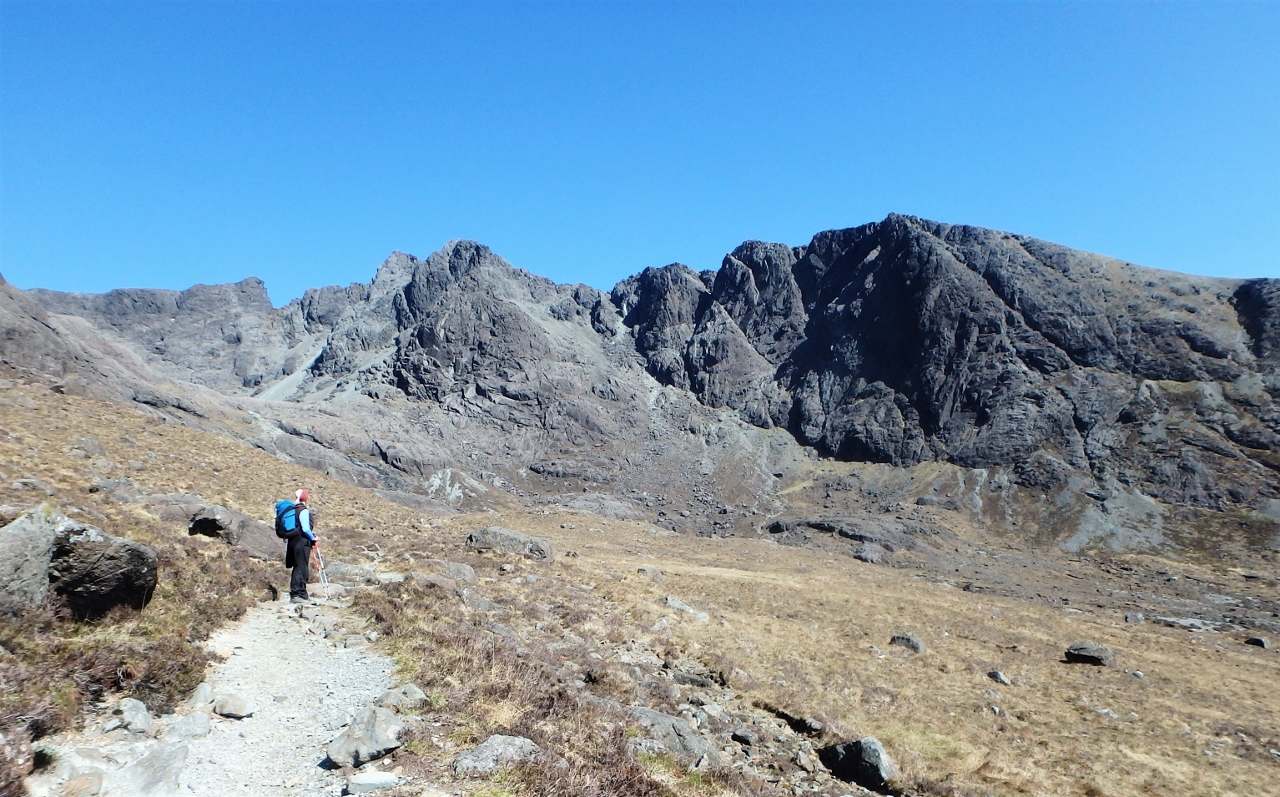
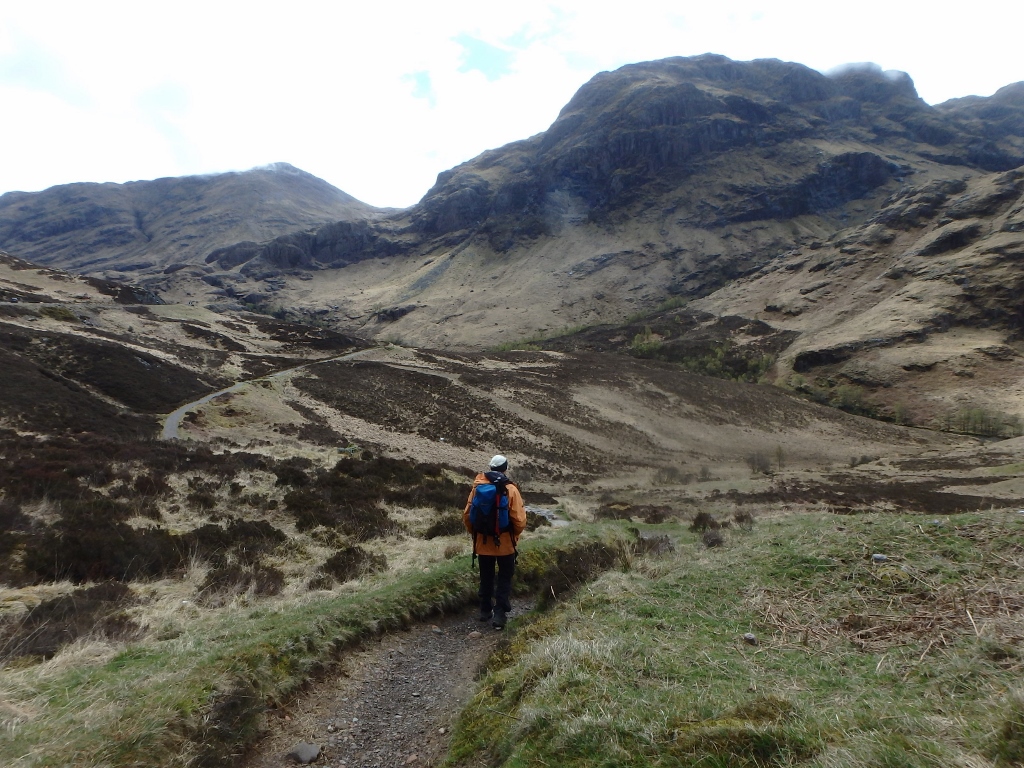
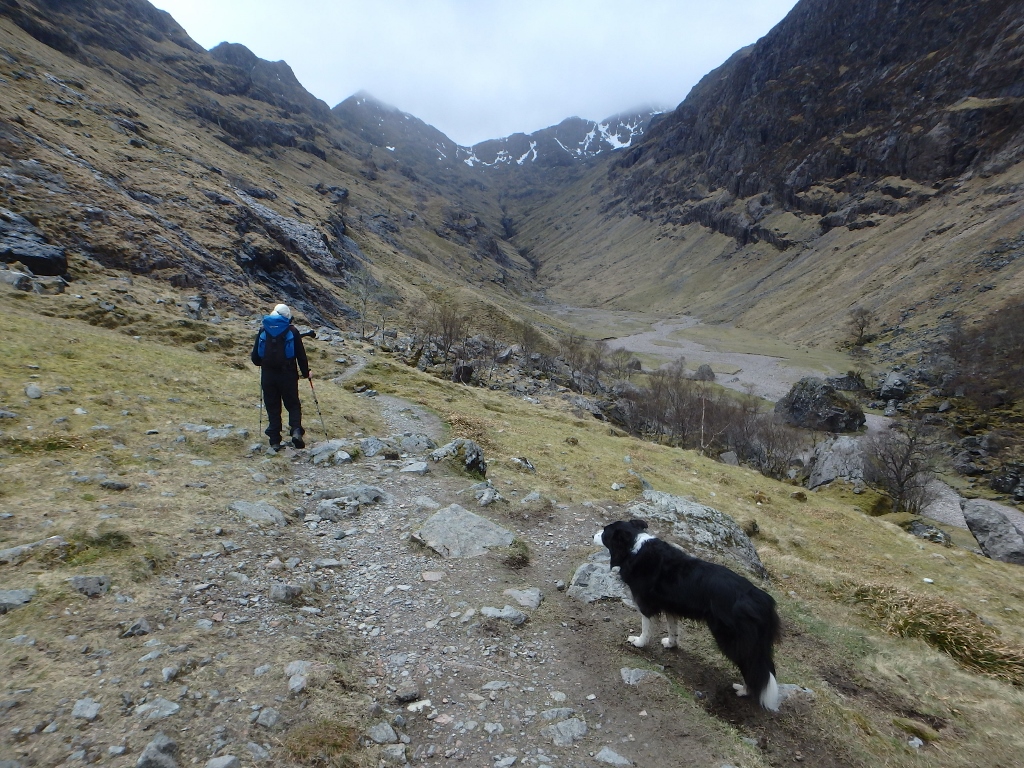
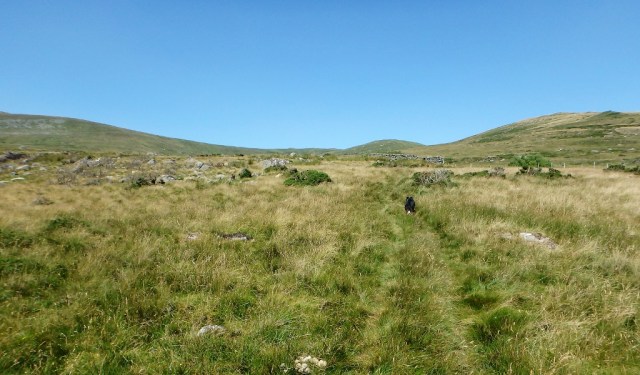
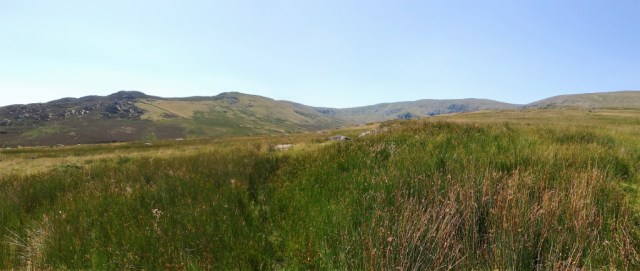
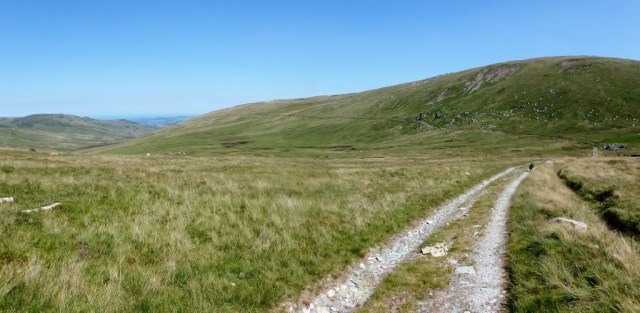
The route was on a good track running between the two mountain masses of Beinn Eighe and Liathach.    The plan was to walk the track to the corrie and to return the same way, a total of almost 14 kms (about 8¾) miles with a height gain of 575 metres (almost 1900 feet).    The northeast side of Liathach was a constant companion for much of the way, but eventually we parted company to head round the shoulder of Sail Mhor.
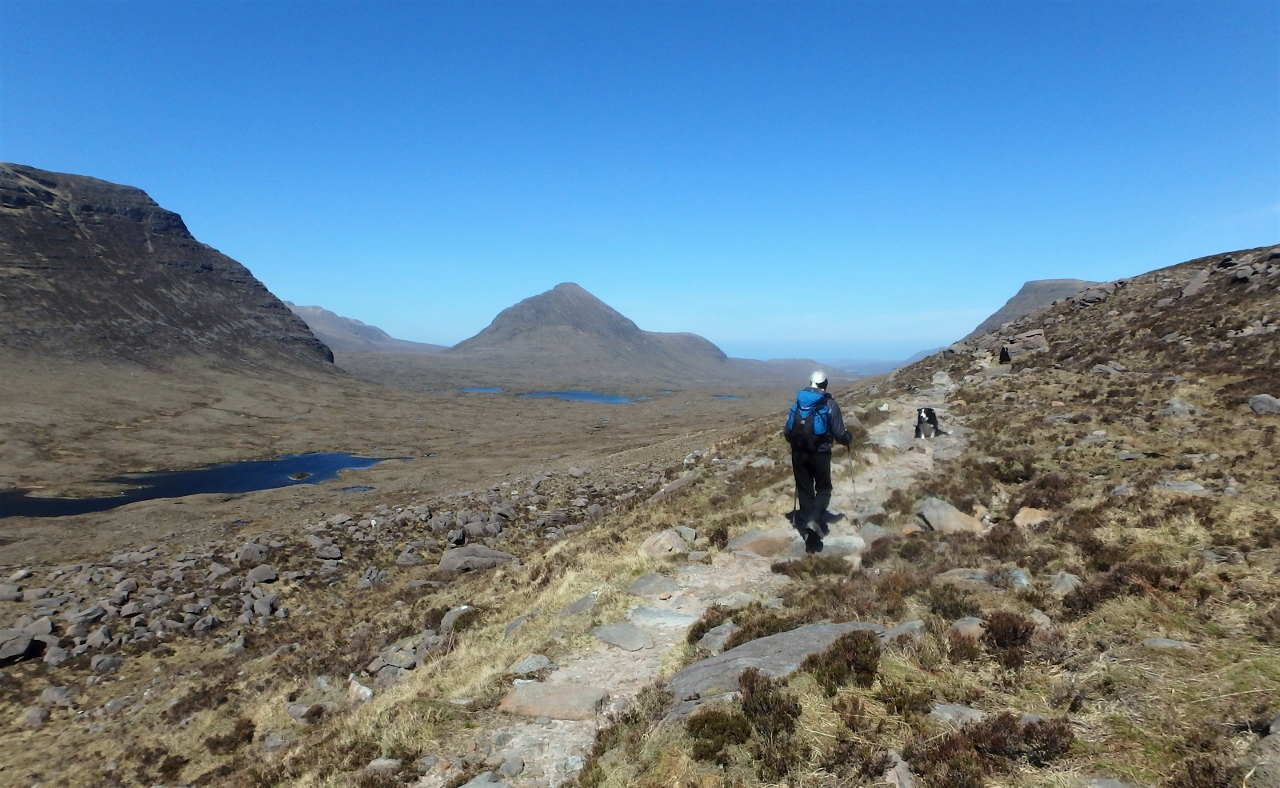
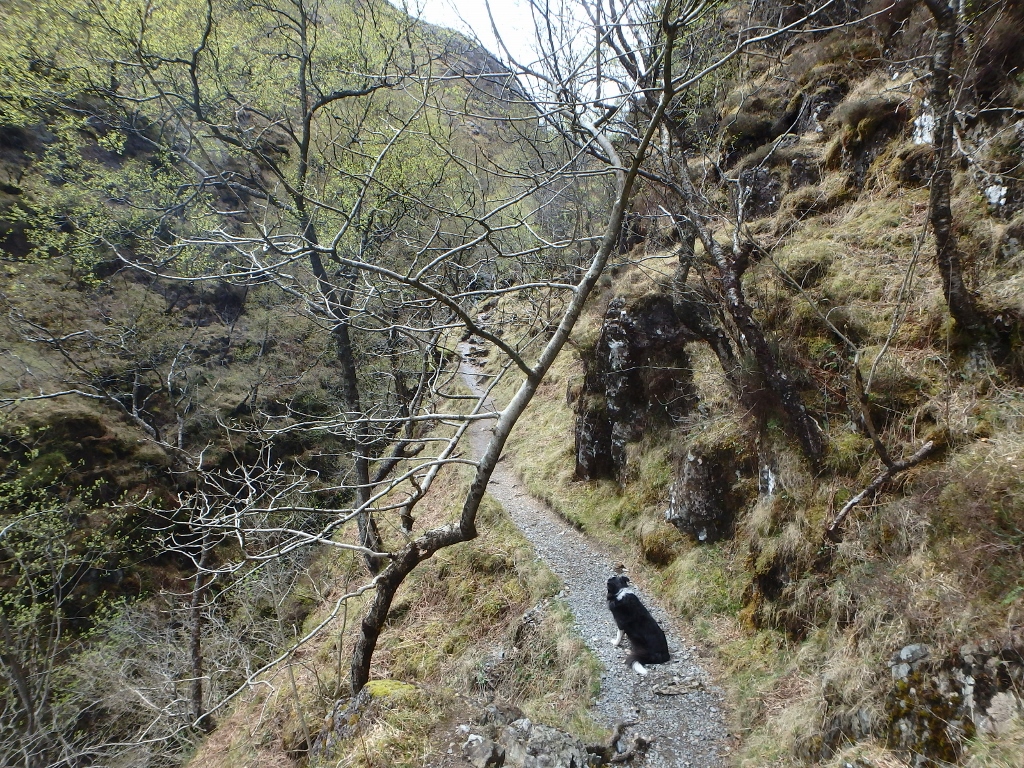
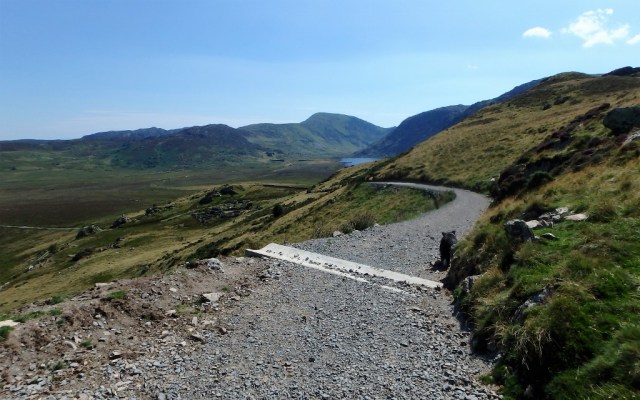
Heading round the west side of Sail Mhor ….

…. before turning east and heading up into Coire Mhic Fhearchair
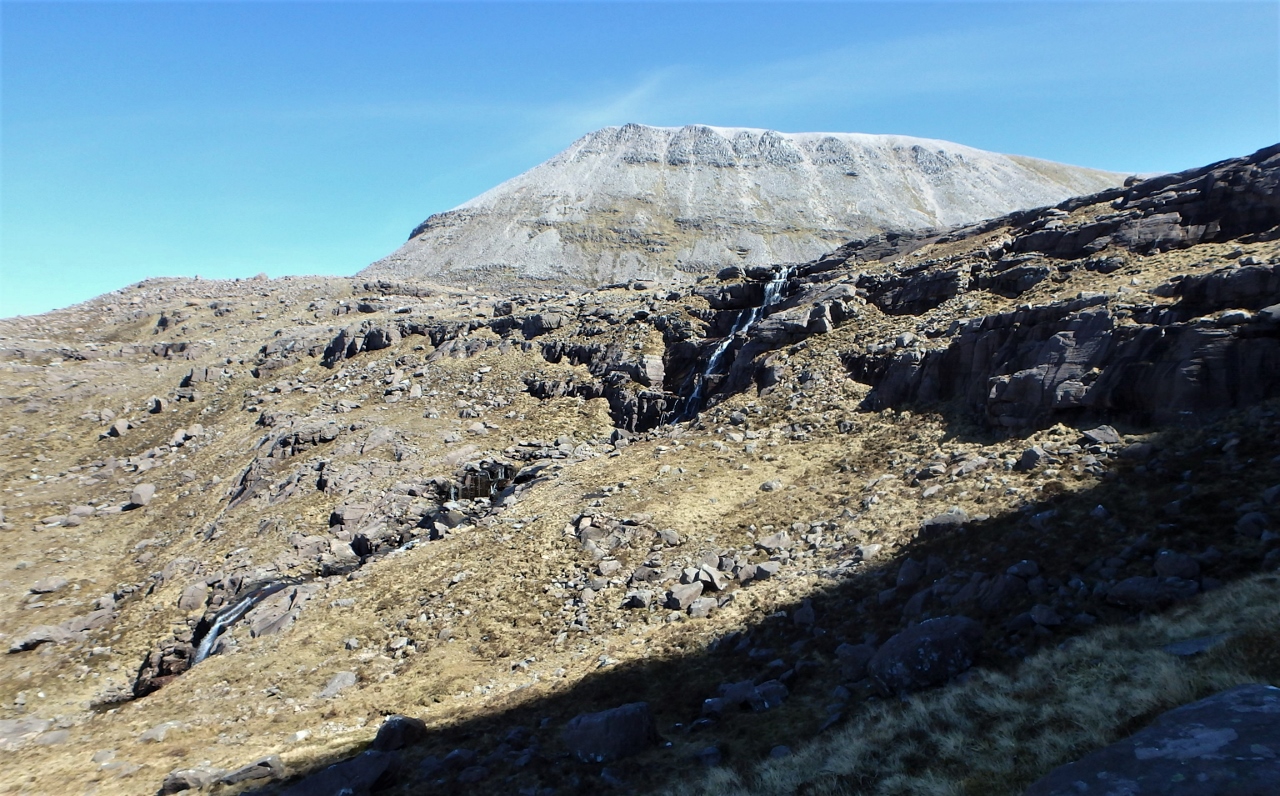
Waterfalls in the outflow stream of Loch Coire Mhic Fhearchair

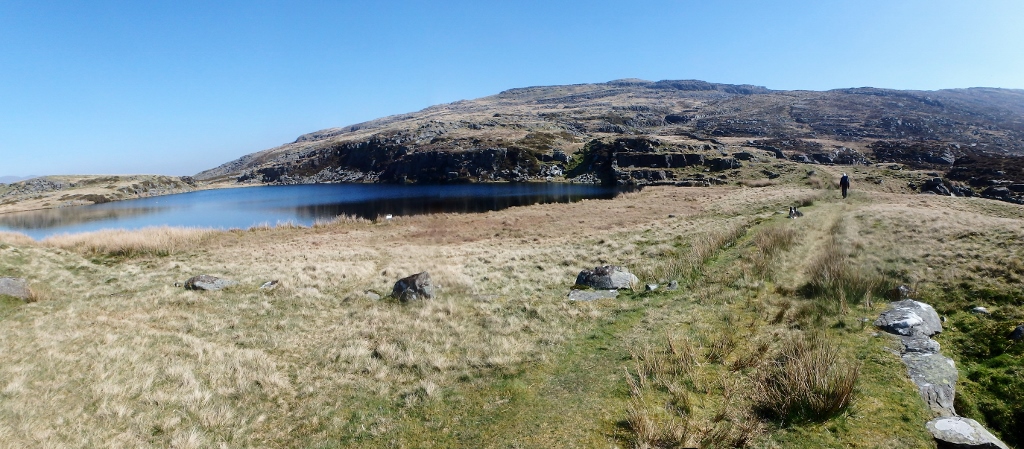
The route so far had been a gently rising path, but we had to gain altitude eventually – when the time came it was pretty short lived, with a height gain of 100 metres over 500 metres of horizontal travel.    The reward for this fairly minimal effort was one of the best spots for a picnic that you could wish for.

Loch Coire Mhic Fhearchair and ‘Triple Buttress’

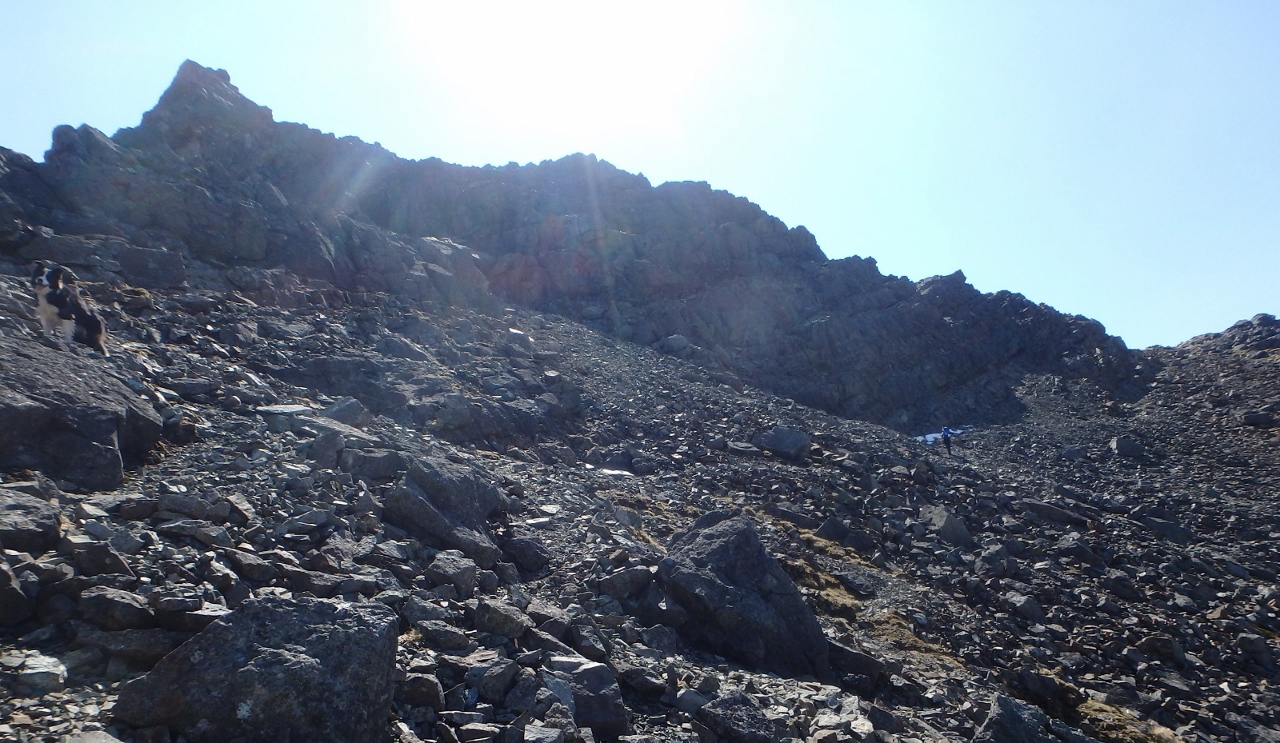
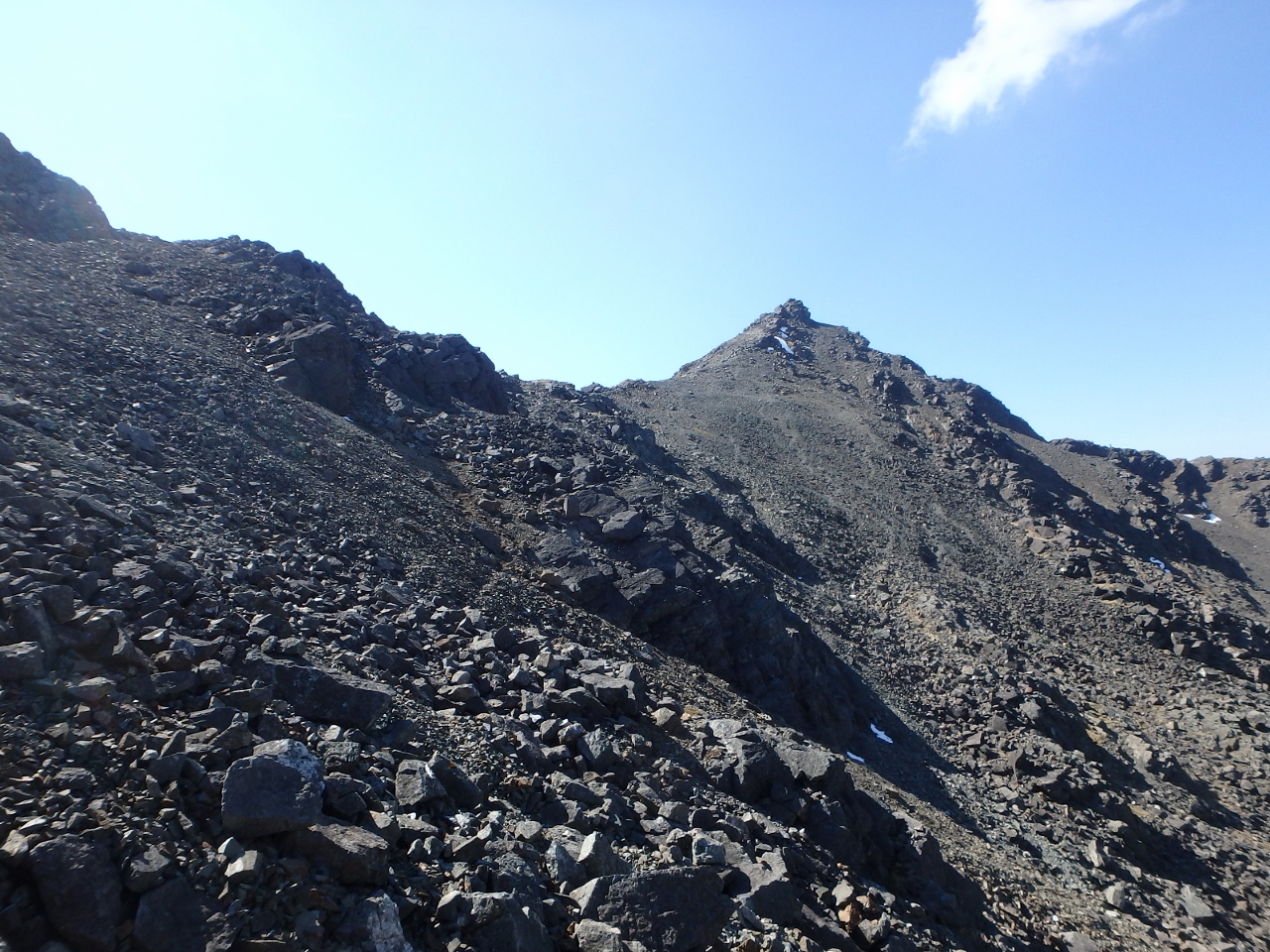
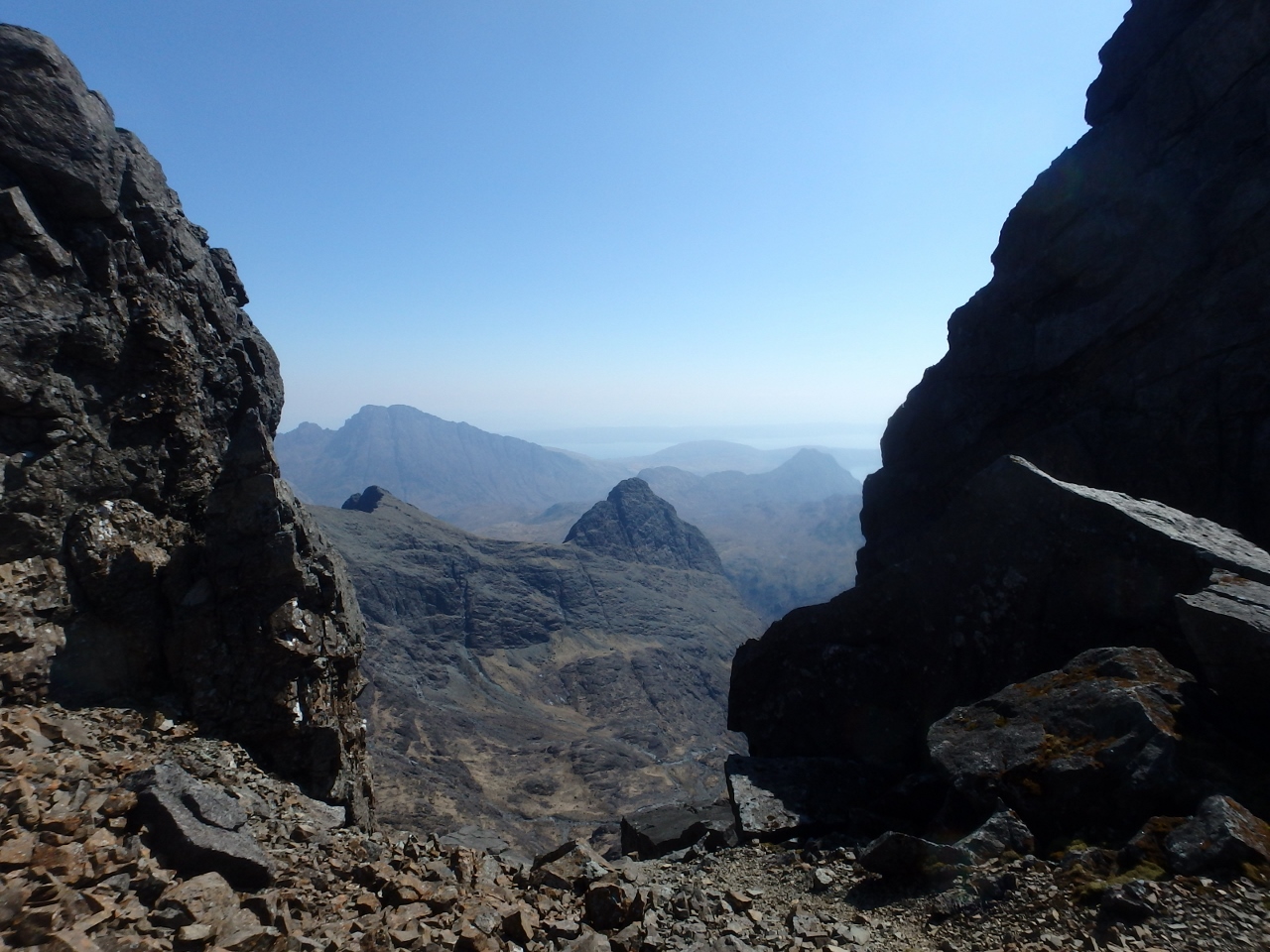
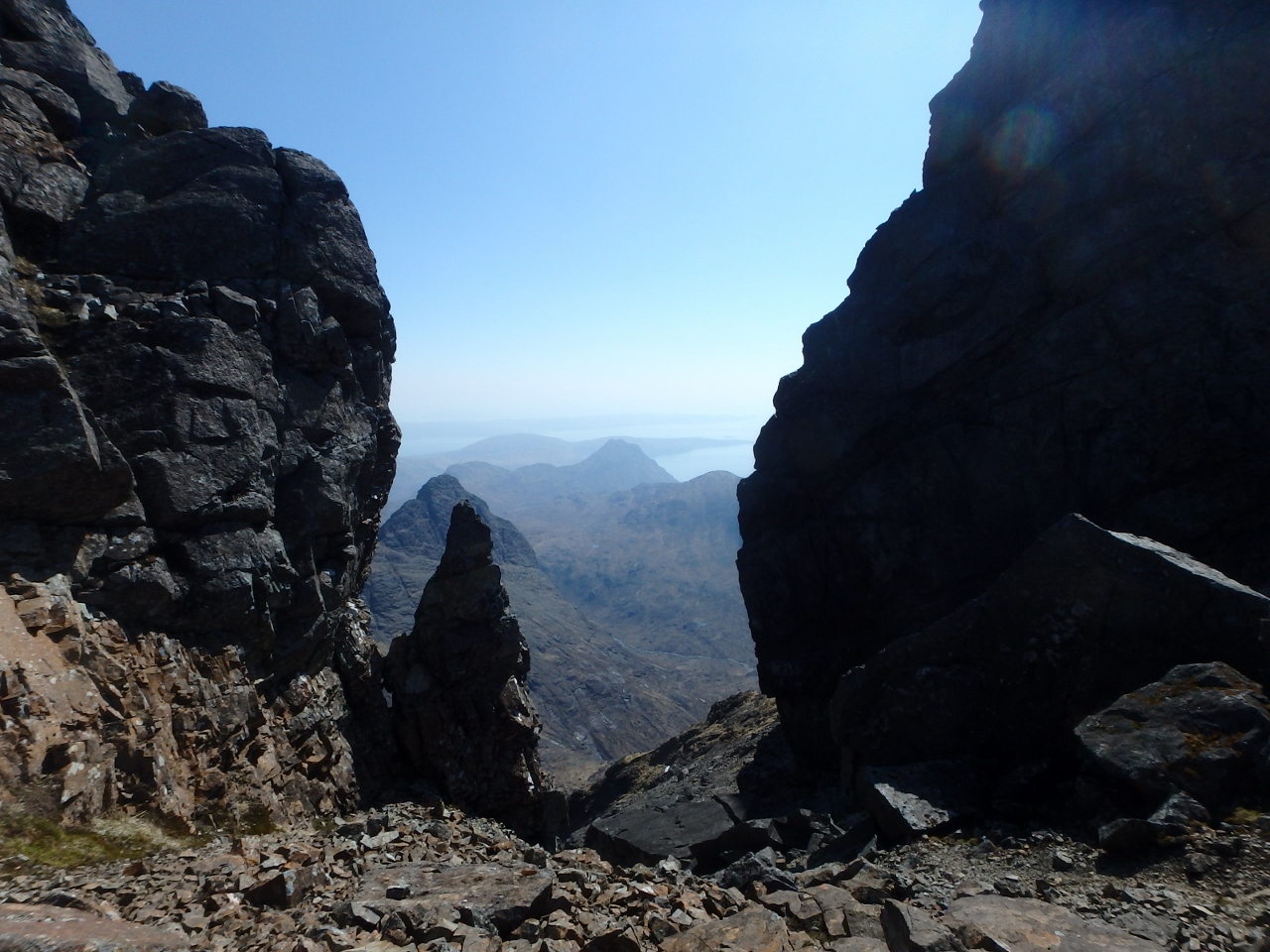
The corrie is a big amphitheatre surrounded on three sides by the mountains of Sail Mhor, Coinneach Mhor and Ruadh stac Mhor.    In the centre of the corrie lies the peaceful lake of Loch Coire Mhic Fhearchair, but the most striking feature is the huge mass of ‘Triple Buttress’ with its three rock walls rising about 300 metres in height and it’s hard to imagine a more impressive setting.    It hasn’t always been as peaceful though – in March 1951, Triple Buttress was the setting for a tragic air-crash which, it would turn out, was to have far-reaching consequences.

*    *    *    *    *

Avro Lancaster (Photo unknown)

Northern Scotland

On the evening of 13 March 1951, an Avro Lancaster aircraft took off from RAF Kinloss on the Moray Firth for a navigation exercise in the Rockall and Faroes area.    The weather was atrocious with strong winds from the northeast.    The last radio message from the aircraft had given their position as 60 miles north of Cape Wrath – from there they should have headed southeast towards Kinloss, but the strong side-wind was pushing them towards the mountains of Torridon.    The aircraft did not return to base, and was listed as missing.

Triple Buttress, Beinn Eighe, in late spring conditions (May 2017)
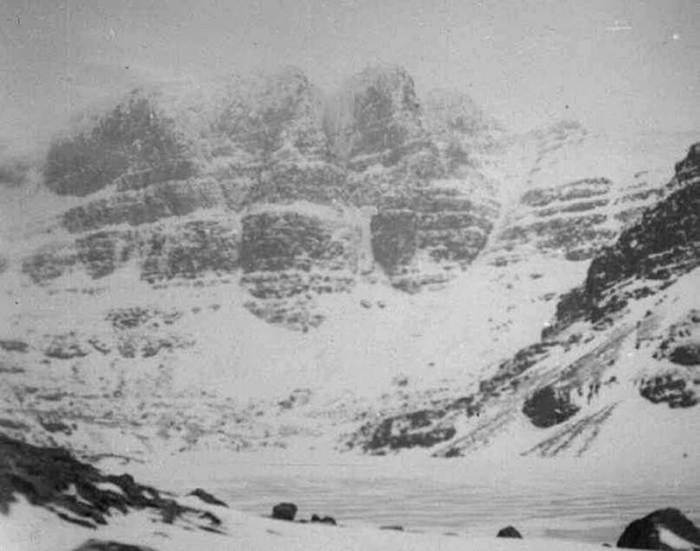
Triple Buttress in March 1951 (Joss Gosling collection)

For two days, other aircraft from RAF Kinloss flew search missions, but without more accurate information it was a hopeless task.    The first clue came two days later from a twelve-year-old boy living at Torridon who remembered seeing a red glow in the sky near to Beinn Eighe – another search mission was flown, this time to the Torridon area, and the missing Lancaster was located just below the summit of Coinneach Mhor, directly above Triple Buttress.    Another 5 metres (16 feet) of altitude and the Lancaster might have cleared the summit.
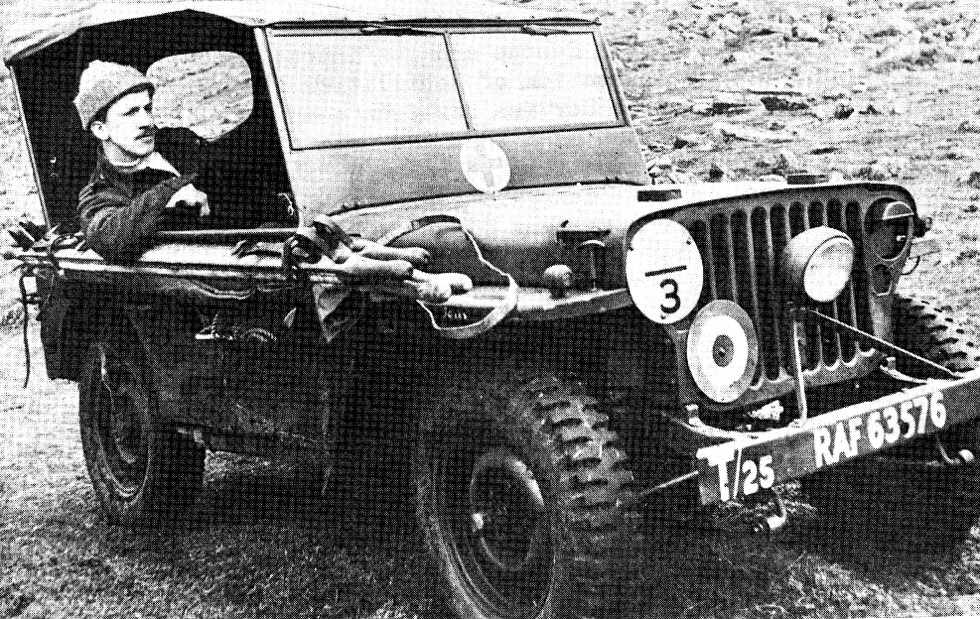
Flight Lieutenant George Graham MBE, Medical Officer at RAF Llandwrog in 1943 (Photo unknown)

Prior to WW2 there were no mountain rescue teams in the UK – in the case of a mountain accident a rescue party would be formed from climbers and mountaineers in the local area, sometimes assisted by local police officers, shepherds, quarrymen or gamekeepers.  During the war, there was a substantial rise in the number of flying accidents due to the increased training activity, which led to the Royal Air Force forming unofficial Search And Rescue teams in North Wales, the Lake District and Scotland.
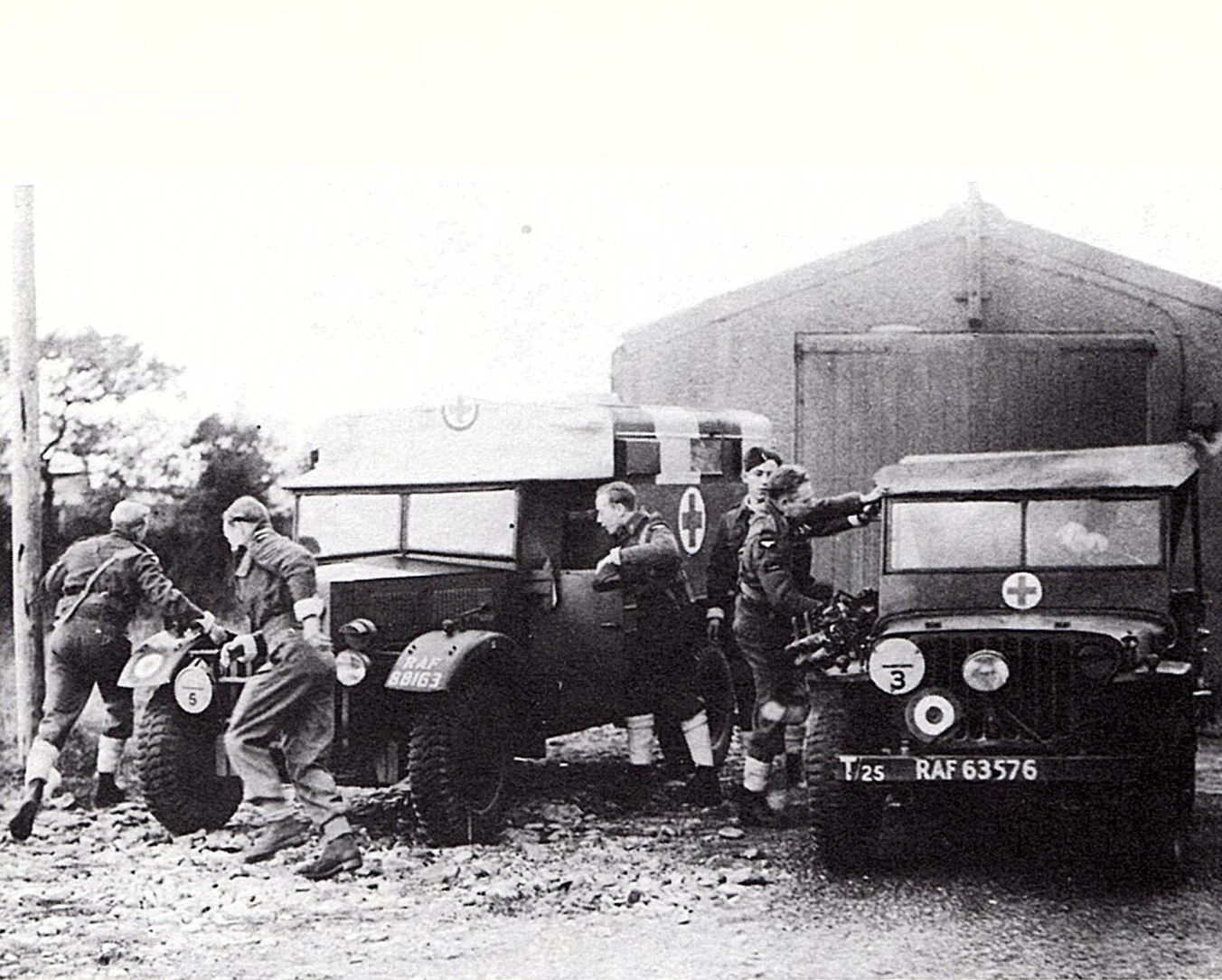
RAF Llandwrog MRT ‘scrambling’ to a call in WW2 (Photo unknown)

It soon became apparent that this ad hoc arrangement was not satisfactory, and in 1943 the first dedicated RAF MRT (Mountain Rescue Team) came into being at RAF Llandwrog near Caernarfon under Flt/Lt George Graham.    By the end of WW2 there were nine official RAF MRT’s, but a lower incidence of flying accidents resulted in a reduction in the number of teams.    At the time of the Beinn Eighe accident, the nearest RAF MRT was based at RAF Kinloss, the home base of the crashed Lancaster.
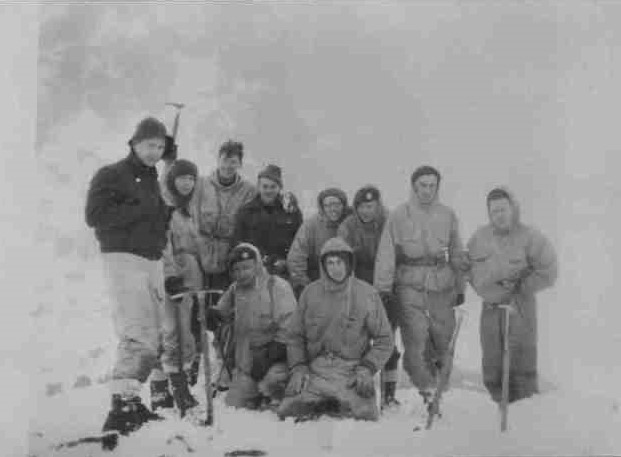
Kinloss team members at the time of the Beinn Eighe accident (Joss Gosling collection)

On 11 March, two days before the Lancaster was declared missing, the RAF Kinloss team had been asked to assist in the recovery of the body of a climber killed in a climbing accident in the Cairngorms (by this time, the RAF was being called to assist with civilian incidents on a regular basis).    The operation had been a drawn out, arduous task and almost as soon the Team returned to RAF Kinloss they were put on standby to search for the missing aircraft.    On 17 March, following the discovery of the crash site by the search aircraft, the Kinloss team made the first attempt to reach the Lancaster.

The initial route taken (in red) by the RAF Kinloss Mountain Rescue Team

The early approach route taken by the Kinloss team, looking back towards Bridge of Grudie
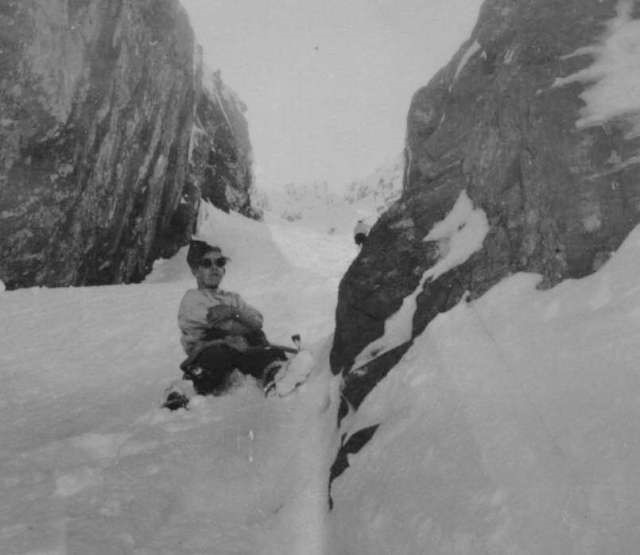
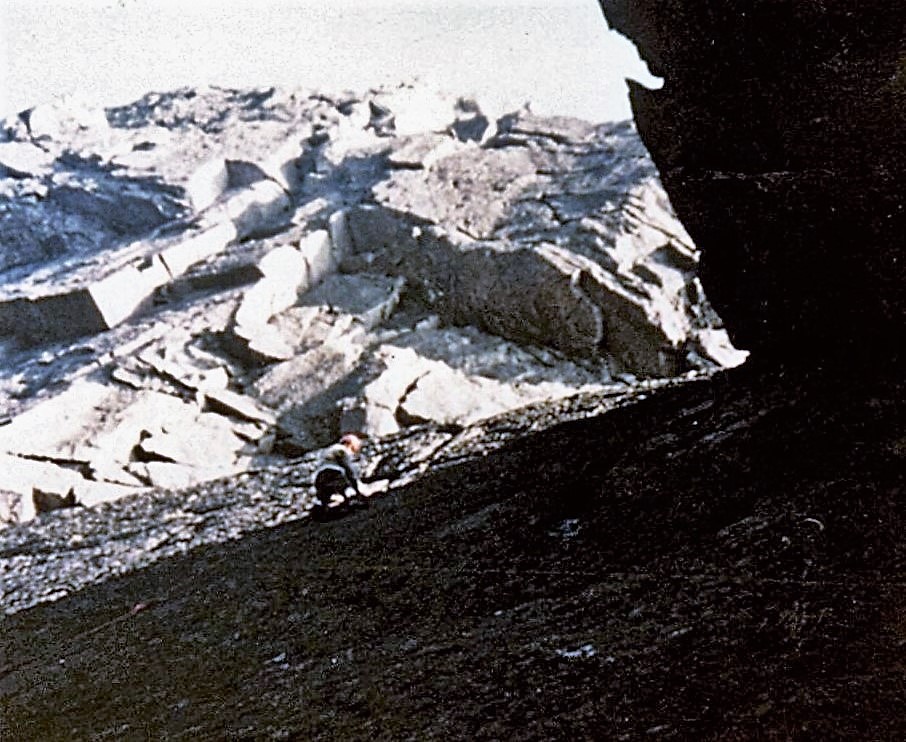
Kinloss team member in Far West gully, now known as Fuselage Gully (Joss Gosling collection)

Over the next three days, the RAF Kinloss team made several attempts to reach the crash site.    One early attempt was made even more difficult when a local police officer advised that the best approach was from the north from Bridge of Grudie.    The Team then changed tactics, following the same route that Chris and I took on our walk.    Although this gave an easier approach, the airmen were hampered by appalling weather and difficult mountain conditions.
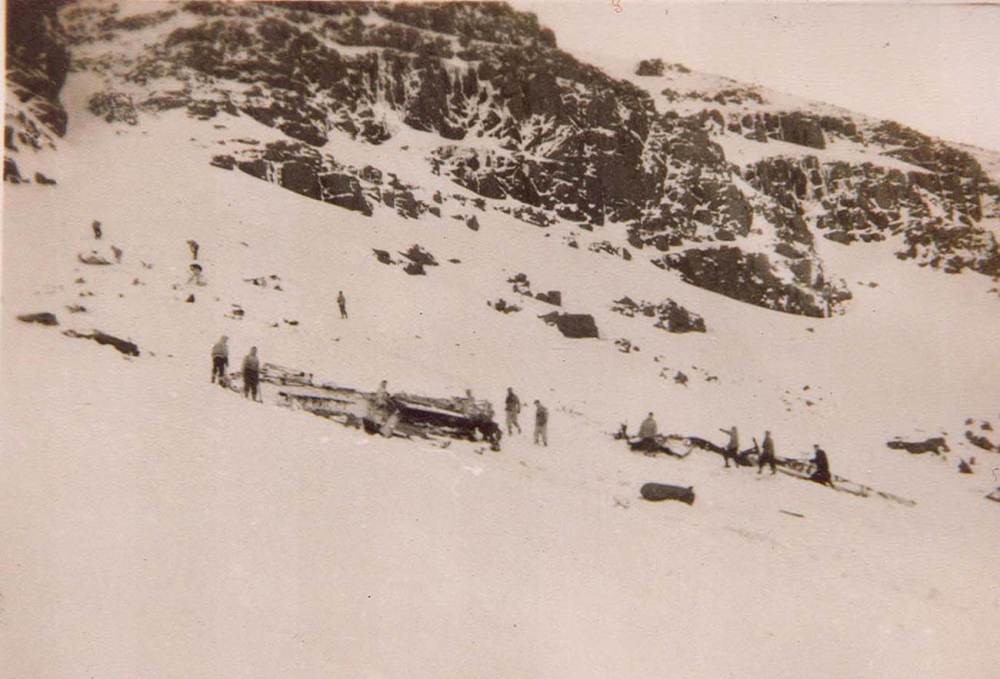
The RAF Kinloss MRT with wreckage, below Triple Buttress (Joss Gosling collection)

They were also hampered by lack of suitable equipment and training.    In his book ‘Whensoever’, an excellent history of the RAF Mountain Rescue Service, ex RAF Edzell MRT member Frank Card describes the situation –  “Only the enthusiastic mountaineers … had good gear, and that was because they bought it.   Ice-axes were unheard of at Edzell.  Kinloss had six or so but a report after this incident said that nobody knew how to use them”.

Near the top of Beinn Eighe (Joss Gosling collection)

After several unsuccessful attempts to reach the main wreck above Triple Buttress, the Team was withdrawn on 20 March.    The Moray Mountaineering Club offered assistance, but this was turned down by the RAF.    The first successful attempt to reach the site at the top of the buttress was by Royal Marine Commando, Captain Mike Banks and his Royal Navy climbing partner, Angus Erskine.   Banks and Erskine were experienced and accomplished mountaineers, but they found conditions on the mountain to be near their own personal limits.
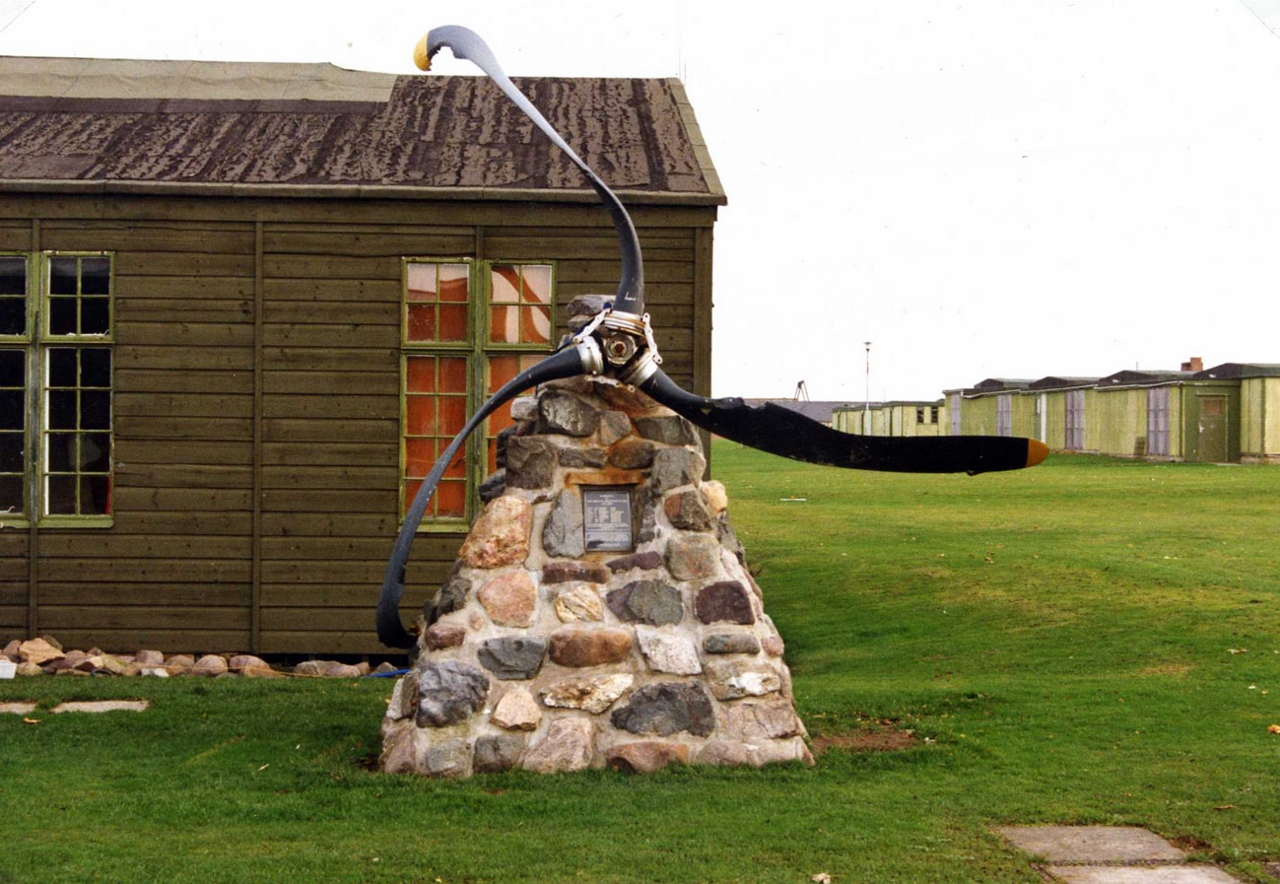
The memorial (At Kinloss in the photo, now relocated to RAF Lossiemouth) (Photo unknown)

It was 30 March before the first body was recovered.    This must have been a harrowing operation for the MRT members – the aircraft was from the same base, and some team members would have known the crew, either socially or on the flight line at Kinloss.   The recovery operation continued over the following weeks, but the task continued to be hampered by deep snow and appalling weather – the last body of the crew of eight was finally recovered on 27 August.

The memorial to the crew of eight who died in the Beinn Eighe crash (Photo unknown)
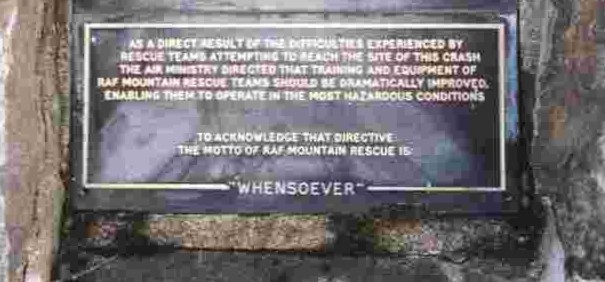
Another view of the memorial plaque (Photo unknown)

I mentioned above that there were far reaching consequences as a result of the Beinn Eighe crash.    The RAF MRT’s had been under-resourced since WW2, and an enquiry after the crash voiced criticism, but a further problem was conscription – a man would join the RAF and become a rescue volunteer, but by the time he was trained and experienced, it was time to return to civilian life.     After Beinn Eighe the Air Ministry might have abandoned mountain rescue altogether, but instead went in the opposite direction.
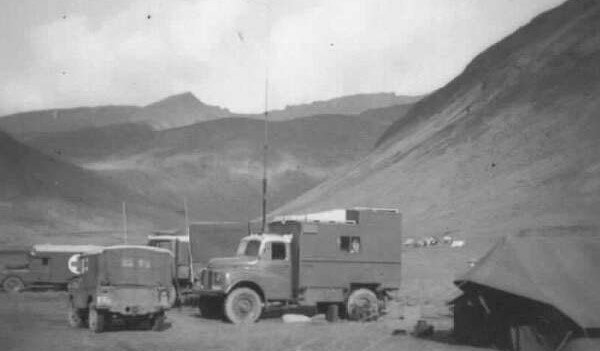
Post-war RAF MRT operation (Photo unknown)
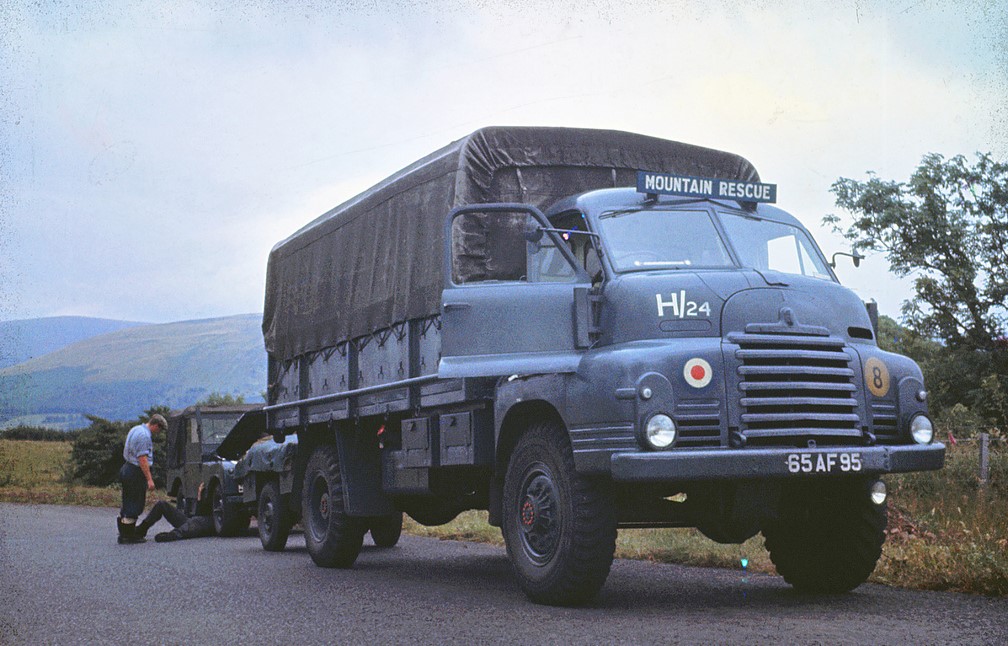
Bedford 3 Tonner on RAF MR duty in the 1960’s (Photo unknown)

The following year saw the first organised summer and winter climbing training in RAF MR under Sergeant (later Flight Sergeant) Johnnie Lees.    Lees was an RAF Physical Training Instructor, but more importantly he was already an experienced and skilful climber and mountaineer, both in the UK and the Alps.    Over the next decade, Lees and others brought the RAF teams to the high standard that they still hold today, and the RAF Mountain Rescue Service remains one of the finest Search And Rescue organisations in the world.

The current RAF mountain rescue vehicle – the Toyota Hilux (Photo unknown)

*    *    *    *    *
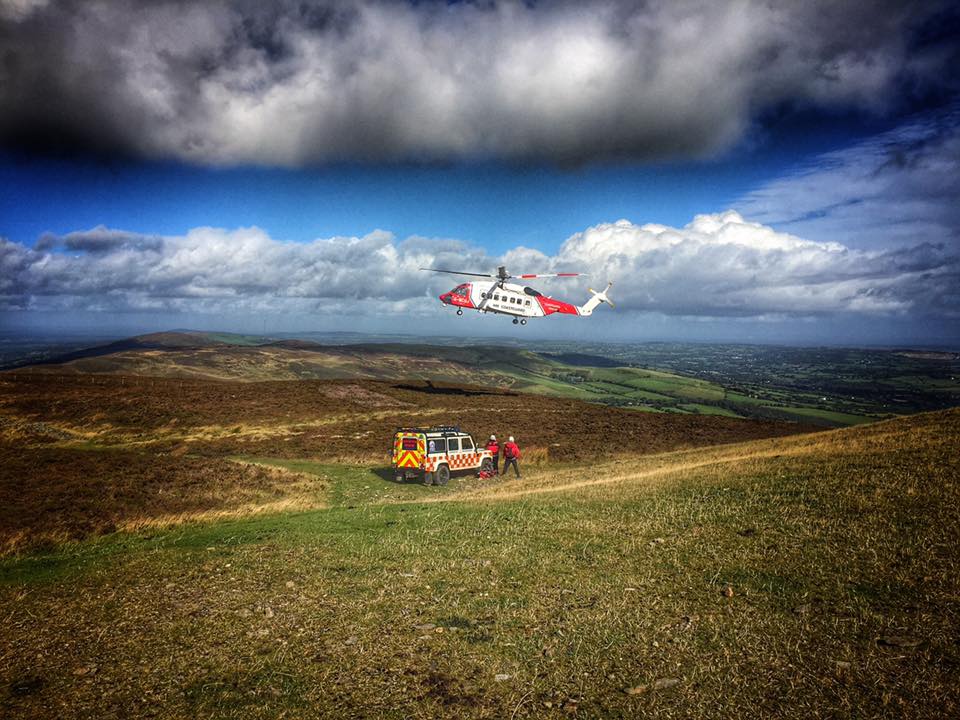
NEWSAR Landrover and crew training with the HM Coastguard helicopter (Photo Babs Boardwell)

The majority of civilian mountain rescue teams in the UK were formed in the 1950’s through to the 1970’s, and the RAF teams provided much of the inspiration and experience in the early days.    Civilian teams still use military radio voice procedure, and in North Wales some of the teams have even adopted the RAF Valley term ‘troops’ for their members.   Flt/Lt George Graham provided the original inspiration at RAF Llandwrog, but the enquiry after the Beinn Eighe crash pointed the RAF teams towards greater excellence, and this ultimately had a knock-on effect on civilian mountain rescue in the UK.
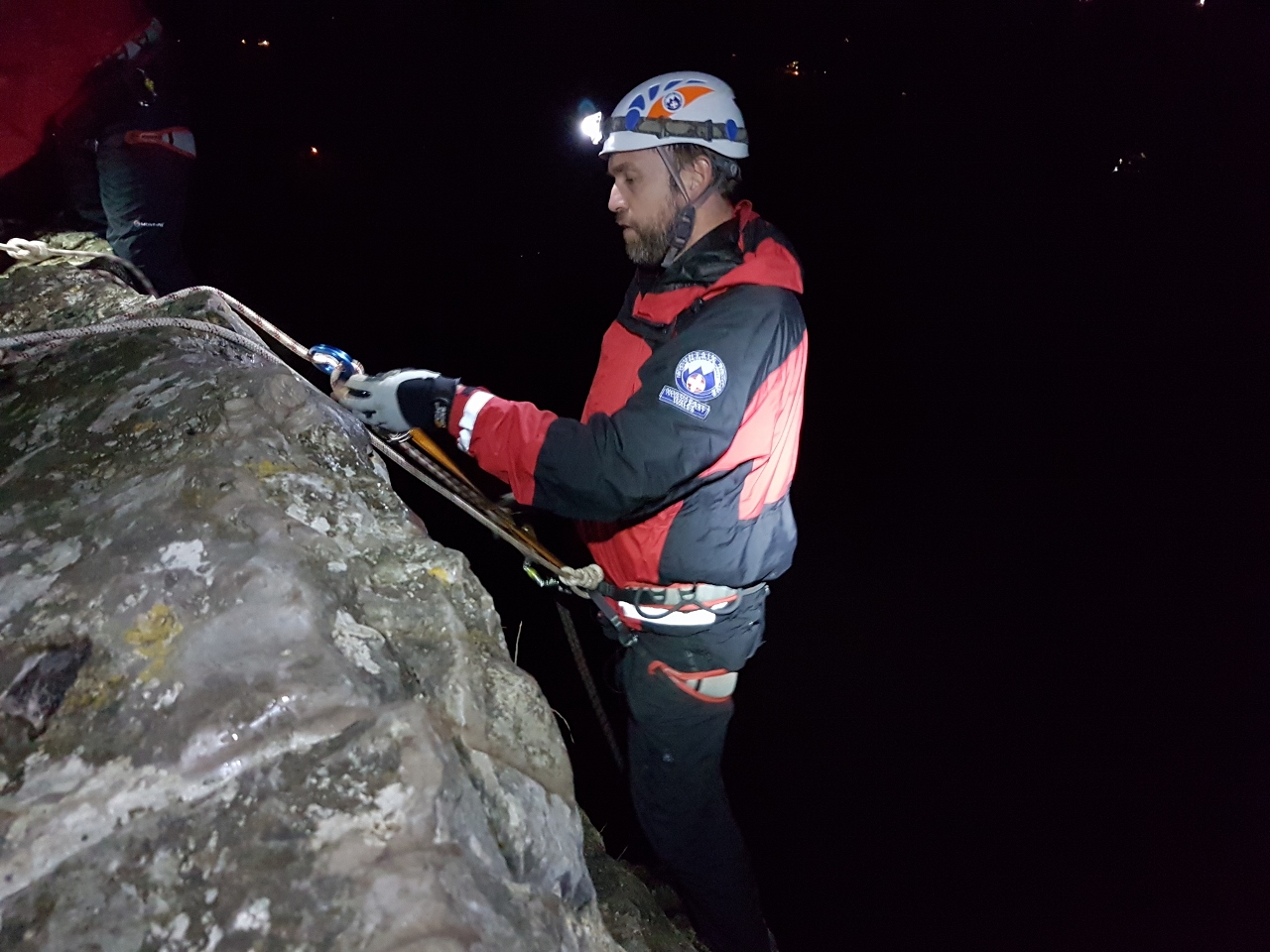
NEWSAR team, training in crag rescue at night near Llangollen
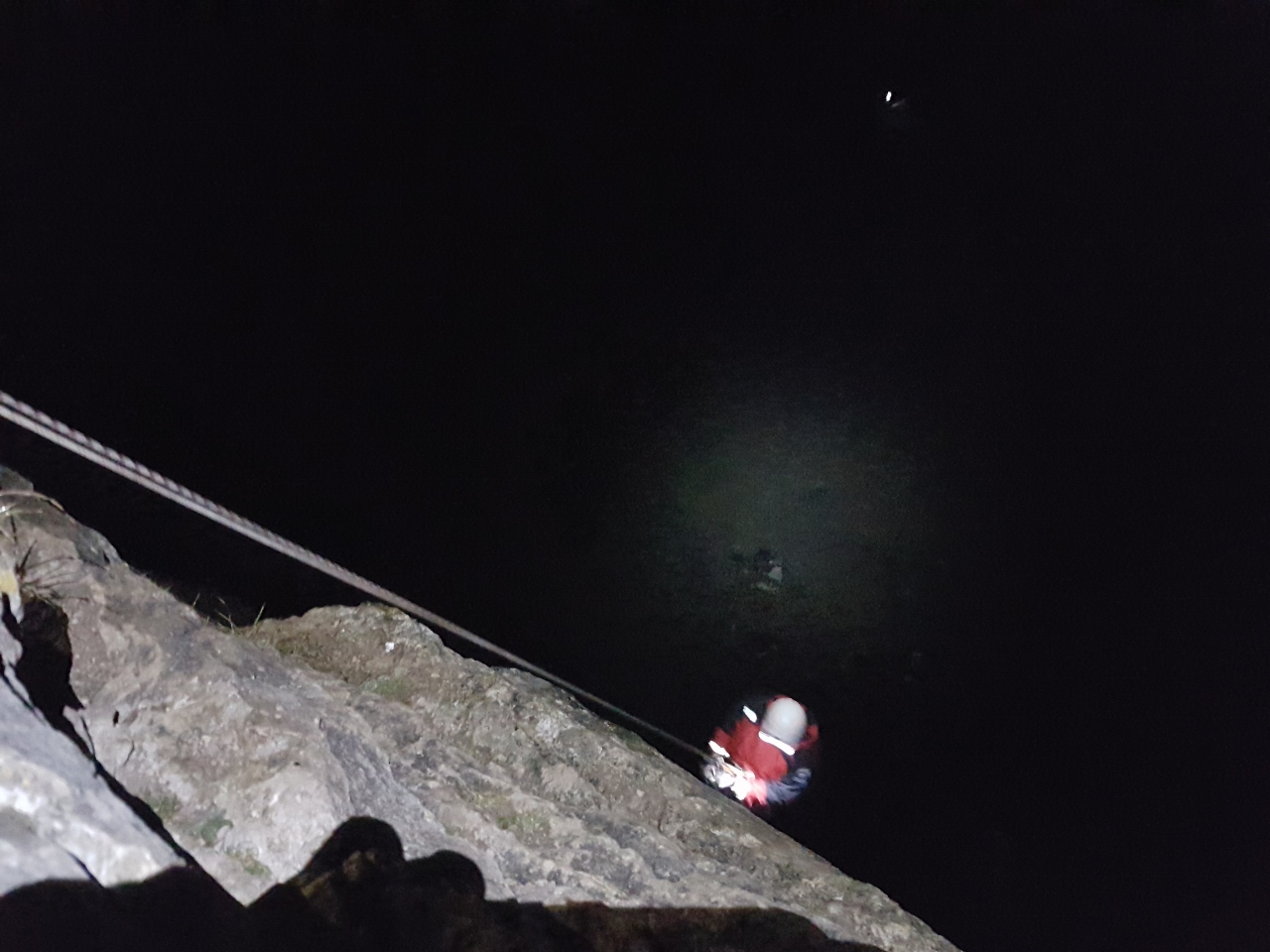
Halfway down

When I was in my teens I came across the book  ‘Two Star Red’ by Gwen Moffat, which was the story of the early days of RAF MR.    I was in the Air Cadets at the time and had also just started walking the local hills back home.    The book was inspiring and it started me on a life of adventure in climbing and mountaineering – I’ve still got my copy, though sadly it’s now out of print.  Eventually it led me to mountain rescue as a team member – in the 1980’s and 90’s I was a member of Penrith MRT and I’m now a member of NEWSAR (North East Wales Search And Rescue).

*    *    *    *    *
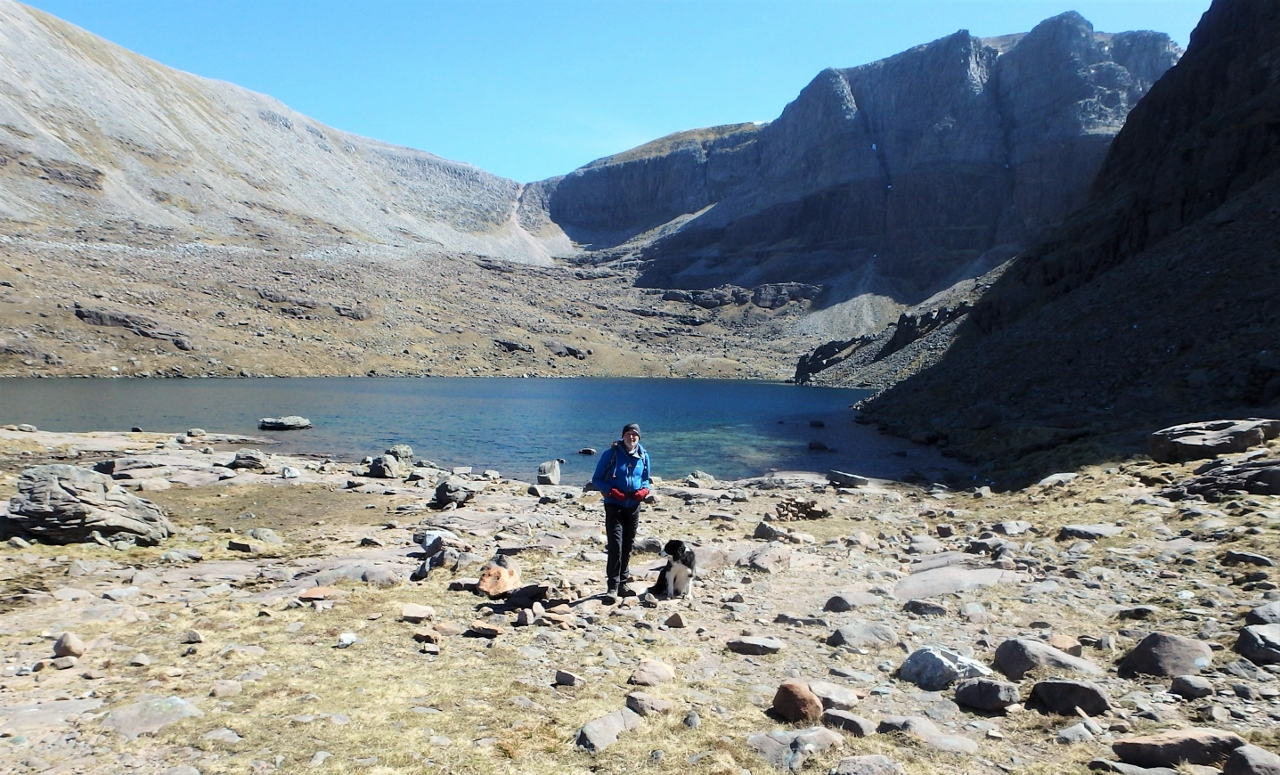
The author in Coire Mhic Fhearchair, May 2017

When Chris and I took our walk up to Coire Mhic Fhearchair, I already had a real sense of the history of the place.  I knew the story from ‘Two Star Red’ and in a way it was a pilgrimage to the memory of those who died in the crash and to the fortitude and endurance of the men who brought them down from the mountain.

For a hungry Border Collie it was time for dinner, but on the way back down I was thinking of ways to fit in an extra day to go up to Beinn Eighe summit – a week later I was back.
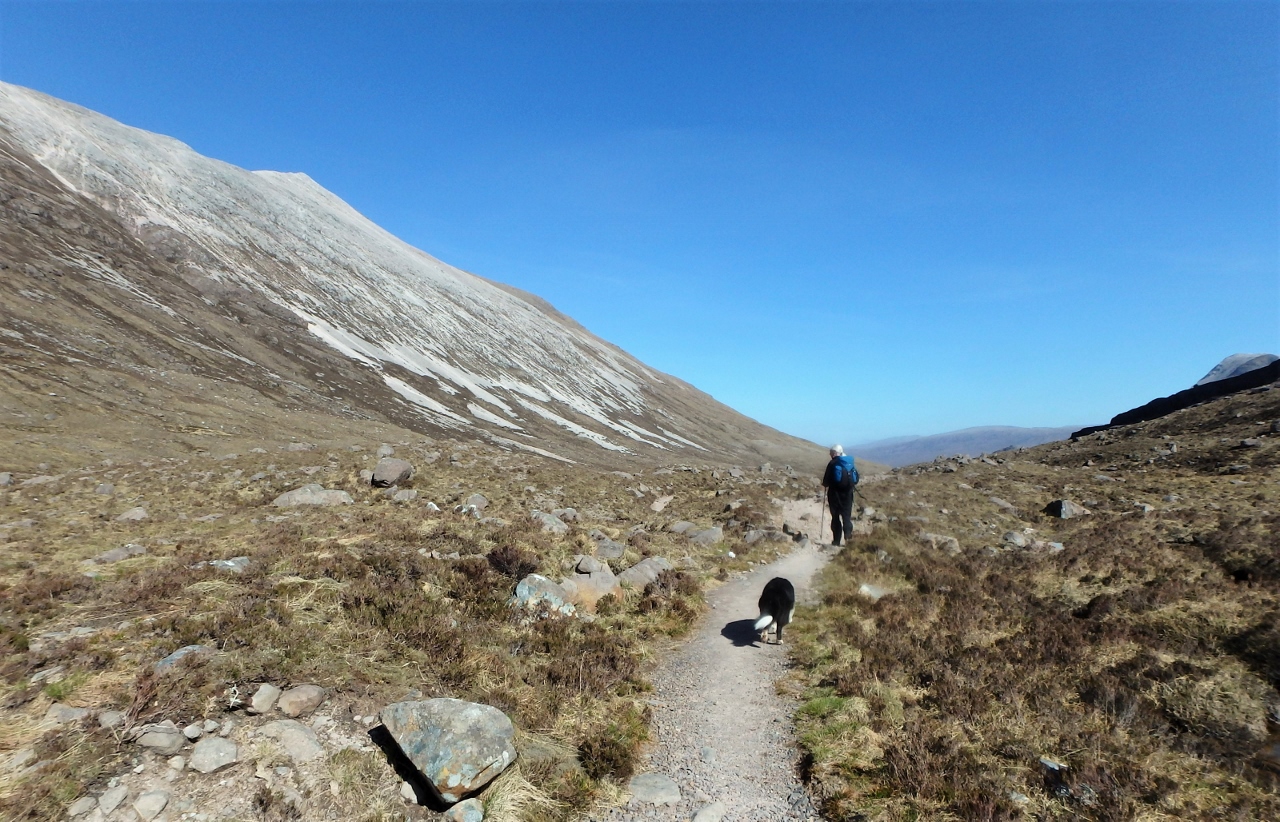
Time to head for home

Text and images © Paul Shorrock except where stated otherwise.

p.s.  I’ve had to edit the story of the Beinn Eighe operation because of the length of the tale.  ‘Two Star Red’ is a good start (but you will be lucky to find a copy for less than £60, usually more!) as is Frank Card’s ‘Whensoever’ mentioned above.  Perhaps the best account, though, is by ex RAF team member Dave ‘Heavy’ Whalley – in his excellent blog he tells the story in three parts starting with the early part of the operation, the recovery of the first bodies and the final phase of the recovery.  Go make a coffee then read on.

p.p.s.  Like all civilian MR teams, NEWSAR members are volunteers, and we have to raise funds to keep the Team running – DONATIONS, however large or small, are always welcome.

It’s also worth pointing out that 95% of the members of RAF MR Teams are also volunteers, with day jobs in the RAF such as technician, fitter, etc – RAF team members give up their free time, including weekends, to train together, and our local team at RAF Valley frequently supports the six North Wales civilian teams.  Long may it continue!
Posted in 1. Scotland, Aircrash Sites | Tagged , , , , , , | 11 Comments

#226 – Coire na Creiche and the Fairy Pools

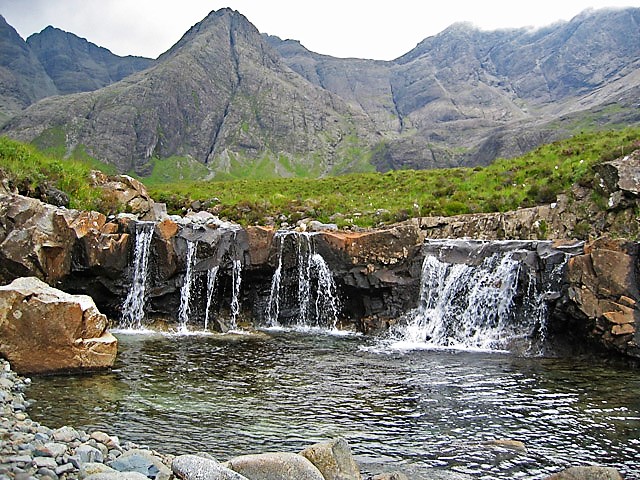
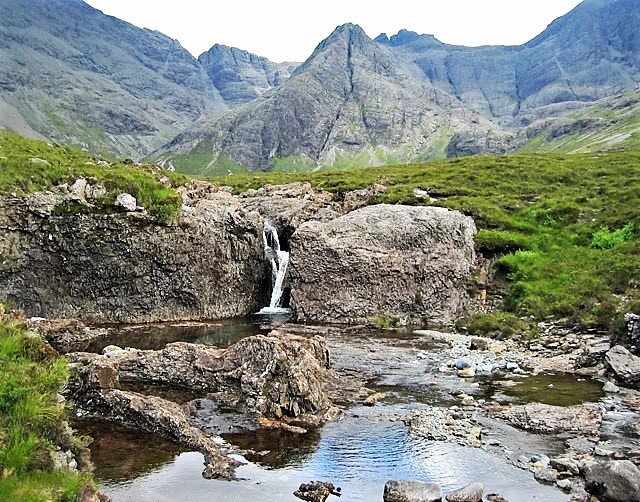
The Fairy Pools of Coire na Creiche (John Allan)

(Some images will zoom – Left click to zoom in, use browser return arrow to go back)

So far, our May trip to Scotland hadn’t got any further than Glencoe (see post #222) and Skye (posts #223, #224 and #225) which was fine by me as the settled weather and lack of midges meant that time could be spent visiting new places as well as old favourites.    The Fairy Pools of Allt Coir’ a’ Mhadaidh were certainly a new one on me, but every reference to Skye on the Internet gave the area a mention, so it looked like a plan.

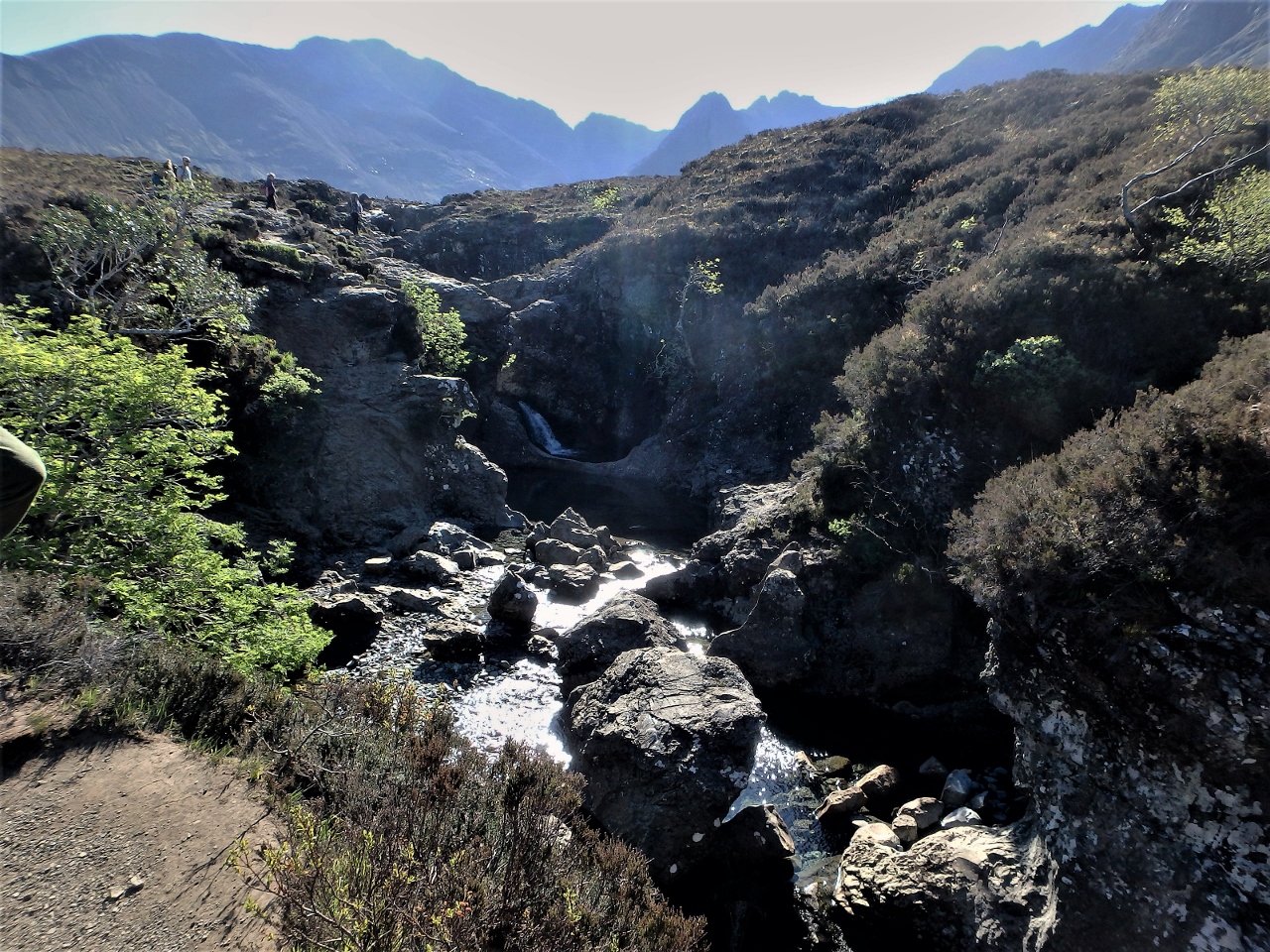
The route by the Fairy pools at the Allt Coir’ a’ Mhadaidh river

The constructed path at the start of the route (Nigel Corby)

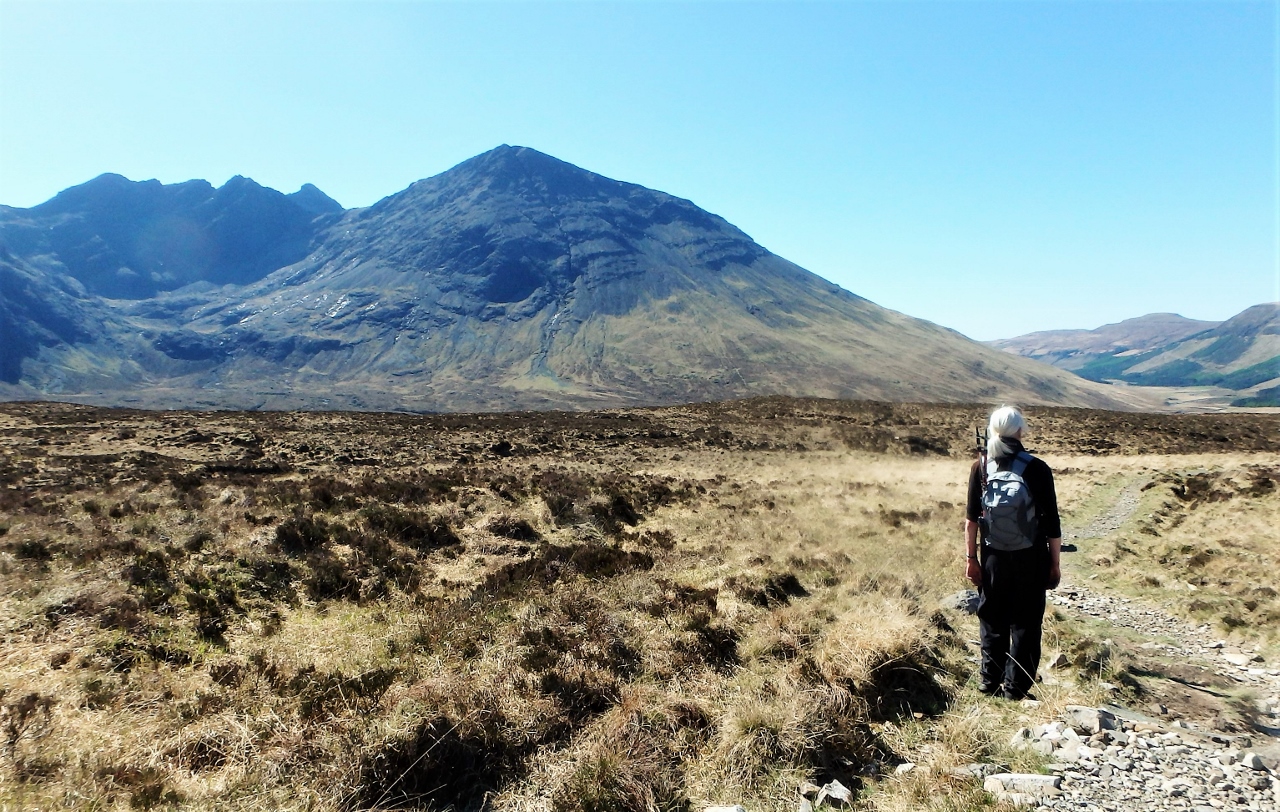
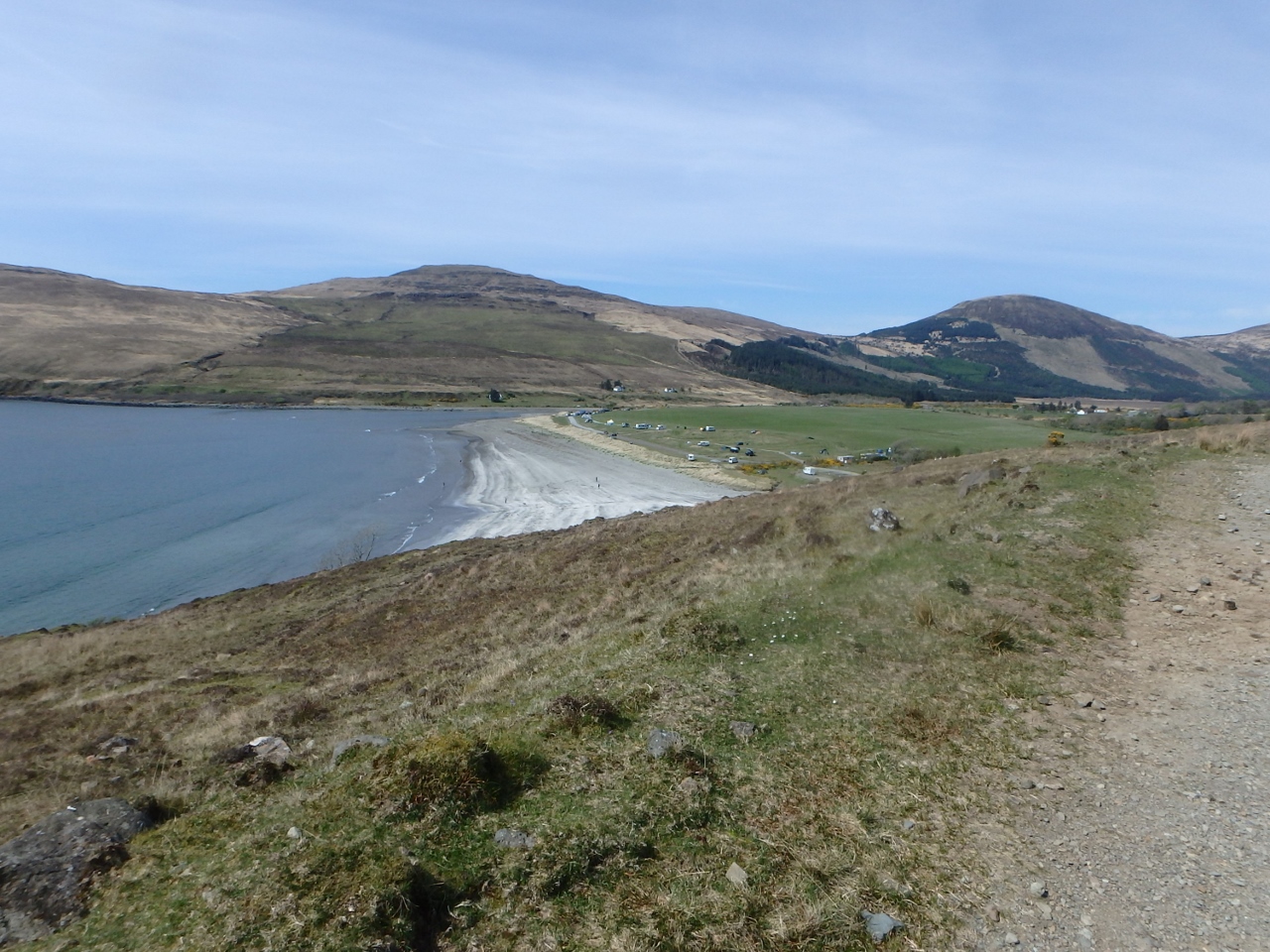
I’ve camped at Glen Brittle on Skye many times over many years, and one of the iconic sights of the Cuillin Ridge coming over the narrow road from Carbost is the peak of Sgurr an Fheadain with the striking cleft of ‘Waterpipe Gully’, so obvious that you can’t miss seeing it.    This time there was something new – a constructed path where previously there had only been moorland.    It looked like we had found the Fairy Pools.

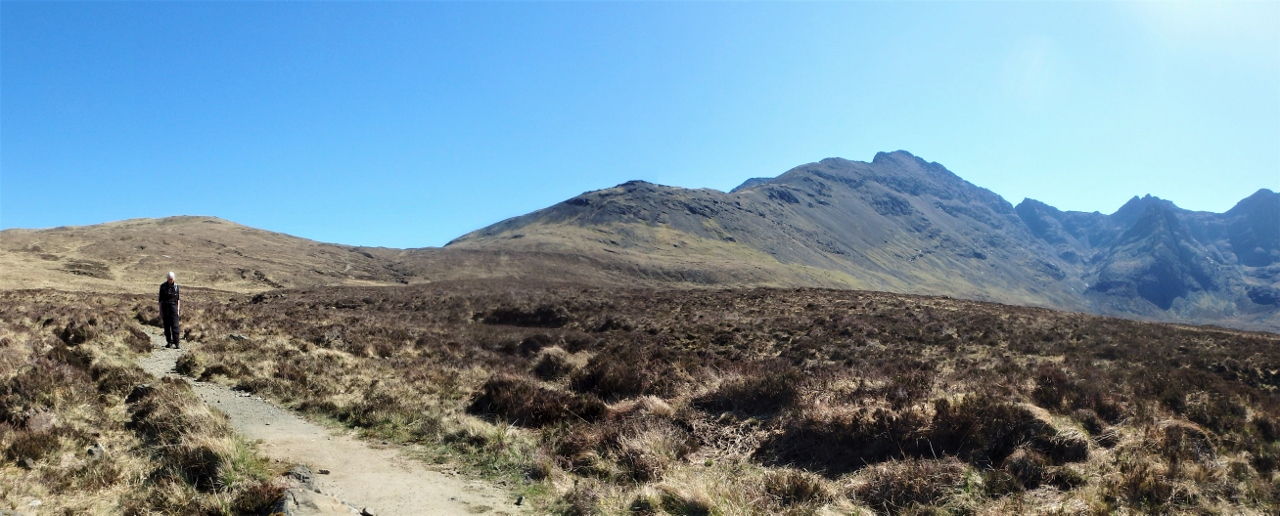
The early part of the walk – light conditions not optimum!

Chris and I had managed a couple of decent walks out from Glen Brittle (see post #225) and were now heading for Torridon, but Border Collie ‘Mist’ was ready for her daily walk and the Fairy Pools ticked a few boxes.    Unfortunately, light conditions for photography were not the best – it was sunny enough, in fact it was too sunny, with the light shining right in the camera lens for most of the way up the path.

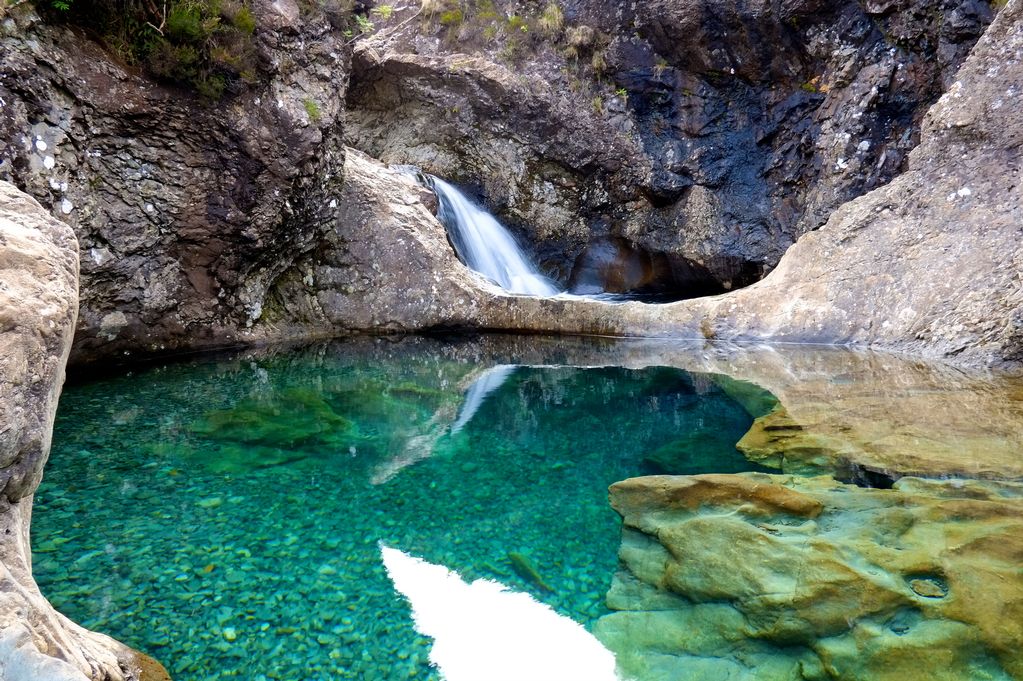
The famous pool with the underwater arch – © isleofskye.com

My current weapon of choice for mountain photography is the Olympus ‘Tough’ TG-850 camera – it’s reasonably priced, but is also able to take a 2.1 metre (7 ft) fall and is waterproof to a depth of 10 metres (33ft).    That means it will survive anything that I’m likely to do to it!   It also has a very wide-angle lens (21 mm) which is great for landscapes.  However, I’ve never really mastered how to get the best out of it in ‘less than perfect’ light conditions – perhaps the answer is to carry a bottle of blue dye when photographing the famous pool with an underwater arch!

Further upstream with the Cuillin Ridge beyond (Rob Farrow)

Meanwhile, the views are just as good (even if the light conditions could be better)

A busy day – almost certain to be more packed in summer

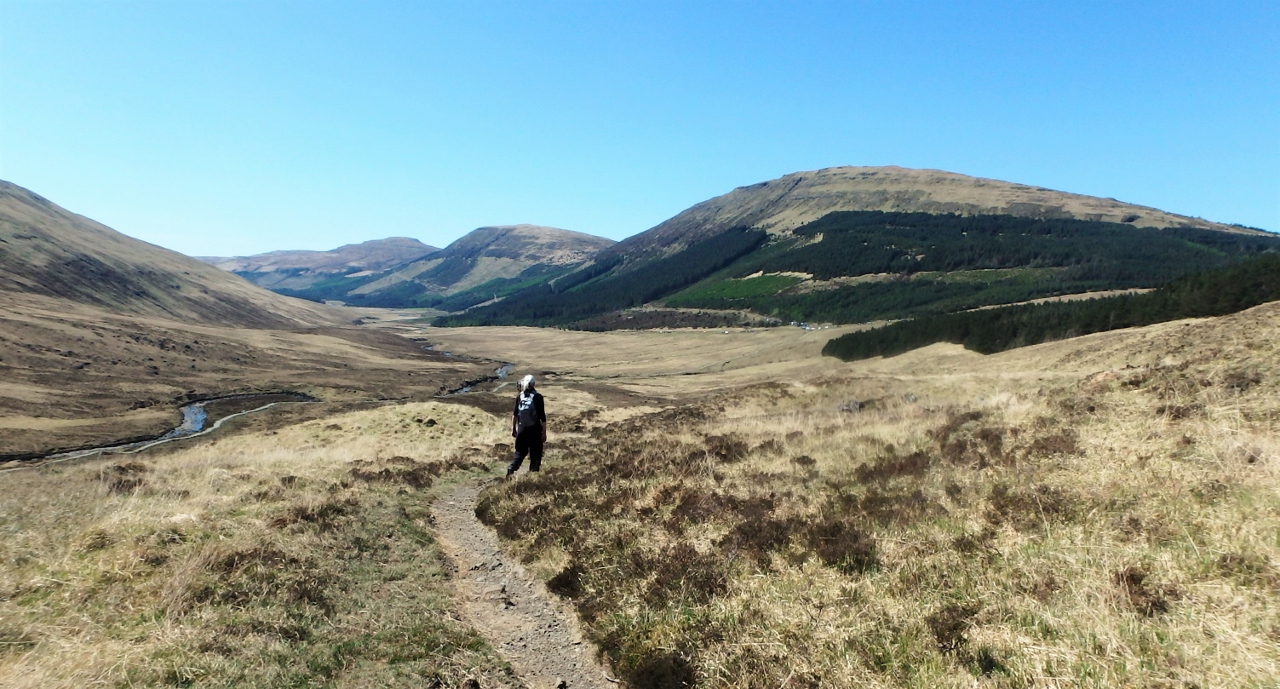
I didn’t have the ‘blue dye’ with me on this occasion, so some of the images lack the ‘buzz’ that the professionals achieve – perhaps I need to learn how to use Photoshop!    Whether or not photography is the aim, the walk up by the river (Allt Coir’ a’ Mhadaidh) has become very popular over recent years, and you will rarely find solitude there unless it’s pouring down, or the midges are biting as they do over the summer months.

Great image of one of the falls (John Allan)

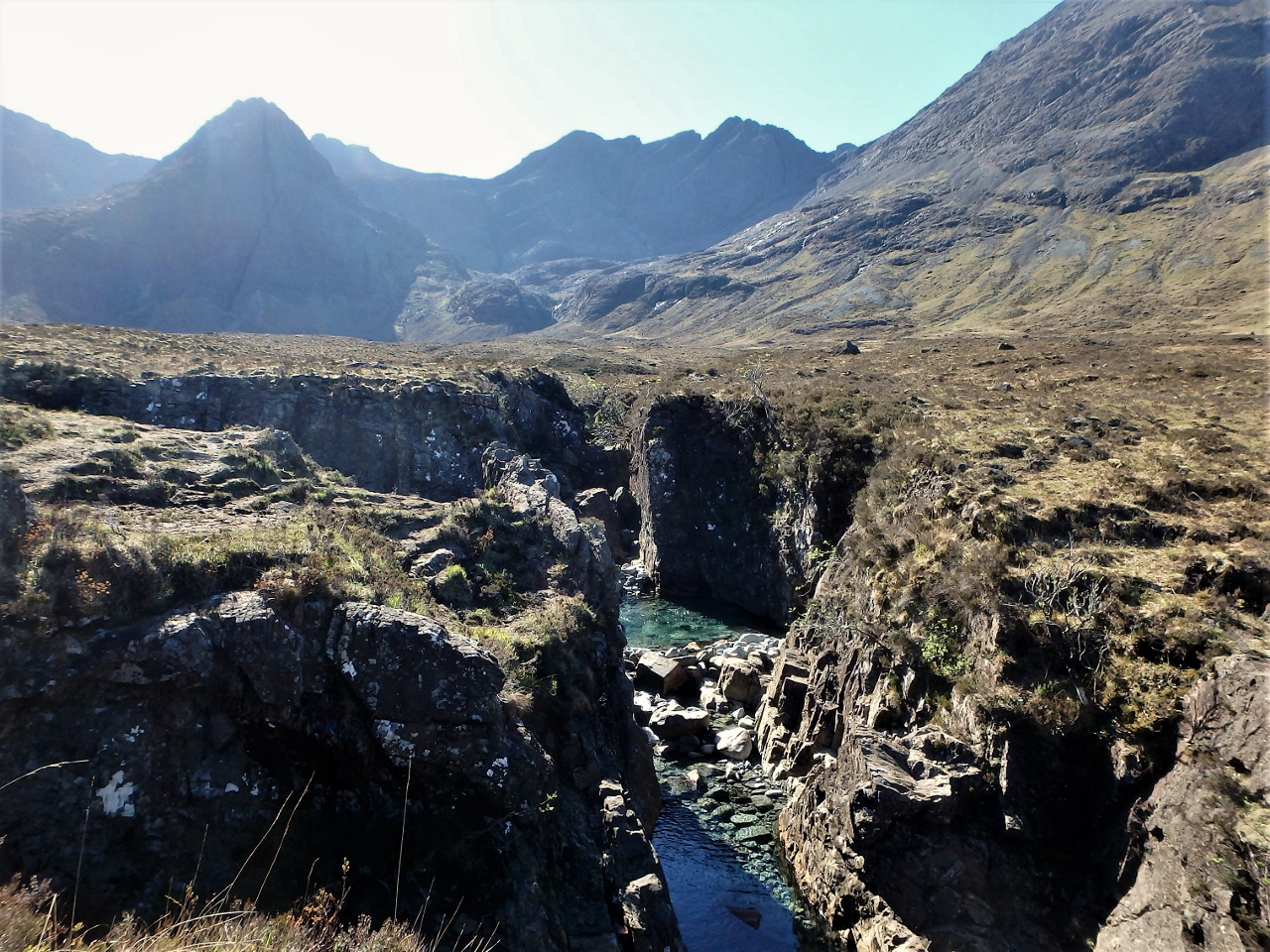
Further up the Allt Coir’ a’ Mhadaidh river ….

…. and nearing the head of Coire na Creiche

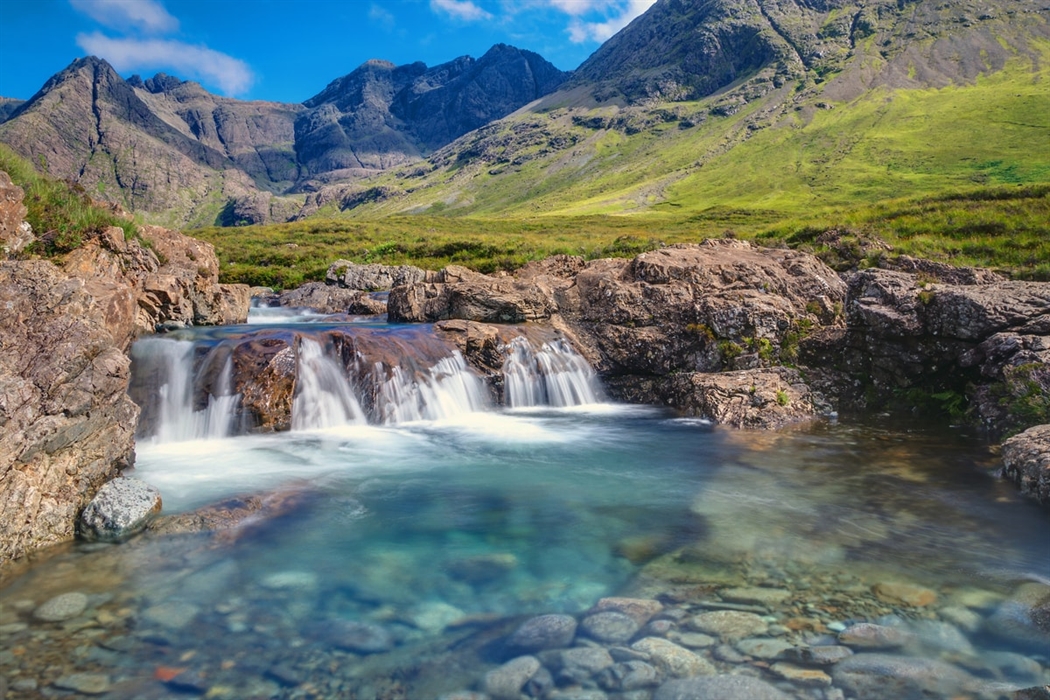
Lovely shot, demonstrating why this walk has become so popular © VisitScotland.com

It’s said that most tourists don’t walk much further than 100 metres from their cars, but the pools and waterfalls had enticed quite a few visitors to follow the path just that bit further – the sunny day also contributed and it was a pleasant change to take just a light pack instead of a hill rucksack.    What’s more, Chris carried it which was even better!

Looking up to the Cuillin Ridge – ‘Waterpipe Gully’ on Sgurr an Fheadain very obvious (John Allan)

The shoulder of Bruach na Frithe on the skyline

Coire a Mhadaidh on the right and the smaller Coir’ a’ Tairneilear on the left

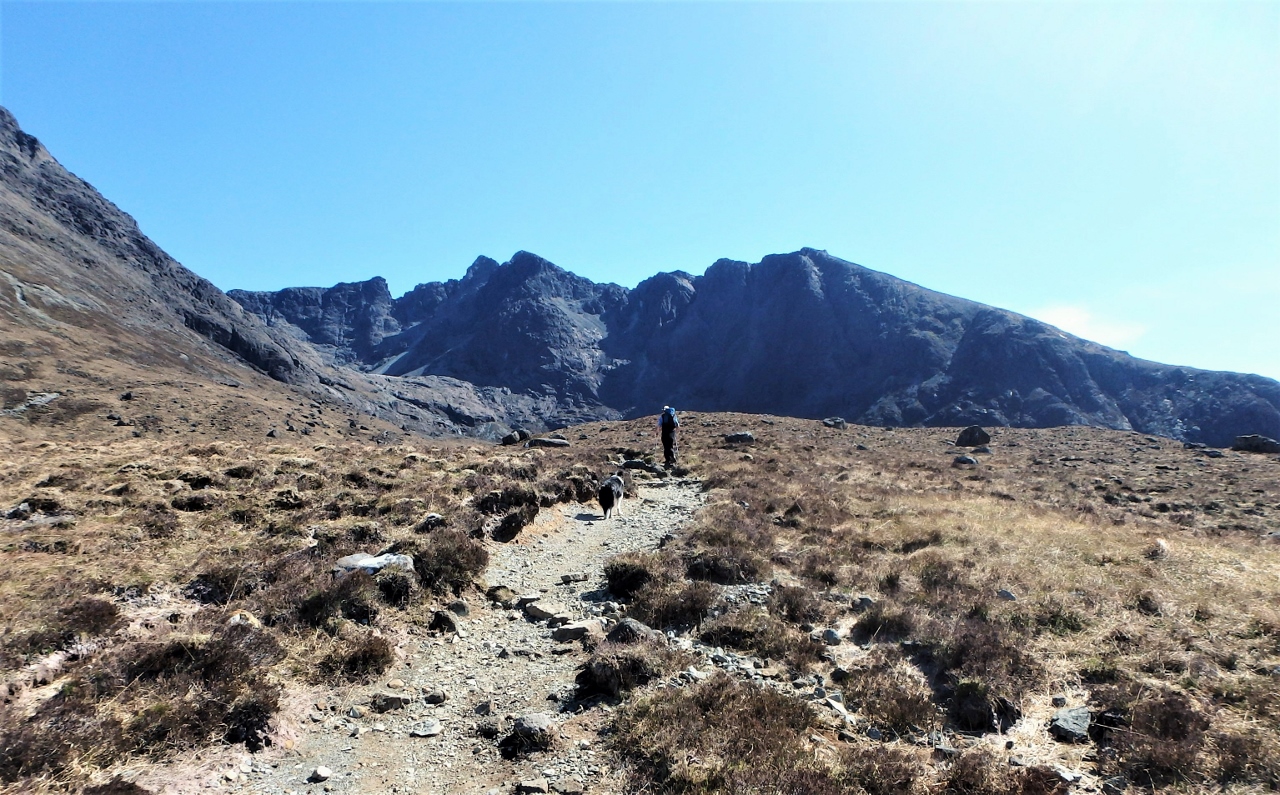
It the falls and pools were impressive, I found the feature dominating the scene was the Cuillin Ridge, which was getting closer with each step.    As we reached the turning point away from the river we came right up to the lower slopes of Sgurr an Fheadain, and soon had a good view into the twin corries of Coire a Mhadaidh and the smaller Coir’ a’ Tairneilear, and I remembered that I had been here once before, in 1976.

Route taken in 1976 (red) round the coast, up Coir Uisg and over the Ridge

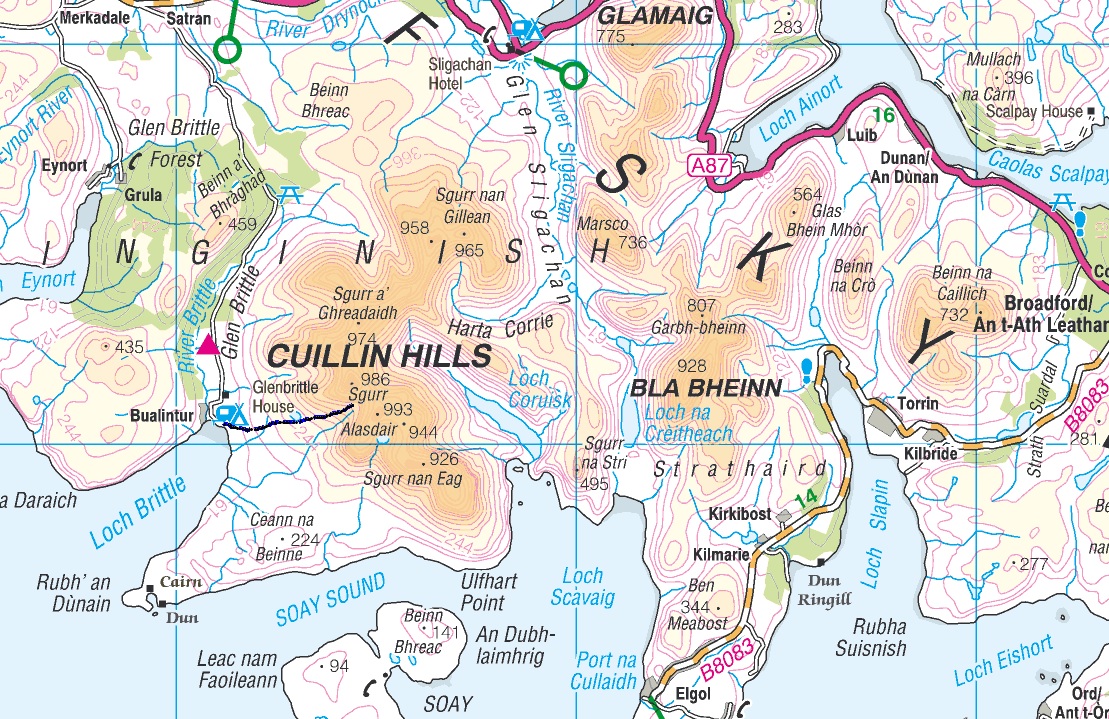
The Cuillin Hills, showing both routes

I wrote about mountain training in the Royal Marines Commandos in an earlier blog (#224) and the reader might have imagined it to be one big ‘jolly’!    We did, in fact, have to do a bit of work on the trip to pay back ‘the Pusser’ (Royal Navy slang for anything to do with, or owned by, the Navy) and one day’s training was a tactical patrol (with weapons, etc) round the coast from Glen Brittle to Coir Uisg (Coruisk).

Coir Uisg (Coruisk) seen from Sgurr na Stri (John Allan)

Coir Uisg is one of the most beautiful parts of Skye, if not the planet (well, in my humble opinion anyway).    What’s more, it was good enough to fight for, which is exactly what we did.   Our enemy were ML’s (Mountain Leaders) of the Royal Marines ‘Mountain and Arctic Cadre’, who were our instructors during Skye training – as well as being skilled mountaineers and skiers, they are also one tough and fit bunch of soldiers!

Route taken by Z Company RM in 1976, crossing the Ridge at Bealach na Glaic Moire (Gareth Foster)

Our task was an ‘Advance to Contact’ heading up alongside Loch Coruisk, with the ‘enemy’ firing the occasional shot at us (blanks thankfully!).    Our task was to continue to advance up the corrie, clearing ‘enemy’ positions along the way – visualise Afghanistan in more recent times, but a bit cooler, and that’s the kind of thing we were doing.    Eventually the mission was complete and all we had to do was get back to our camp at Glen Brittle – the solution was a crossing of the Cuillin Ridge at Bealach na Glaic Moire.

Coire na Creiche with Coire a Mhadaidh on the left

Having crossed the ridge, we descended by Coire a Mhadaidh into Coire na Creiche, and walked down the Fairy Pools path without really noticing the water, though to be fair it had been a long trip covering 24 kms with 1400 metres of height gain.     It had been a long, strenuous day, but the mountain scenery made up for it!

View from the Glen Brittle – Sligachan path into Coire na Creiche

The long Northwest Ridge of Bruach na Frithe, seen from the Glen Brittle- Sligachan path

We weren’t the first to come down Coire na Creiche bearing arms – in 1601 the corrie was the scene of the last Clan battle on Skye.    The MacDonalds and the MacLeods had been feuding for over a year, with several bloody skirmishes having taken place, but things came to a head and the MacDonalds won the day, defeating the MacLeods and capturing the Clan Chief.

One final look ….

The only battle fought nowadays is the battle to find car parking space for the walk – the Fairy Pools trip is well worth the journey, but you need to arrive early on a fine day to beat the traffic problems.    As an alternative, I can recommend a stroll round the coast from Glen Brittle to Loch Coruisk followed by a crossing of the Cuillin Ridge at Bealach na Glaic Moire – carrying a rifle is optional!

…. then it’s time to head for home

Text and images © Paul Shorrock except where indicated otherwise.

Images tagged John Allan, Nigel Corby, Rob Farrow and Gareth Foster are taken from the Geograph Project and are reproduced under a Creative Commons Licence

http://www.geograph.org.uk/

p.s.   For more information about this area and the rest of Skye visit  isleofskye.com  There is also useful information on Skye and the whole of Scotland at VisitScotland.com

Posted in 1. Scotland | Tagged , , , , , , , , | 1 Comment

#225 – Coire Lagan and the Cuillins

Coire Lagan

(Left click images to zoom in, use browser return arrow to go back)

The Cuillin Hills of Skye are a mountaineer’s paradise – there’s an alpine feel about the place and the area remains popular with hikers, climbers and mountaineers from home and abroad.    There is one fly in the ointment though – in fact, on a summer day there are tens of thousands of them!    I’m talking about the humble Scottish midge.    Add the unpredictable weather (it isn’t called the ‘Misty Isle’ for nothing!) and you might question why Skye remains so popular.   The answer to the question is the quality of the climbing.

The route – there and back!

The Cuillins

Getting up onto the Main Ridge of the Cuillins generally involves some fairly hard-core rock climbing or mountaineering, and my missus would be the first to say that she doesn’t ‘do’ hard-core!    However, there’s lots to go at that doesn’t include the risk of sudden death, but still gives the buzz of being somewhere special.    One such place is Coire Lagan above Glen Brittle.
Glen Brittle campsite and beach

Chris and I were at the campsite at Glen Brittle.    In my youth, this was a fairly primitive campsite, but things are catching up now – they even have hot showers, for heaven’s sake!  The trick with the old cold-water showers was to wait until the heat of the sun had got through to the collecting tank above the toilets, then to make a move before everyone else on the campsite did the same – it was still bloody cold though!
Setting out – Corie Lagan just right of centre

Passing Loch an Fhir Bhallaich (Lake of the speckled trout)

The lower part of the path, between the campsite and the small lake of Loch an Fhir Bhallaich, used to be one big bog in anything but a drought, with the path becoming about 20 metres wide with people trying to avoid getting filthy in the black peat.    Some impressive work with drainage and path improvement has changed all that, though the good weather we were enjoying certainly helped.

Gaining height ….

…. but not too steep yet (Loch Brittle behind)

The crags of Sron na Ciche come into view

Beyond the small loch, the path heads up to the impressive Coire Lagan – the mountain scenery becomes more and more impressive, though the views behind looking out to sea tick a few boxes as well.    In the corrie, one feature dominates above the rest – this is the impressive set of cliffs that make up the crags of Sron na Ciche.    It’s hard to appreciate the size of the place at first – suffice it to say, there are a couple of 1300 ft (400 metre) rock climbs with several more approaching that length.    It’s an impressive place to climb.

*    *    *    *    *

Our 1972 rock climbs on Cioch Buttress (The small circle is the Cioch – see photo below)

One of my earliest climbs here in 1972 was a combination of three linked routes.    We started on Cioch Direct (500 ft/150 metres) followed by Arrow route (200 ft/60 metres) – Cioch Direct has re-assuring chimneys and cracks which give an illusion of security, whereas Arrow route, although a grade easier, takes off up an almost bare slab.    On arrival, the top of Arrow Route gives access to an amazing rock feature, The Cioch (see photos below).

1972 – The author climbing on Cioch Buttress

Rock climb ‘Cioch Direct’ (rope just visible left of centre, climber Andy Berrill just above centre)

Second climb – Arrow Route, leading to the Cioch

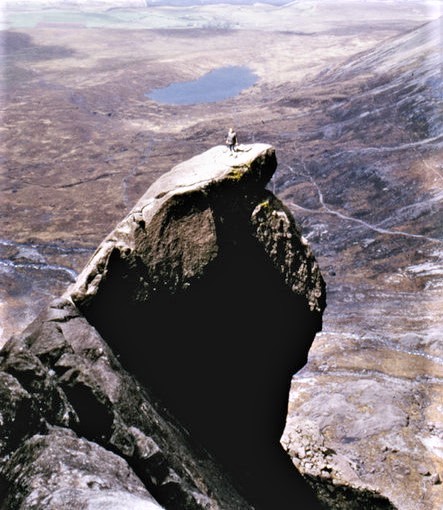
The Cioch is a rock pinnacle that seems to defy gravity, hanging on to the side of Cioch Buttress.    It’s almost unthinkable to climb up there without going out onto the almost flat top, and although it looks small there’s enough room for a picnic – just make sure you don’t invite too many friends!     After finishing your picnic, the best end to a climbing day is to continue up a third climb, Integrity (250 ft/75 metres) which takes you to the ridge of Sron na Ciche.

The Cioch – © John Wray

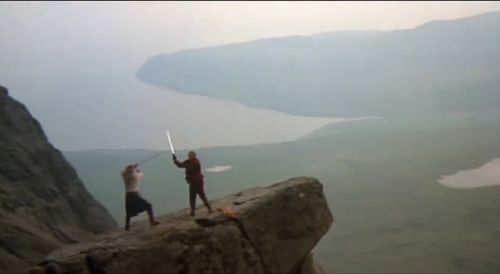
The Cioch as seen in the film ‘Highlander’

The Cioch is also famous for being a location in the 1986 cult movie ‘Highlander’, though rumour has it that Sean Connery was helicoptered in – if he was, he missed some ace rock climbing!

*    *    *    *    *

Getting a bit steeper now!

Short rock wall leading to Upper Coire Lagan

Getting closer to the rock wall

Over the obstacle – looking back down the track we had followed

Chris and I hadn’t come for the rock climbing on this trip, though Chris must have thought I had lost the plot when the path we were on led us up to a short rock wall.    Now, for some, the short rock wall is an easy scramble to add a bit of interest to a walk – for others, including Chris it must be said, a short rock wall was not on the agenda.    However, we found an easy enough way of working through the obstacle, though predictively, Border Collie ‘Mist’ was already up and waiting for us.

A bit more height gain ….

…. before the corrie opens out – Sgurr Mhic Choinnich above in the centre

(l to r) Sgurr Mhic Choinnich, Sgurr Thearlaich, Sgurr Alasdair and Sgurr Sgumain

The author and ‘Mist’ by the tiny loch in Upper Corie Lagan

Upper Coire Lagan gets right in amongst the action!    The rock architecture is almost alpine in scale and appearance, and it’s a lovely quiet spot to have the picnic you might have had on the Cioch.    The climber and mountaineer will probably be busy identifying the different peaks and routes, but on a pleasant warm day it’s a great place to idle away a few minutes in the sun.

‘Mist’ chilling out, with our return route in the background

Setting off back down ….

…. with a last look back into Coire Lagan

What’s more, if you go in May as we did, there’s a good chance that you will have settled weather and no midges.    However, sooner or later the time comes to move, either up on to the ridge above for a bit more sport, or back down for a cold cider, as was our plan.  Whatever you go for, it’s a great day out.

Time to head for home

Text and images © Paul Shorrock except image tagged John Wray, which is taken from the Geograph Project and reproduced under a Creative Commons Licence

http://www.geograph.org.uk/

Posted in 1. Scotland | Tagged , , , , , , | 5 Comments

#224 – Bruach na Frithe and the Cuillin Ridge, Skye

The summit of Bruach na Frithe, seen from Upper Fionn Choire

(Left click images to zoom in, use browser return arrow to go back)

Skye weather can be fickle and the midges ferocious, but a visit in May is often blessed with settled weather and no biting insects.    Chris and I had a couple of enjoyable walks out to bothies on our Skye trip (see post #223) but a day on the higher mountains was tempting.    Chris had no great desire to head for the Cuillin Ridge, so it was going to be a solo trip –  with Border Collie ‘Mist’ of course.

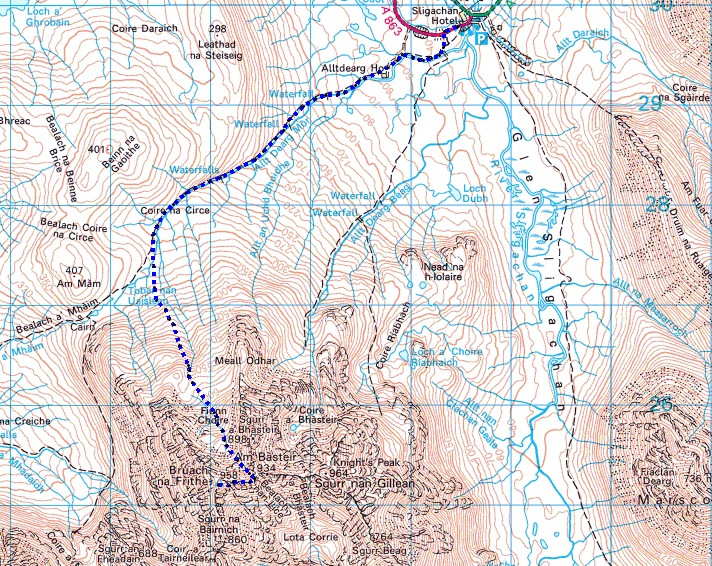
The route – Sligachan to Bruach na Frithe via Fionn Choire

The Cuillin Mountains of Skye

We were at the campsite at Sligachan, so something at the northern end of the Cuillins looked favourite.   Although I have never done the whole Cuillin Ridge in one trip, I’ve collected most of the summits over the years.    However, one omission on my ‘tick list’ was Bruach na Frithe, which makes an interesting but non-technical day out, an important consideration when taking a dog along.    So, Bruach na Frithe it was.

*   *   *   *   *

In Coire Lagan 1972 (the author centre with the light-coloured shirt AND with hair!)

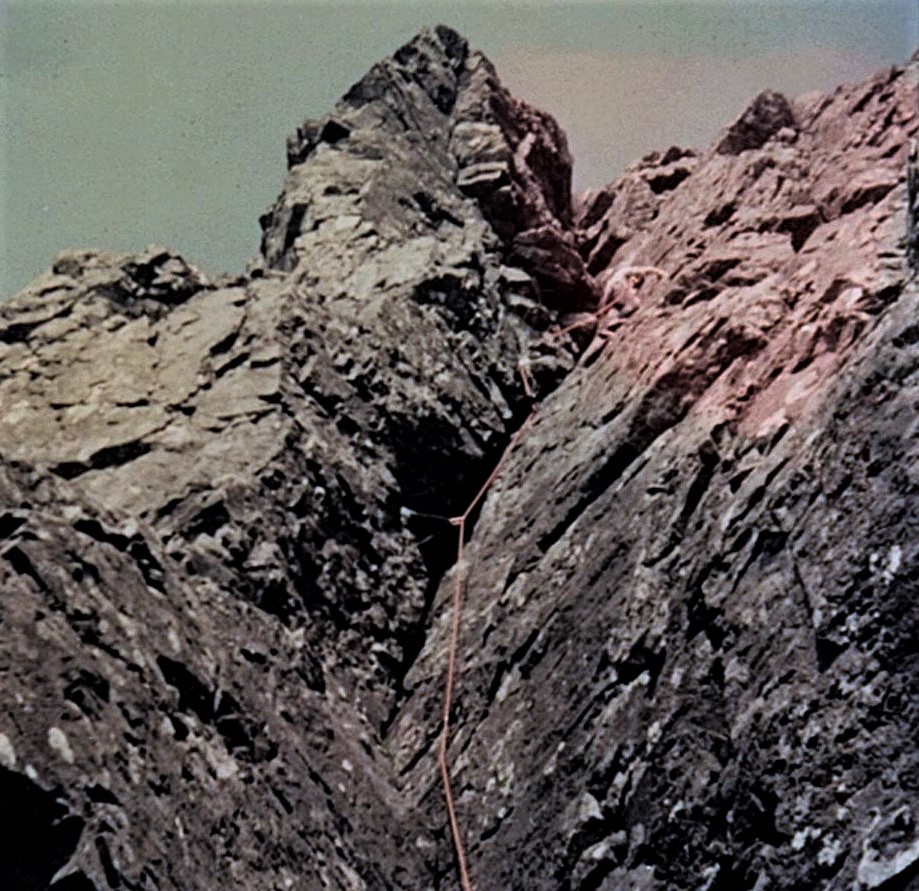
The author climbing on Sgurr Mhic Choinnich

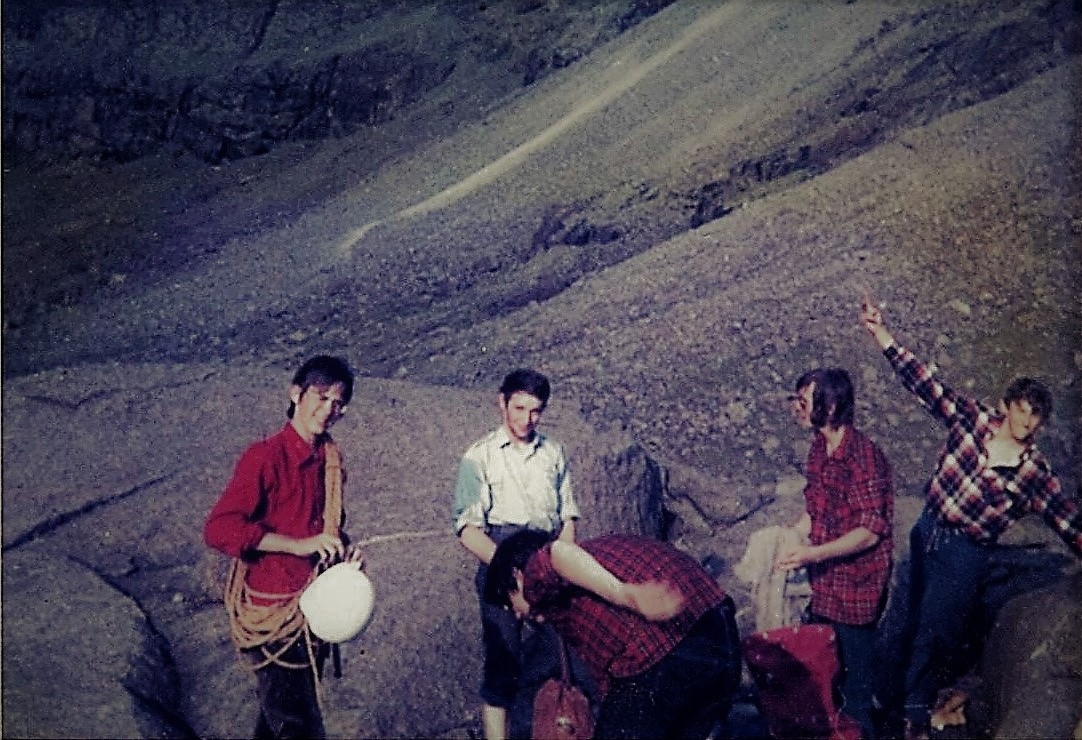
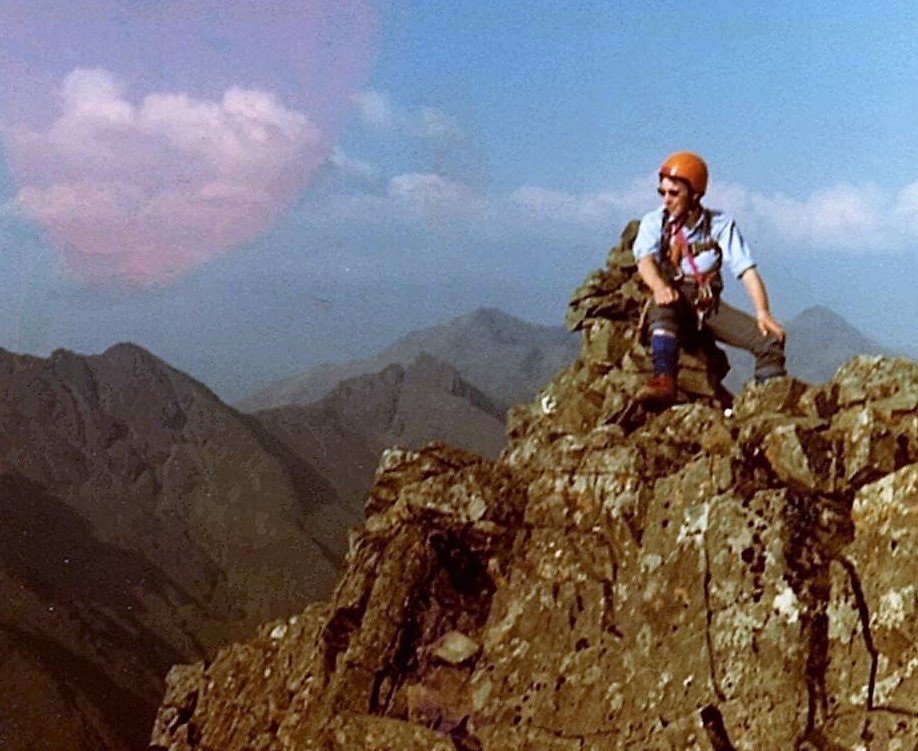
My first visit to the Cuillins was in 1970, but the ‘Misty Isle’ was well named that year, and we didn’t get any serious hill days, and 1971 was only marginally better.    Then in 1972 we hit the jackpot with the weather and I had my first trip out on to the main Cuillin Ridge.  We started on a 1000 ft (305 metres) rock climb on Sgurr Mhic Choinnich for no other reason than it was one of the longest in the guidebook.

On the summit of Sgurr Mhic Choinnich

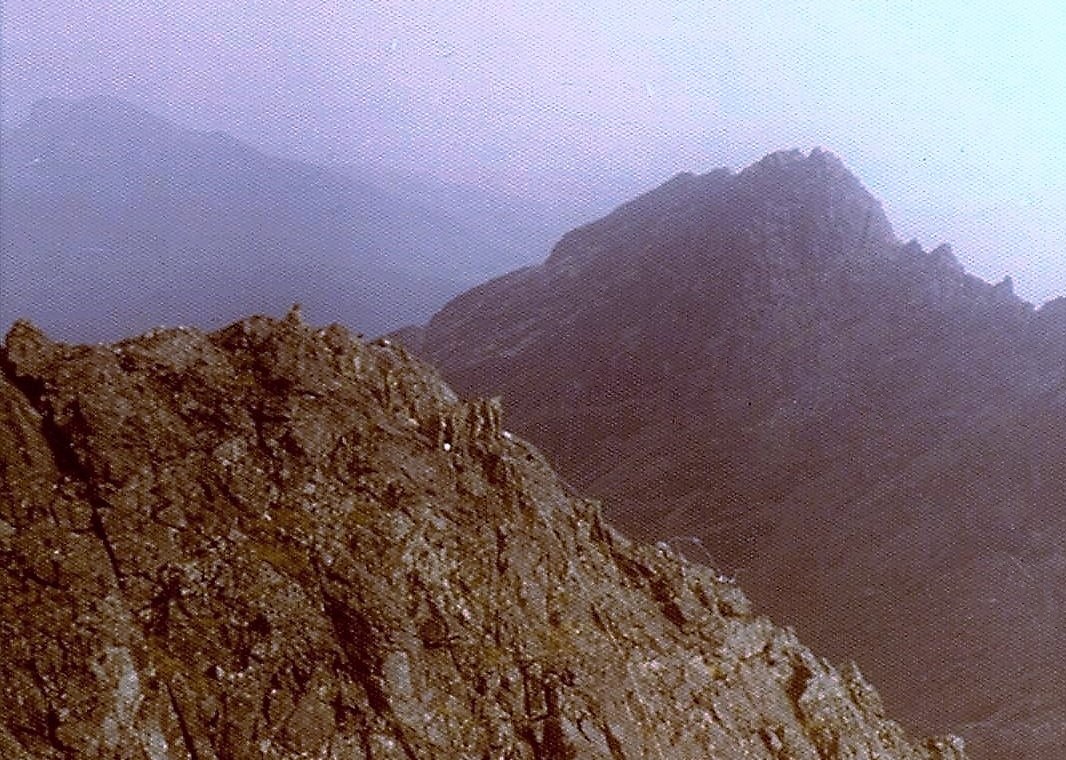
Descending the ridge, Sgurr Mhic Choinnich

1973 was almost as good, but by then we had learned to go for quality rock routes rather than just quantity – as with many things, size really isn’t everything!    Then, in 1974, I joined the Royal Marines.    My recruit troop completed the RM Commando Course just before the training centre went on annual leave – most of my mates went home for a lazy two weeks holiday, but I headed back to Skye for another climbing trip.

Royal Marines Commandos training on the Cuillin Ridge

My first unit after training was 45 Commando, based in Arbroath.    In my first year, I did a tour of duty in Northern Ireland, learned to ski (the military way!), completed Arctic Warfare training in Norway and took part in Mountain Training back in Scotland.    Then, 12 months after joining the unit I was back at the Commando Training Centre, this time on an officer training course; when I completed the course I asked to go back to 45 Commando, the only unit I ever wanted to be in.

8 Troop, Zulu Company, 45 Commando Royal Marines on Sgurr Alasdair, October 1976

The Inaccessible Pinnacle

Royal Marines Commando abseiling off the ‘Inn Pin’

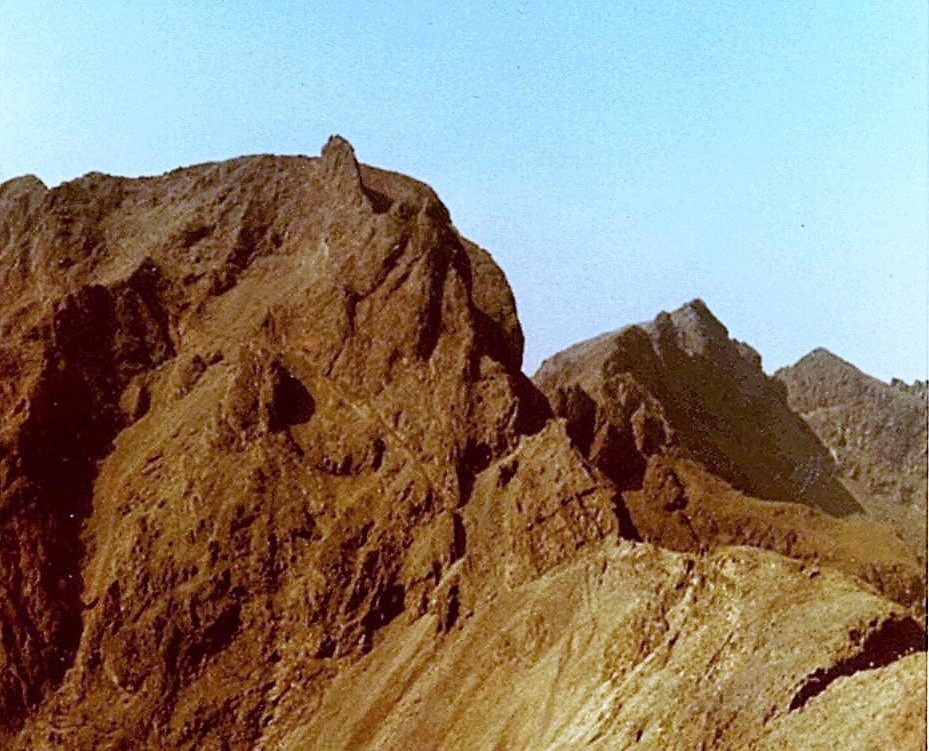
My first posting as a junior officer was as Troop Commander of 8 Troop, Z Company.    45 Cdo was regarded as THE Mountain and Arctic unit at the time, and my Company Commander, Dougie Keelan, was a keen mountain man himself.    In 1976 the unit went to Skye for mountain training and I couldn’t believe my good fortune – there I was, playing on the best mountain range in the UK and getting paid to do it!    During the time we were there, the Company ticked off most of the Cuillin Ridge – But not Bruach na Frithe!
*   *   *   *   *

Setting out from Sligachan ….

…. with (l to r) Sgurr nan Gillean, Am Basteir and Sgurr a Bhasteir dominating the view

The campsite at Sligachan has one of the best views of the northern Cuillins, with Sgurr nan Gillean, Am Basteir and Sgurr a Bhasteir dominating the view.    Setting off from the campsite with ‘Mist’, my objective, Bruach na Frithe, was just round the corner in the corrie of Fionn Choire, and hidden from view from the campsite.

Waterfall on the Allt Dearg Mor

The west side of Pinnacle Ridge on Sgurr nan Gillean coming into view ….

…. then a better view into the bowl of Fionn Choire (just right of centre)

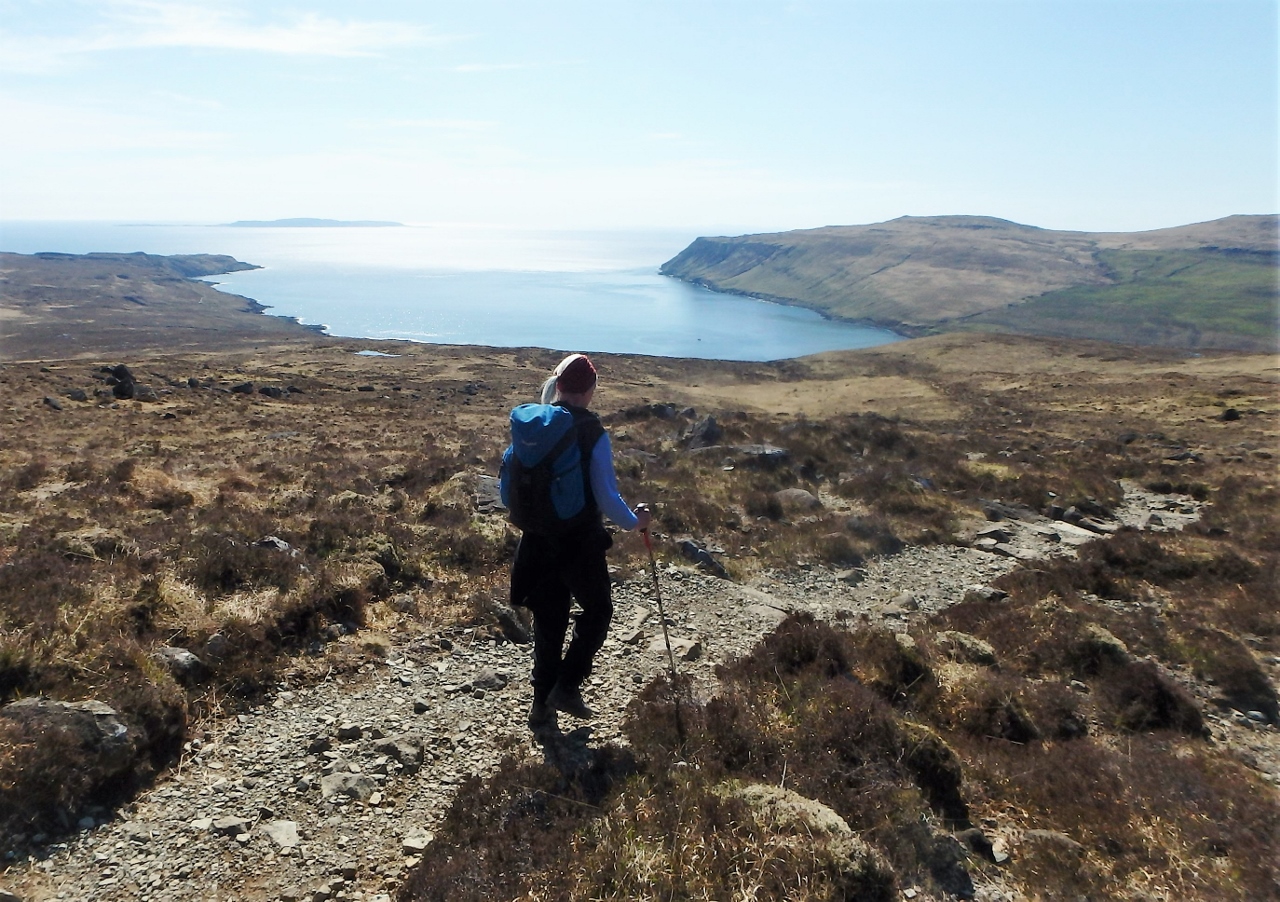
A steady walk in alongside the waterfalls and pools of the Allt Dearg Mor soon brought a different view of Sgurr nan Gillean.    The panorama of the west side of Sgurr nan Gillean from the Allt Dearg Mor is a classic view, and the saw-tooth edge of Pinnacle Ridge is unmistakable – it’s a cracking mountain route and I had climbed it in the summer of 1976, while on leave with a couple of mates who were also marines.    Then, as I made further progress along the Glen Brittle path, I started to get a better view into Fionn Choire.

Fionn Choire, with the notched outline of Sgurr a Fionn Choire in the centre

Fionn Choire

The route – up the left side of the corrie, then right, passing underneath Sgurr a Fionn Choire

The last of the grass ….

…. before heading up to Sgurr a Fionn Choire

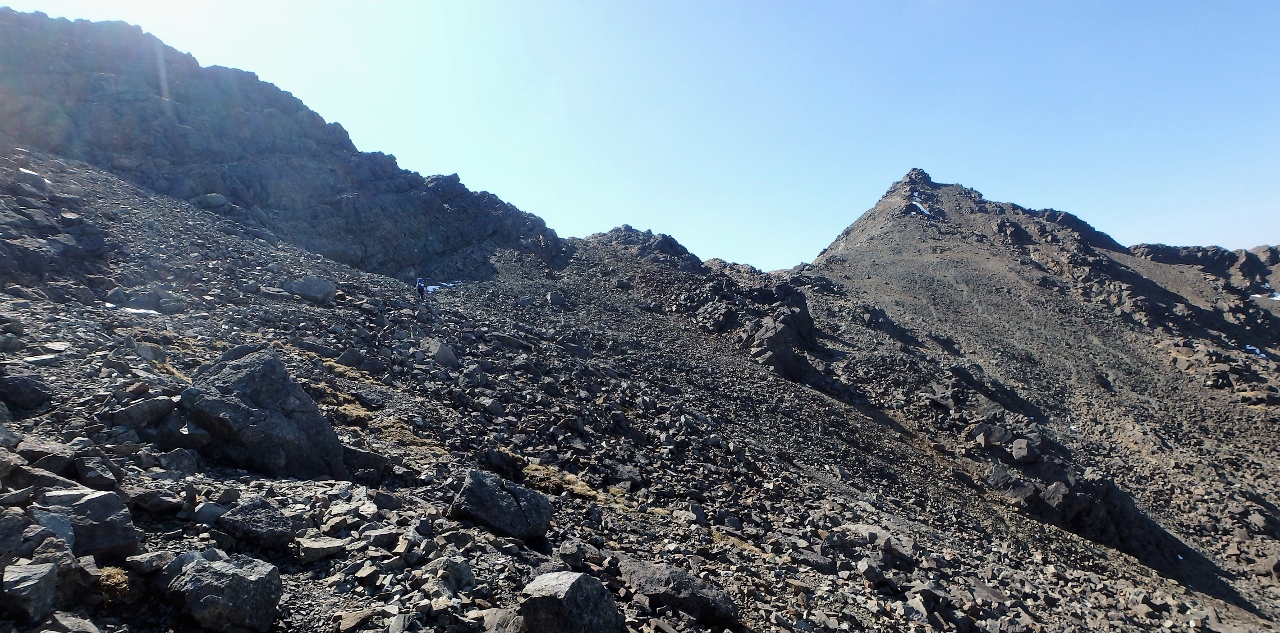
There was still quite a bit of moorland to cross, with a steady height gain.    Once into the rocks of the corrie things changed, and before long it was time for a brew of coffee and a ‘sarnie’.    Coming down the slope was an old guy who must have been in his mid-70’s – I had passed his tent on the way up.    He’d been up early for a wander around the Ridge, and was heading down for a kip.    I remember thinking that I hope I’m still doing that sort of thing when I’m his age!

The East Ridge of Bruach na Frithe leading to the summit

Views from Bealach nan Lice – looking towards Blabheinn (Blaven) ….

…. with a view out towards Elgol

Nearly on the East Ridge of Bruach na Frithe ….

…. then the main Cuillin Ridge comes into view

The plan was to head up the left side of the corrie to Bealach nan Lice, then to traverse underneath the peak of Sgurr a Fionn Choire to hit the East Ridge of Bruach na Frithe.   At the bealach (pass) there were great views across Lota Corrie towards Blaven, and across Harta Corrie towards Elgol, where we had witnessed a superb sunset a few days back (see post #223).    The East Ridge seemed longer than the map suggested, but that thought disappeared as the Cuillin Ridge came into view.

The easy ridge to the summit ….

…. then at last, the top

The view of the ridge from the summit of Bruach na Frithe is something else – it’s also virtually impossible to do it justice in a photograph, so the curious reader will have to go and take a look in person.    I had decided on a return by the same route – the Northwest Ridge looked like a ‘goer’, but I didn’t fancy an ‘epic’ with the dog if I came across an awkward bit.

Reversing the route, heading back down towards Sgurr a Fionn Choire

Reversing a route isn’t such a big deal anyway – the views are always different for one thing, and this option didn’t disappoint.    I was also a bit wary of having the dog on gabbro rock for too long – ‘Mist’ is a real mountain dog, and her pads are quite hard, but gabbro is possibly the most abrasive rock you can come across, and it shreds boots and clothing in quick time.

A quick drink for ‘Mist’

I made my way down, shouting a quick ‘hello’ to the old guy in his tent.    ‘Mist’ had a drink in just about every pool on the descent, but I was happy to wait until we were back at Sligachan campsite for an ice-cold cider out of the fridge – after all, we are supposed to ‘re-cidrate’ aren’t we?

Time to head for home

Text and images © Paul Shorrock

Posted in 1. Scotland | Tagged , , , , , , , , , , | 15 Comments

#223 – The Bothy – A very British institution

Bothy life © Tho Mountain Bothies Association

(left click images for expanded view, use browser return arrow to go back)

There’s something uniquely British about bothies and the way they fit into British mountain activity.   A bothy was originally rough accommodation for itinerant workers such as shepherds, quarrymen, miners and gamekeepers, but as the need for bothies fell away the lonely cottages were falling into disuse and becoming derelict.  To the rescue came the Mountain Bothies Association (MBA).

Greg’s Hut in the Northern Pennines © JB

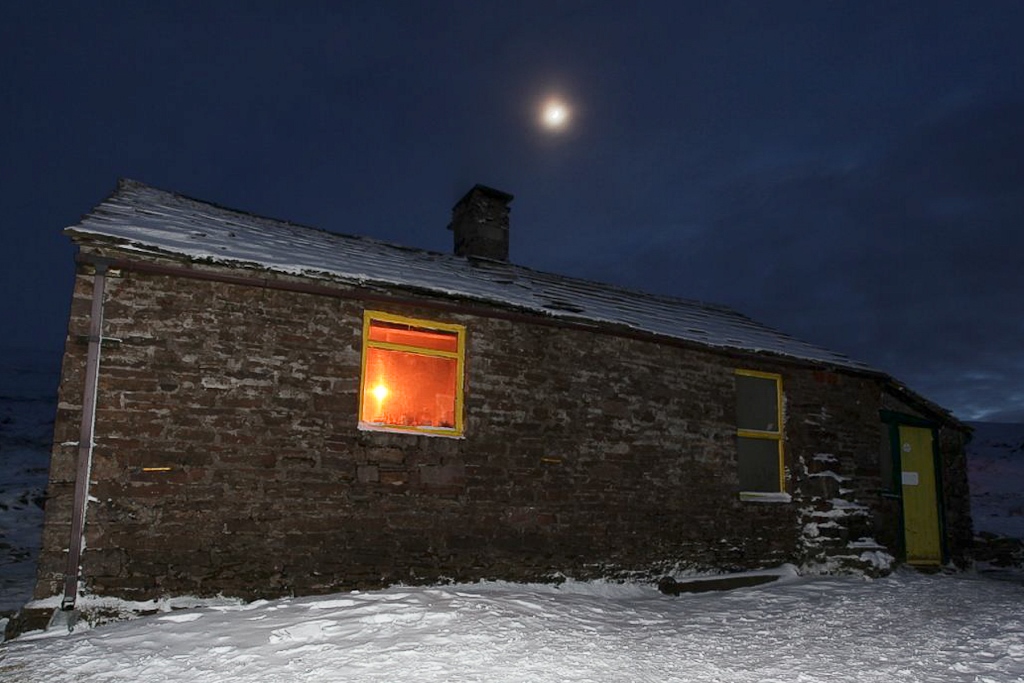
The deal is this – the MBA maintain the bothies on behalf of their owners and with their permission.   They are then made available for use by anyone travelling through the mountains of the UK – for FREE!  The MBA raises money as a registered charity to repair and maintain the buildings, but it costs nothing to stay in a bothy, nor do you have to be a member of the MBA to do so.   Quite often the bothies are in remote and beautiful locations, and to spend a night by a bothy fire with a glass of whisky to hand must be as near to heaven as you can get.

Greg’s Hut, highest bothy in the UK …. © JB

…. and in winter it feels like it! © JB

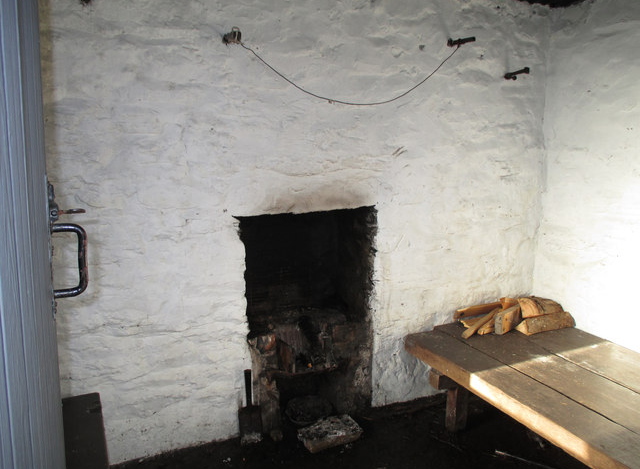
Inside Greg’s Hut during the Spine Race

Head Chef, John Bamber

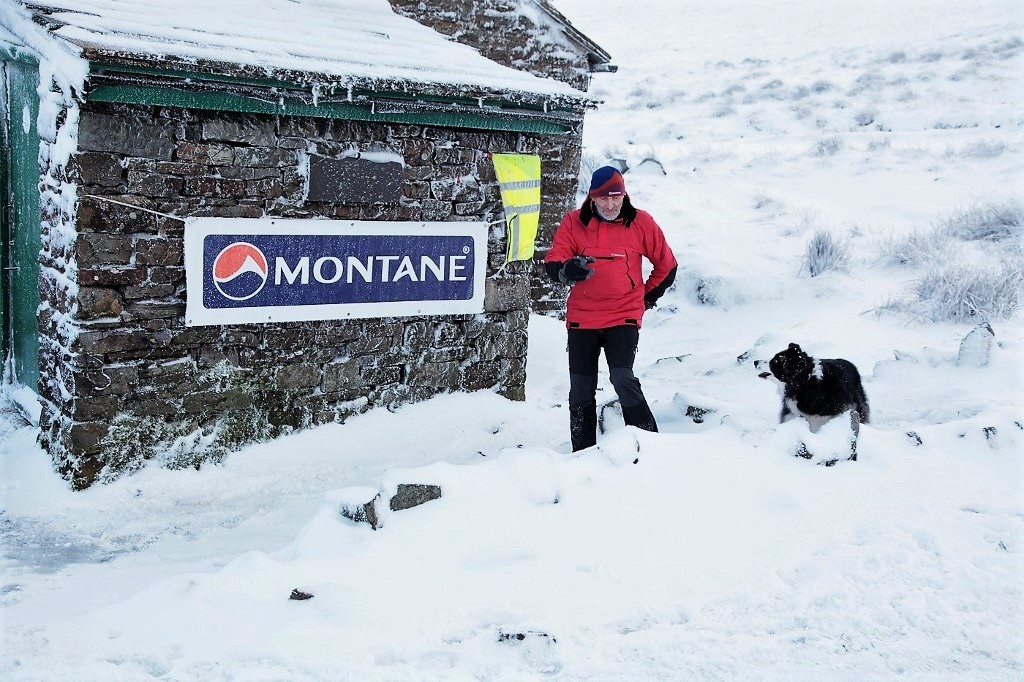
The author and Border Collie ‘Mist’ at Greg’s Hut during the Spine Race © JB

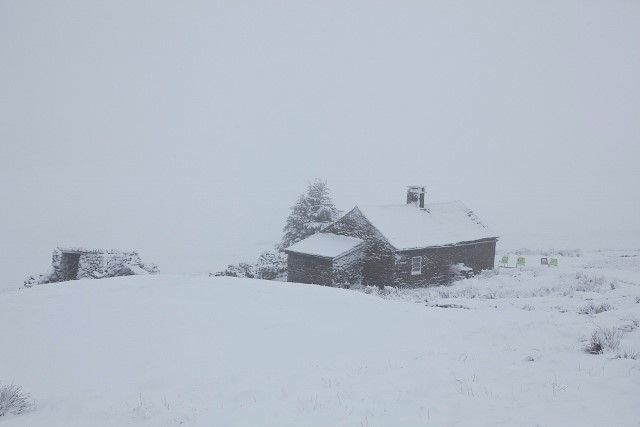
Regular readers will remember that every January I head off to ‘Greg’s Hut’ bothy near to Cross Fell in the Northern Pennines.  Greg’s Hut is one of the bothies maintained by the MBA, and at an altitude of 700 metres it is the highest bothy in the UK – in January it’s probably also one of the coldest, but a wee bit of coal on the fire soon makes the place a bit more homely.  Also along for the trip are the usual suspects, lifelong friend John Bamber and my Border Collie ‘Mist’ – for 2-3 days we become part of the Spine Race (see post #141) and Greg’s Hut (plus the weird inhabitants) has become part of the Spine legend.

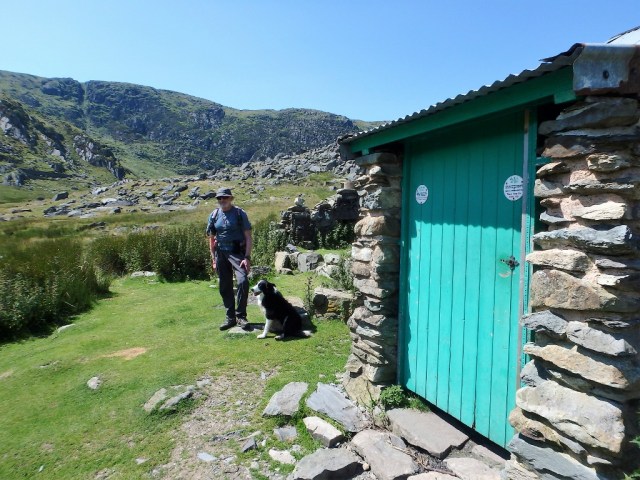
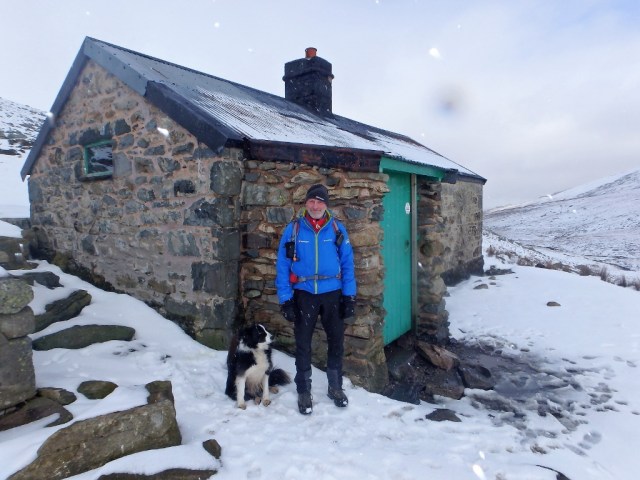
Man and dog at the Dulyn Bothy (the author and Border Collie ‘Mist’)

Inside Dulyn bothy

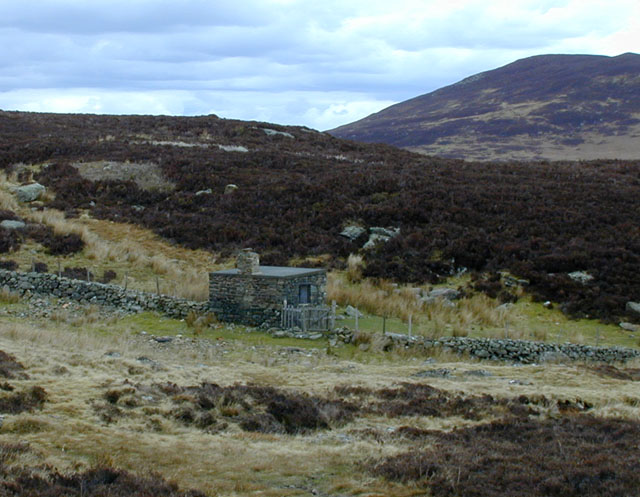
The tiny bothy near Arenig Fawr © Dave Crocker

Inside Arenig Fawr bothy © Dave Crocker

Arenig Fawr Bothy © Nigel Brown

Of the 100 or so bothies maintained by the MBA, the majority are in Scotland, with eleven (including Greg’s Hut) in England and nine in Wales.  Living in North Wales, I’m lucky to have a couple of bothies almost on the doorstep.  Nearest is the bothy at Dulyn in the Carneddau, about 38kms (less than 24 miles) from where I live as the crow flies (see posts #197 and #218) and just a little further away is the tiny bothy near Arenig Fawr (see post #180).

Sunset over the Cuillins, seen from Elgol on the Isle of Skye

Still looking good the next day

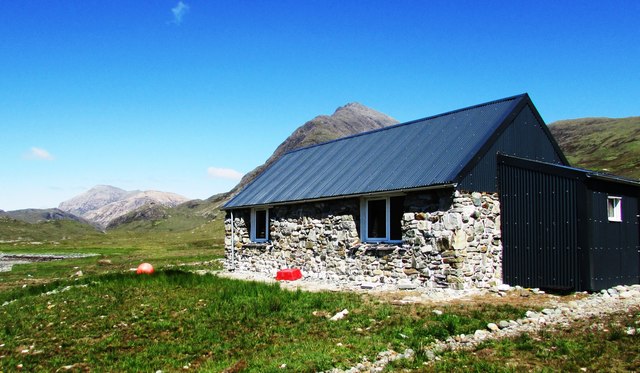
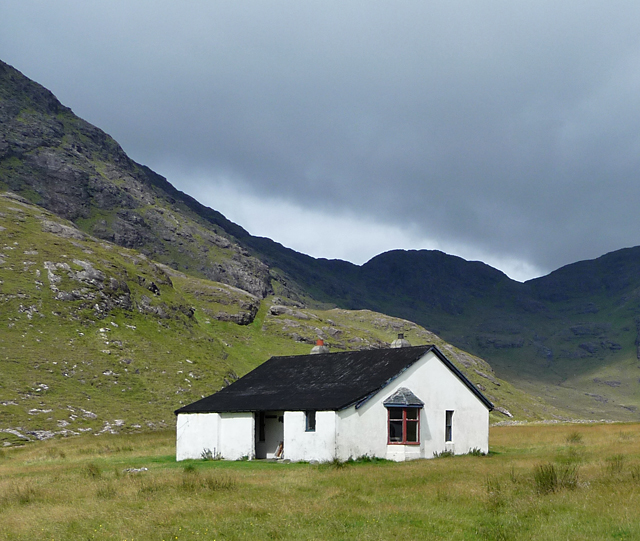
On our Scottish trip in May we found time to walk out to two bothies on Skye.  Unfortunately an overnight stay wasn’t on the cards (Chris likes her comfort nowadays, and leaving a comfortable campervan complete with cocktail cabinet wasn’t part of her game plan!) but ‘Mist’ needs a good walk each day and is always up for a trek somewhere.  We started the Skye visit at Elgol, and that night we watched the sun go down over the dramatic Cuillin Mountains – the next day we had a wander out to nearby Camasunary Bothy.


Camasunary Bothy 

Looking down to Camasunary Bay near Elgol


The track from Kirkibost crosses a bealach (pass) ….

…. before dropping down to the shore

The walk in is short by standards, with a total of 10kms there and back, though surprisingly for a low-level walk it has a total height gain of nearly 400 metres.  The previous night I had spoken to a fisherman at Elgol who told me how his uncle had built the rough track from Kirkibost to Camasunary – ‘Uncle’ had been a Colonel in the Royal Engineers, and apparently had great fun blasting the track through solid rock, but the track has stood the test of time and is the most logical way into Camasunary Bay other than going around the coast.

Great views ….

…. a mixture of mountains and sea

The walk in to Camasunary may be a low-level route, but it’s full of drama.  After crossing the bealach (pass), the panorama opens up to include some of the best views of the Cuillin Mountains – as this was the first time I had approached the Cuillins from this direction, I was seeing familiar mountains from a totally different aspect.  The path from the bay heading north to Sligachan was very tempting but we didn’t have time on this trip.

The new Camasunary Bothy © Bill Kasman

The new bothy blending in © John Allan

The old Camasunary Bothy © John Allan

The old bothy, which had been a popular destination for years, was taken back into use by the landowner in 2014 – the owner had visited travellers at the bothy on numerous occasions and seen for himself the simple pleasure walkers had staying there, and in an extraordinary act of generosity offered to pay for the building of a replacement nearby.  The new bothy was built by 59 (Commando) Squadron of the Royal Engineers as a project, and volunteers from the MBA fitted out the building when it was complete – the new bothy is the first and only one built as such and not converted from other use.


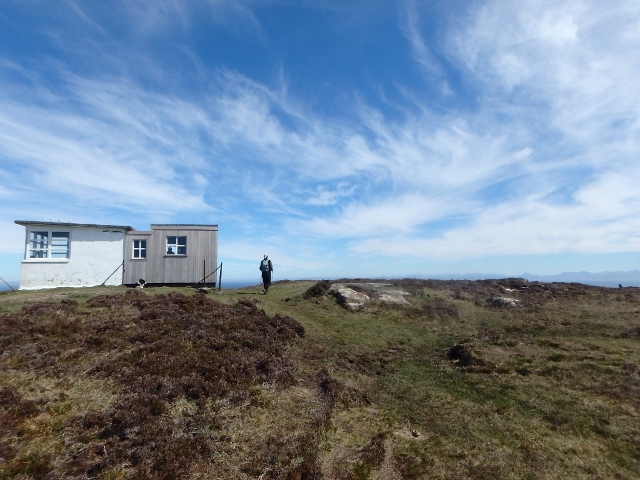
The Lookout Bothy – Rubha Hunish

Setting out near Shulista on Skye ….

….heading for the Lookout bothy ….

…. near Rubha Hunish

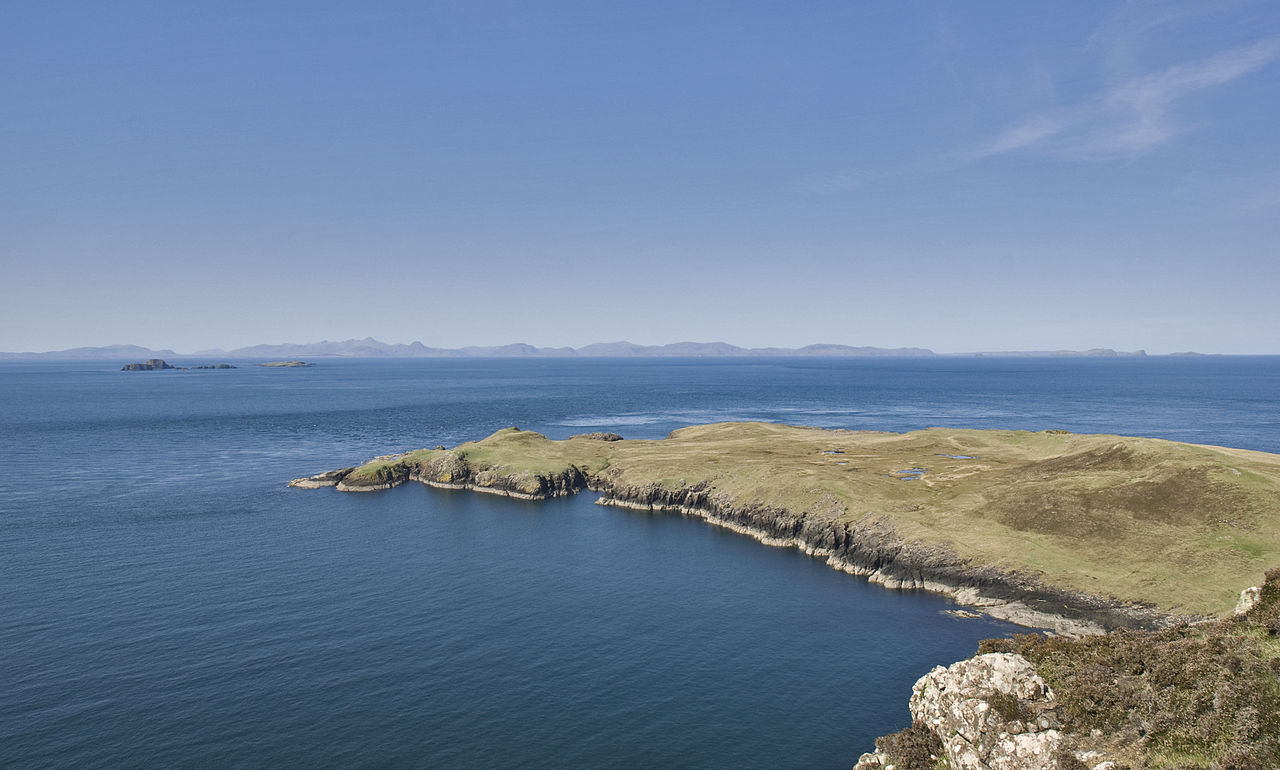
Hunish

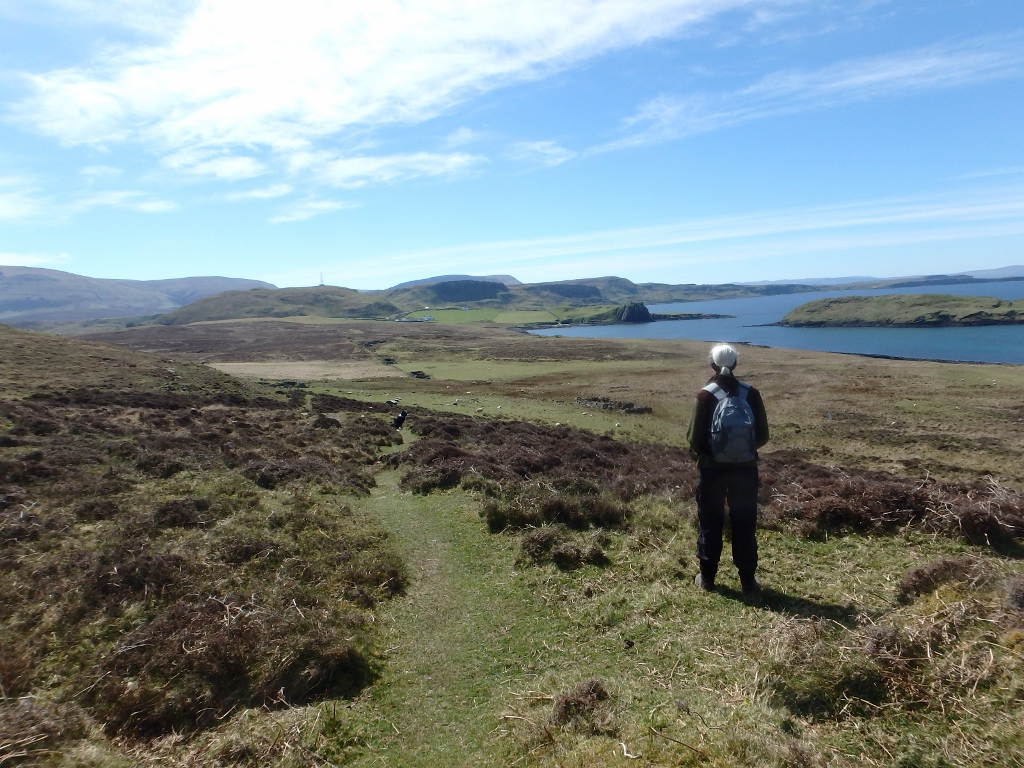
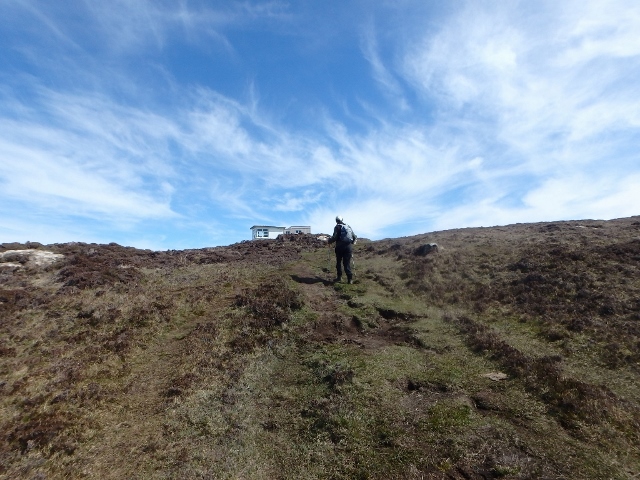
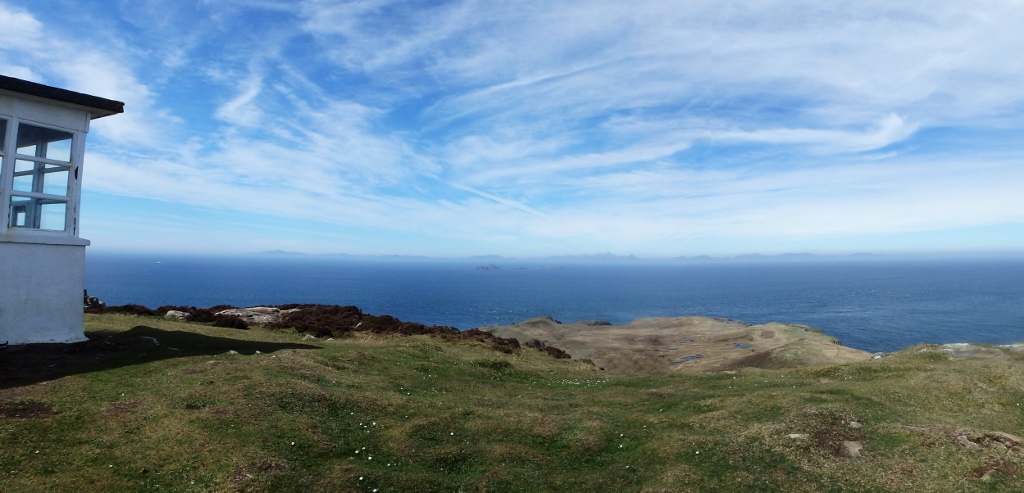
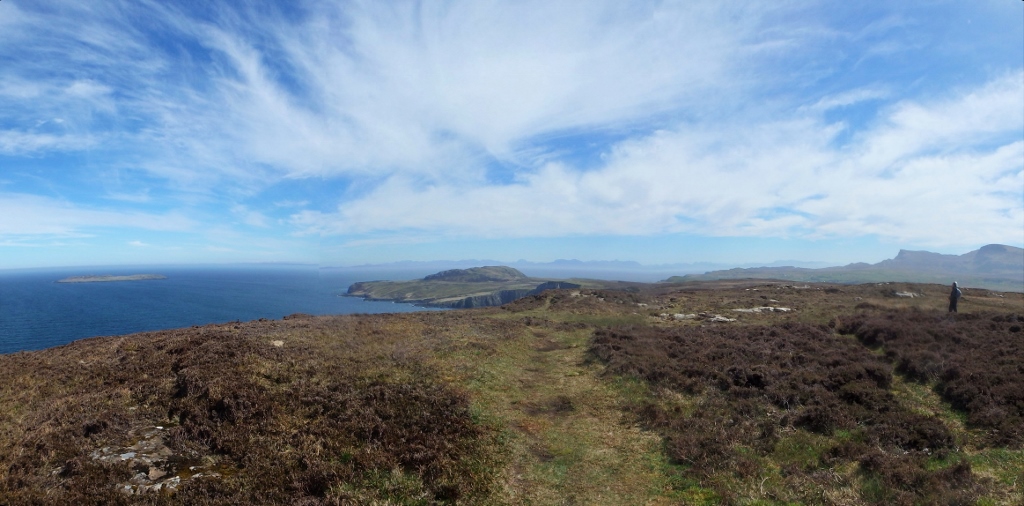
A few days later we were at the far north of Skye to walk out to ‘The Lookout’ at Rubha Hunish Point.    As the name suggests, the bothy was previously a Coastguard lookout, and when it became redundant it was taken over by the MBA.  The walk is different in character to the Camasunary walk – instead of the majesty of the Cuillins we had views of moorland, sea and big skies.

Great views out to sea ….

….and a good viewpoint inside © Mountain Bothies Association

Just visible to the north west are the distant islands of the Outer Hebrides ….

….and to the east, the coastline of Wester Ross on the mainland

At the bothy, we stayed long enough to eat our ‘sarnies’ and have a brew of coffee, and we were lucky enough to meet Bill, the bothy custodian, who had come out for an inspection visit.    Views out to sea were amazing, with the Outer Hebrides visible to the north west, and out to the east was Wester Ross, our next destination on the mainland where we would be heading in a few days.

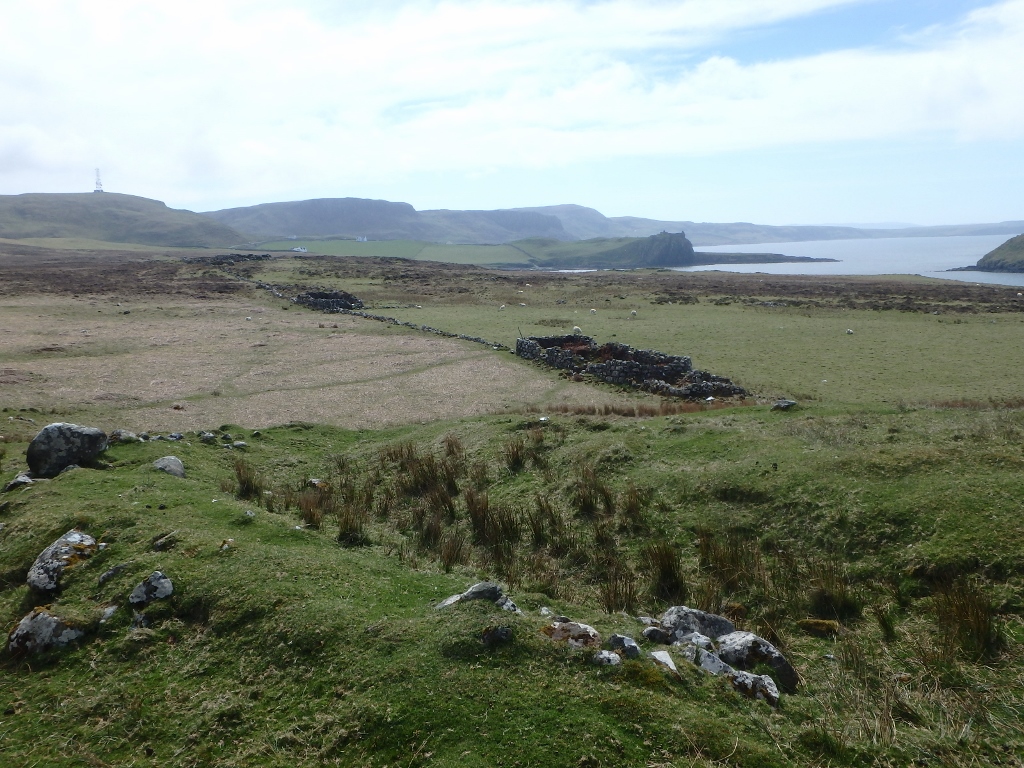
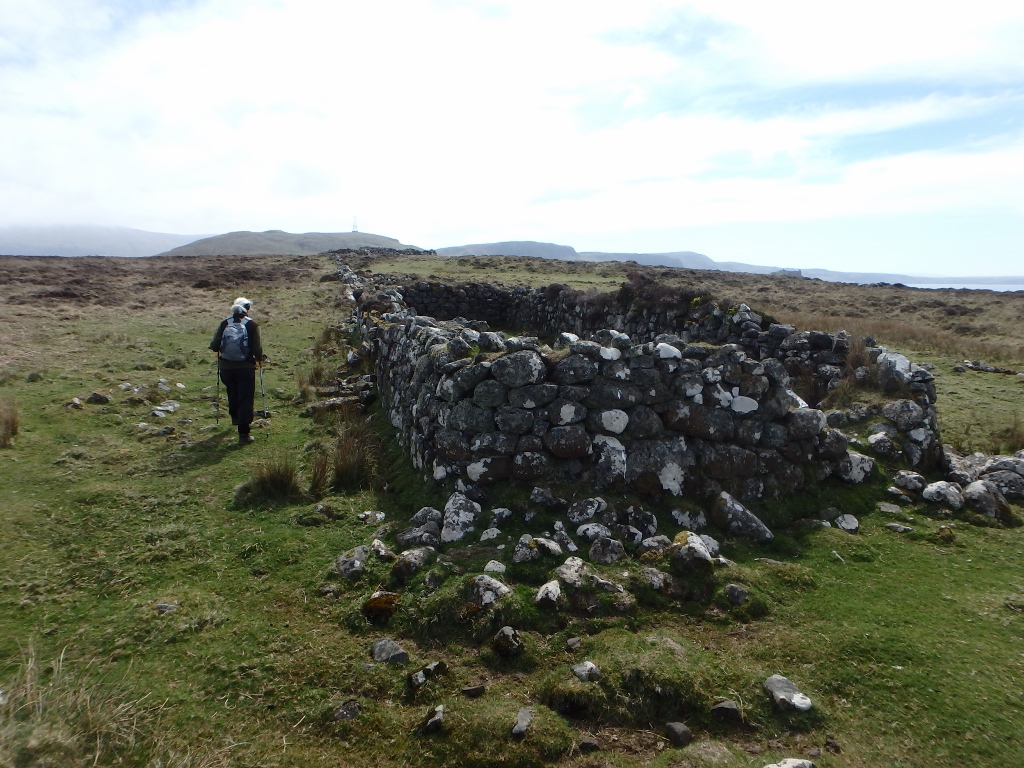
On the way back, the old settlement of Erisco

The abandoned cottages of the crofts of Erisco

Our return route took us by the old abandoned settlement of Erisco.   The small crofting township was built by the land-owning MacDonalds for tenants who were being resettled to better arable land at Erisco from poor land intended for sheep grazing.   In due course, better settlements were built elsewhere, and the crofters abandoned the Erisco township; it now stands deserted, probably full of ghosts and memories.

It’s a fair bet that the same ghosts and memories also inhabit the mountain bothies of the UK.   Go and visit sometime soon.

Crossing the Bealach heading for Camasunary

Text and images © Paul Shorrock except images tagged (JB) © John Bamber and image tagged MBA © The Mountain Bothies Association.

Images tagged Dave Crocker, Nigel Brown, Bill Kasman and John Allen are taken from the Geograph Project and are reproduced under a Creative Commons Licence

p.s. if you want to read a great bothy tale check this out by blogger/writer John Burns  https://www.johndburns.com/the-night-the-bothy-burned/   If you enjoy that, have a wander round his website for more blogs, or even better buy his latest book ‘The Last Hillwalker” – a great read!

Posted in 1. Scotland, 5. North Wales, Bothy days | Tagged , , , , , , | 11 Comments

#222 – The Lost Valley of Glencoe

Coire Gabhail, otherwise known as ‘The Lost Valley’

(Left click all images for expanded view, use browser return arrow to go back)

In May 2016 Chris and I had enjoyed a great two-week trip to the Scottish Highlands, and had enjoyed settled weather that had made mountain days a genuine pleasure (see posts #201, #202 and #203).  May in the Highlands is usually a good bet for settled weather without the curse of the Scottish midge, but would we be pushing our look to try for the same again in 2017?  There was only one way to find out ….

Setting out for the Lost Valley

I’ll admit to being a creature of habit – for me there’s only one way to drive to the North West Highlands and that’s the way I first drove up many years ago, via Stirling, Crianlarich, Tyndrum and Glencoe.  We arrived in Glencoe around midday, and rather than waste good weather we decided to have a wander up the Lost Valley – it’s a great short walk, with a feel of being in the mountains.

The old wooden steps (photo 2002) ….

…. now replaced by these

After the steps ….

…. comes the bridge over the River Coe

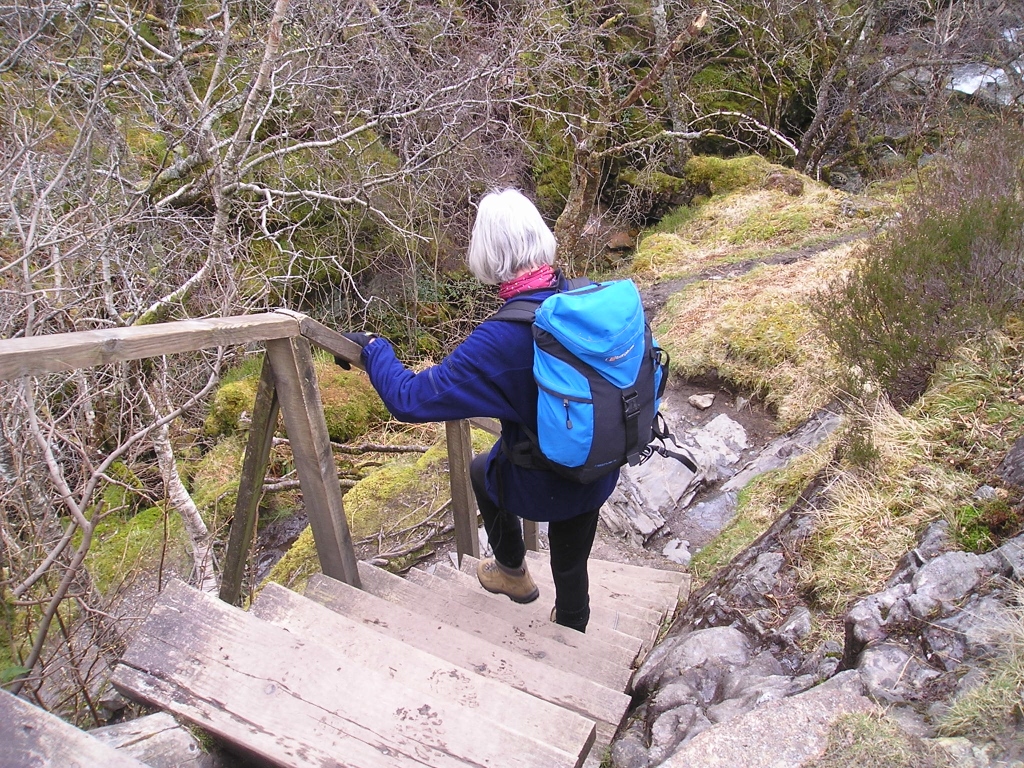
The valley is a high, wide glen, hidden from the main valley below by the remains of a huge, ancient landslip, and the route is full of surprises.  The first obstacle is the gorge of the River Coe – this would be completely impassable at this point without a set of steps leading down to a narrow bridge.  The steps used to be wooden, but thousands of pairs of boots took their toll and the wooden steps have been replaced by a substantial metal staircase.

Looking down the protected section of path after the bridge (© Mick Garratt)

The fenced conservation area beyond the bridge ….

…. with an impression of what the mountains would be like with no grazing

The deer fence and gate


Immediately after the bridge, a short rock step is now protected by a steel cable following several fatal accidents.  Beyond the rocky bit comes a conservation area surrounded by a high deer fence.  As deer and sheep cannot graze there, the land has reverted to what most of the Highlands would look like without grazing, and pioneer tree species such as silver birch have started to re-assert themselves.

Looking across the glen to Am Bodach

The path alongside the ravine

The path after the stream crossing

Nearly there!

Once beyond the birch trees, the view opens up across the glen looking towards Am Bodach and the start of the Aonach Eagach (see post #52).  Heading southwest away from the road below, the walls of the ravine start to close in, leaving a narrow path with a big drop down to the stream below – the route is in no way technically difficult, but a slip here could be serious or even terminal.  After an easy stream crossing the ravine opens out a little on the last bit of ascent.

The first view into the Lost Valley

The short descent to the Lost Valley

The first view into the Lost Valley comes as a surprise to those who haven’t seen it before – the landslip which blocked the valley entrance formed a lake which gradually silted up. The water eventually found an underground route through the rocks left by the landslip, leaving a wide, flat valley that looks Himalayan in character.

Coire Gabhail – ‘The Lost Valley’ (photo 2008)

The Gaelic name for the valley is Coire Gabhail which means ‘Hollow of the bounty’ or ‘Hollow of capture’, due to its historic use by the local MacDonald clan as a place to hide cattle stolen from their neighbours, usually the Campbells.  It was also one of the routes by which the MacDonalds fled during the infamous Glencoe Massacre in February 1692. Campbell clansmen wearing the uniforms of the King (William of Orange) turned on the MacDonalds, who had offered them hospitality, and murdered 39 men, women and children.  Another 40 died fleeing in a blizzard, and Coire Gabhail was one of the escape routes taken that night.

Boulders as big as houses (photo 2002)


The return route is the same as the way up

The valley is a quiet, peaceful place now.  It would be possible to spend half a day wandering up the valley or scrambling on the huge boulders, some as big as houses, but we were on a mission – we still had to find a place to park the camper for the night, so it was time to head back, following the route we had taken up.

Time to head for home (with a big drop to one side!) ….

…. but with the metal steps still to negotiate

Border Collie ‘Mist’ is safe and sure-footed in the hills, though I still keep a careful eye on her near big drops.  She romped along the narrow path above the ravine, but the low point in the day for the dog was the metal staircase – it was the only time in the day I had to put her on the lead, to persuade her that she wouldn’t drop through the one-inch gaps in the steps.  Funny animals, dogs!

Not the best part of the day for Border Collie ‘Mist’!

Text and images © Paul Shorrock except image tagged ‘© Mick Garratt’ which is taken from the Geograph Project and reproduced under a Creative Commons Licence

http://www.geograph.org.uk/

p.s. apologies to regular readers for a long gap between posts – the trip to Scotland was full of surprises, including 4G internet on the phone at times, but getting out on the hills soon became more important than writing about them!  I’ll be putting more posts up about the trip over the next few weeks.

Posted in 1. Scotland | Tagged , , , , , , | 6 Comments

#221 – Moel Ysgyfarnogod in the Rhinogs.

Moel Ysgyfarnogod (left click all images for expanded view, use browser return arrow to go back)

The Rhinogydd (Rhinog) mountains present some of the toughest walking in North Wales.    They may not have the highest summits but what the hills lack in height they make up for with miles of rough, stony, bouldery, heathery wilderness, with few tracks or paths – a good place to escape from the 21st Century then!    We hadn’t been out this way for over four years (see posts #95 and #96), so a return trip was long overdue.

The route, shown in blue

The mountains of the Rhinogydd (The Rhinogs) to the left of the A470 road (Route shown here in red)

The name Rhinog comes from the word Rhiniog meaning threshold, and the Rhinogydd are just that, forming a barrier between the sea and the A470 road between Blaenau Ffestiniog and Dolgellau.    It’s gnarly terrain, not visited by the masses of tourists who head for Yr Wyddfa (Snowdon) and Tryfan, but there are ways through this challenging country, which is why Chris and I, plus Border Collie ‘Mist’, were heading towards Moel Ysgyfarnogod.

Setting out from the road head above Eisingrug

The first view of Llyn Eiddew Mawr, which translates as ‘Big Unchanged Lake’ ….

…. and Llyn Eiddew Bach – ‘Small Unchanged Lake’

Looking back to the two ‘Eiddew’ lakes

The lane from Eisingrug to the start point is one of the narrowest lanes you could possibly take a vehicle, but with careful driving we arrived without any damage to the car or to my driver’s pride.    We then had a walk in of almost 5 kms to reach Moel Ysgyfarnogod, but the going was good on an old miners’ track.    Along the way we passed the two Eiddew lakes before heading uphill to meet a terrace path running along the hillside.

The start of the terrace path

Old mine workings ….

…. abandoned long ago

The terrace path continues ….

…. with Chris just visible dead centre to give a sense of scale

Passing below the rocks seen in the previous view ….

…. and looking back along the terrace

Local residents, looking very clean – probably due to the rainfall!

The path is yet another old miners’ track (there must have been a lot of old miners hereabouts!) that takes advantage of a natural rising line which sits between rock walls above and a steep slope below – in places you could almost imagine being in the Dolomites.     The remains of old mines were obvious at the start, and the views opened out as we gradually gained height.


Border Collie ‘Mist’ at Llyn Du (Black Lake) ….

…. but no time to loiter!

‘Mist’ admiring the view

The first view of Moel Ysgyfarnogod (left) and Foel Penolau (right)

The terrace comes to an end where it bumps into the tiny lake of Llyn Du (Black Lake).    It would make a brilliant campsite, but we were on a mission and didn’t loiter there too long.  As we turned the corner of the ridge we had just traversed on the terrace path, the panorama opened up to the east and a little further on we had our first view of Moel Ysgyfarnogod and Foel Penolau.

The last steep, bit to the summit ….

…. then things become level again

The author at the summit with Moel Hebog (centre) and Snowdon (right) in the background

Looking towards Tremadog Bay with the Llŷn Peninsula left of centre in the haze

Up to now it had been an easy day, with gradually rising paths, but on the slopes of Moel Ysgyfarnogod (Bare Hill of Hares) we had to start doing a bit of work on the first steep bit of the route.     The summit gave great views to the north, including Snowdon and the hills around Moel Hebog, and to the west we could see the sea at Tremadog Bay.    To the east was the edge of the lake of Llyn Trawsfynydd but looming up to the northeast was the neighbouring peak of Foel Penolau.

Foel Penolau seen from the descent path off Moel Ysgyfarnogod

Closer view of Foel Penolau – the tiny figure on the centre skyline gives an idea of scale

Foel Penolau (Bare Hill with a Light Top) is one of those mountains that demands a bit of commitment, as the sides are comprised of rocky crags with few breaks in their defences.  This is definitely not what Chris would regard as a fun way to spend an afternoon, but it made a good recce for a return trip by me in the near future.    The photo shows a tiny figure on the skyline, giving an idea of the scale – I’ll be back for that one!

Heading northwest on the way back ….

…. with quite a bit of height to lose

Llyn Dywarchen on the way back

Last view of Llyn Dywarchen

The descent was a bit of a trackless ‘mooch around’, where the ability to read the ground was more important than reading a map, but before long we were at yet another lake, Llyn Dywarchen (Turf Lake or Sod Lake) – from here it was an easy job to re-join the miners’ track we had taken on the way out.    These remote, rough hills may be ignored by the masses, but for lovers of solitude and quiet they are hard to beat.

Time to head for home

Text and images © Paul Shorrock

Posted in 5. North Wales | Tagged , , , , , , | 13 Comments

#220 – Foel Fras – Things don’t go as planned!

The summit of Foel Fras looking north

As Chris and I finished our bimble around Llyn Anafon and Drum (see post #219) we were followed most of the way back by big glowering clouds, and it started to pour down just as we arrived back at the car.   Looking back towards the Carneddau on the drive home, it seemed that Mr Snow had paid a visit to the hills – a return trip three days later seemed like a good idea, but things don’t always go as planned ….

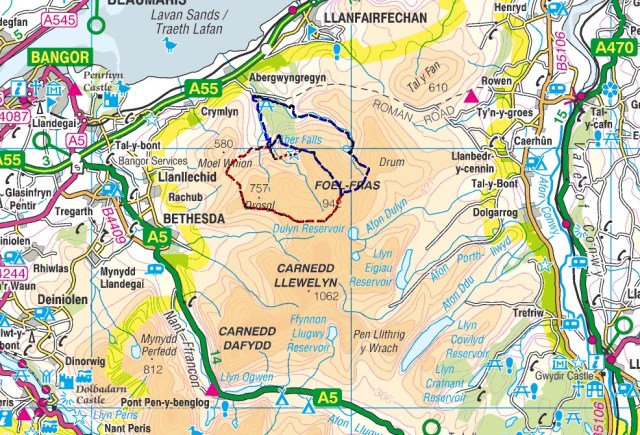
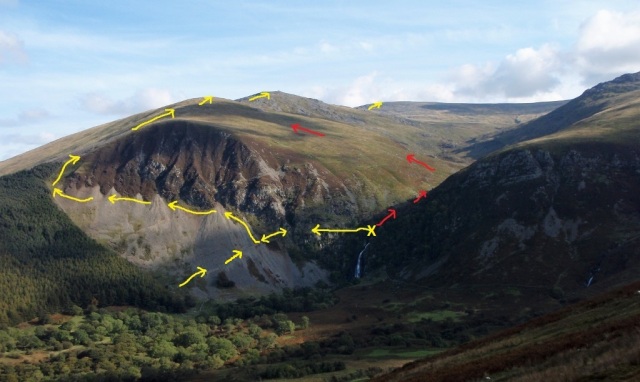
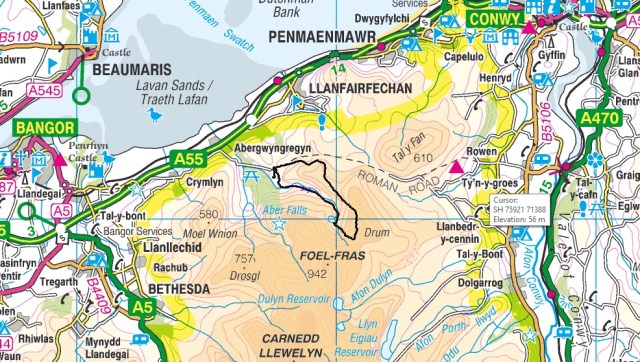
The route – original planned route in red, actual route in blue

The mountains of the Carneddau

The initial plan was simple – I would head up to Aber Falls, take the path to the left of the falls as seen from below, then head up Llwytmor and continue to Foel Fras.   From there I would head south-west to Carnedd Gwenllian then take the path south of Bera Bach and Drosgl before heading back down towards Aber.   A cheeky little 17 kms distance with 1010 metres of height gain was almost Scottish in proportion – six hours was a reasonable estimate.    But, things don’t always go as planned ….

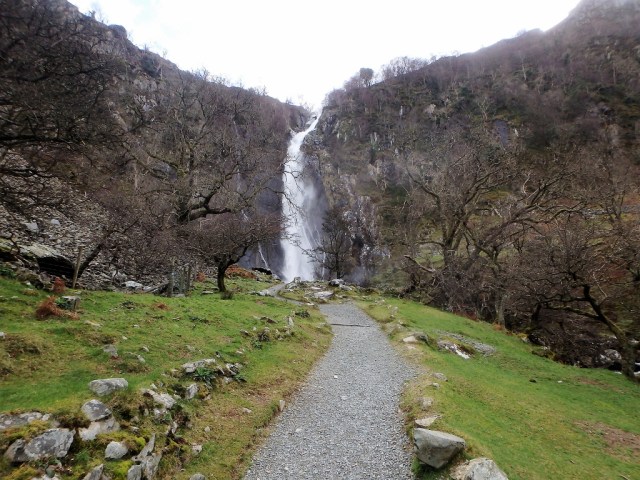
Heading towards Aber Falls ….

…. with much more water than usual!

As we finished our walk three days earlier, it looked as though I could expect a fair amount of snow on high ground on this trip, but the amount of green showing as I set off suggested otherwise.   One thing that soon became apparent, however, was the amount of water in the Afon Rhaeadr Fawr, and as the falls came into view I saw there was much more water than usual.    River crossings were probably off the day’s menu then.

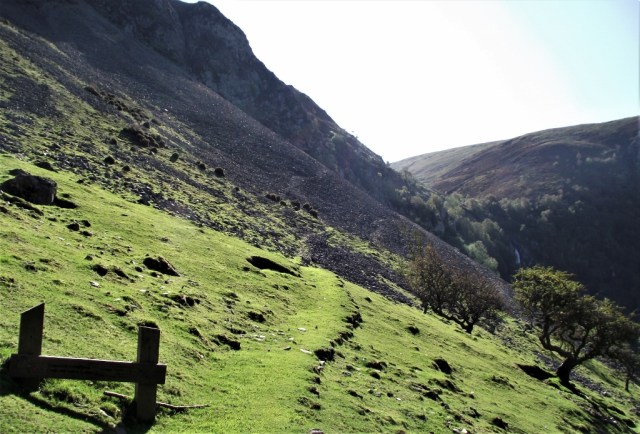
The path to the top of Aber Falls

View of the falls from the path across the scree

I set off on the rising path towards the top of the falls, trailing behind Border Collie ‘Mist’ as usual.   The path crosses a scree slope, before following an entertaining route along rock ledges, followed beyond there by a small rock step.   This requires a bit of care when it wet as it can get greasy, and the ground below drops off towards the waterfall.   Once across the step, the planned route was a long, height-gaining slog up Llwytmor, but things don’t always go as planned ….

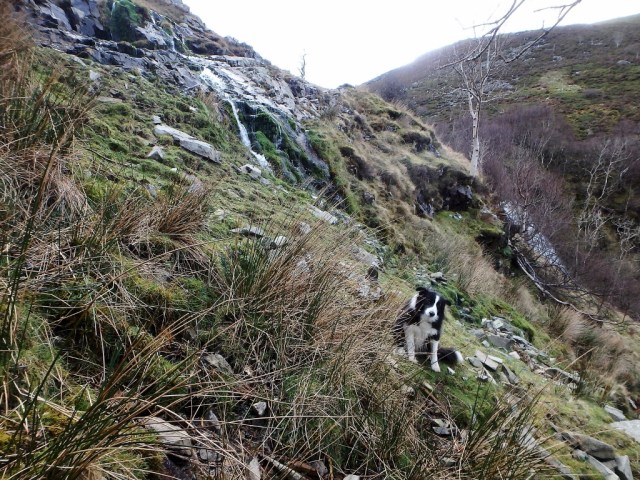
Approaching the rock step ….

…. or in this case the greasy, slimy, wet rock step! (Note the drop-off below)

The rock step usually has a damp patch except in a drought, but today it was a small stream!   Wet rock in itself isn’t a problem – the problem here was that three or four metres of ascending rock slab were covered in slime which had the consistency (and friction level) of liquid soap.   I tried the usual crossing point but was forced to retreat.   Other options were tried, including traversing on the grass below the step.  Things were definitely not going as planned.

“Woof! What do you think Boss? Not looking good is it? Woof, Woof!”

A slip or a fall would probably not have been terminal, but one thing was certain – it would hurt, probably a lot!    I’ve been doing this ‘mountain thing’ for most of my life without getting injured, and I wasn’t about to break that record.   Equally, I wasn’t ready to head home.   A change of plan was looking likely.

The solution – planned route in red, actual route in yellow (Photo – October 2014)

Above the screes I had crossed, there was a line of grotty, greasy crags that looked even less appealing than the three or four metres of soapy slab.   The map showed the crags running out as they reached the Coedydd Aber forest.   I didn’t fancy flogging up or across the loose scree, but quite often it’s possible to find solid ground at the foot of crags, so that became the plan.   Sure enough, it was possible to pick a way below the rocks following sheep paths, and I gradually drew nearer to the forest.

At the end of the screes, time to head upwards

Heading towards Llwytmor Bach

Looking towards Bera Mawr and Bera Bach (intended return route is on the other side of the ridge)

Llwytmor ahead, seen from Llwytmor Bach

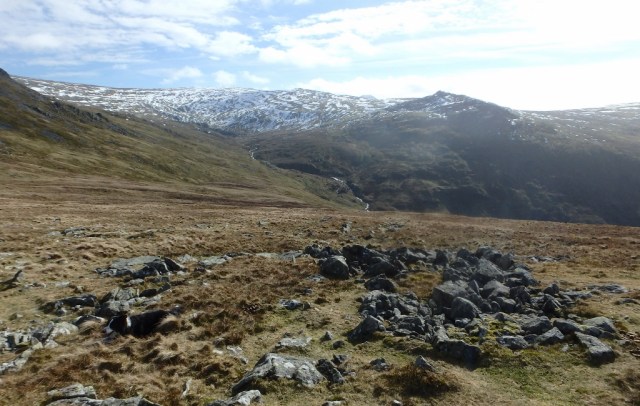
At the end of the screes, a better path headed straight up following the edge of the forest, followed by a slightly less-steep pull up to the summit of Llwytmor Bach.  The faffing about at the slab, plus the detour, had cost me an extra 2 kms and an extra 100 metres of height gain – I had also taken an extra hour, and was about to add more distance and time in visiting one of the many aircraft crash sites found in the Carneddau.

*     *     *     *     *

Heinkel He111 bomber

On the night of 12/13 April 1941, the crew of Heinkel He-111 F4801 had spotted the aircraft carrier HMS Victorious at the docks at Barrow-in-Furness while on a reconnaissance flight.   On the following night, the bomber took off again from its base at Nantes, the crew tasked with bombing the ship.   The attack failed when the crew found that the ship had been moved, and under some intense anti-aircraft fire they released their bombs on the dock and made for home.

Looking down towards the crash site

The anti-aircraft fire had damaged the compass, radio and one engine, and the aircraft headed back to Nantes over the Irish Sea, avoiding the defences around Liverpool.   At 0300hrs the aircraft struck the plateau at Llwytmor Bach.  The aircraft appears to have careered over the ground before coming to a halt on the slopes of Llwytmor before catching fire and burning out.

Weird shaped glacial erratic perched on rocks near to the crash sit

The initial impact killed engineer ‘Gefreiter’ Josef Brüninghausen but the remainder of the crew survived, and the least injured of them, ‘Gefreiter’ Kurt Schlender, made his way across the plateau and down the valley of the Afon Anafon, where he sought help from a farm on the road down to Abergwyngregyn.   The three survivors spent the remainder of the war as prisoners.

*     *     *     *     *

The summit of Llwytmor, looking towards Foel Fras

Snow and boulders on the ascent of Foel Fras

Between Llwytmor and Foel Fras, I met a party of two heading the opposite way.   The older of the two men mentioned the nearby Heinkel crash site, and I told him I had just come from there.    He went on to say that his uncle had visited the site some years earlier and had found a signet ring belonging to one of the crew of the aircraft, and had been able to pass it on to relatives in Germany.

Walkers at Foel Fras summit

At Foel Fras I had another decision to make.    I still had about 10 kms of my original route (red dashes on the map) back to the car, but it had taken me 5 hours to get to Foel Fras instead of about 3½ hours, due to the delays caused by the diversion, and the state of the snow patches on the route – the snow was extremely soft in places, and each patch resulted in a delay, either through sinking knee-deep or in detouring around it.

The view to Foel Fras (left) and Llwytmor, as seen at Bwlch y Gwryd on Monday 6 March ….

…. and the same view just three days later

I had no way of knowing how much snow there might be on the planned route via Carnedd Gwenllian, but most of that way back was high level, and more snow patches on the route would cost more time and energy.    However, I could see that the route down to Llyn Anafon had lost much of the snow that had been present three days earlier, and a return that way would also be about 2 kms shorter – it didn’t take long to decide which option .

Bwlch y Gwryd, looking towards Drum

Drum (right) and the start of the descent to Llyn Anafon

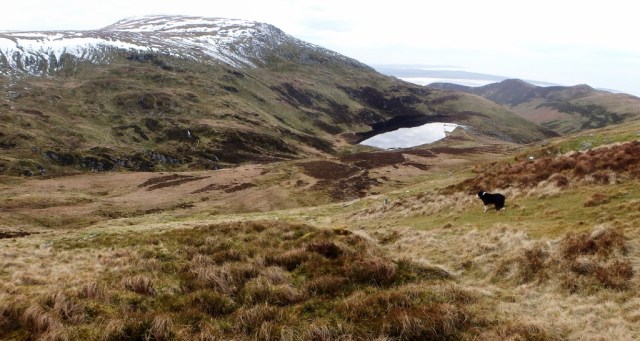
Llyn Anafon just below

The same ground three days earlier

Sure enough, when I reached Bwlch y Gwryd between Foel Fras and Drum, I could see that the rest of the descent was all on grass.   ‘Mist’ and I made short work of that, and the track above the Afon Anafon gave even faster progress.    Two hours after leaving the summit of Foel Fras I was back at the car, having to explain to the dog that her overdue dinner time would have to wait another hour until we arrived home.

Time to head for home

Text and images © Paul Shorrock

Posted in 5. North Wales, Aircrash Sites | Tagged , , , , , , , , | 6 Comments

#219 – Llyn Anafon and Drum in the Northern Carneddau

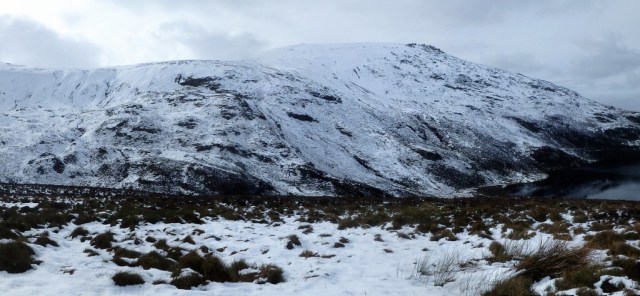
Looking down towards Llyn Anafon from the slopes of Drum

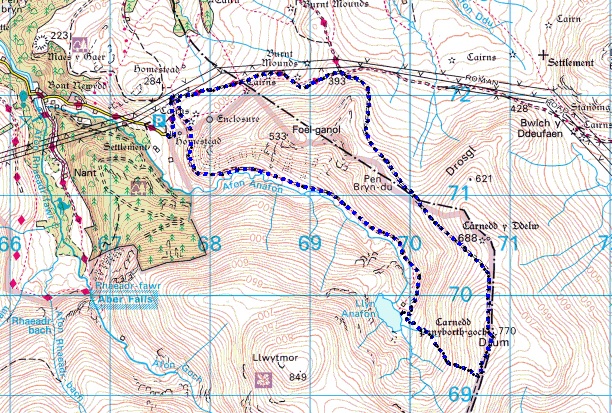
The route – Anti-clockwise to Llyn Anafon then on to Drum

The Northern Hills of the Carneddau

Although I’m usually up for a long mountain day, me missus enjoys her days in the hills when she isn’t being scared out of her wits or setting off on a long ‘yomp’ into the backwoods in crappy weather.   So, that’s a nice easy brief then!

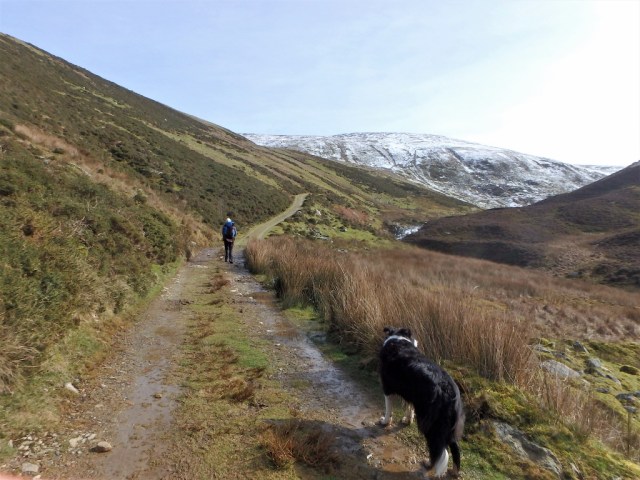
Setting out up the track above Afon Anafon

The early weeks of 2017 had the usual storms in from the sea, with high winds and loads of rain rather than snow, so a calm day with a sprinkling of snow on the tops was enough reason to get out.  In fact, it would have been hard to come up with an excuse not to, so with all the boxes ticked, a trip to the hills of the Northern Carneddau was in order.

Looking back towards Abergwyngregyn and the coast

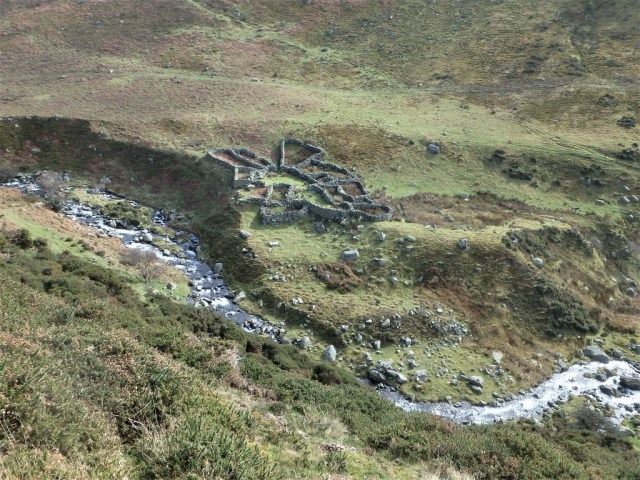
Old sheep folds below the track

The last time Chris and I (plus Border Collie ‘Mist’ of course!) came up this way was late autumn 2014 (see post #167).   There is a good track heading up from the road-head beyond the village of Abergwyngregyn on the coast and this gives quick and easy access to a lovely hidden corner of the Carneddau.

Still heading up the track ….

…. with lots of water in the stream below

Drum comes into view ahead

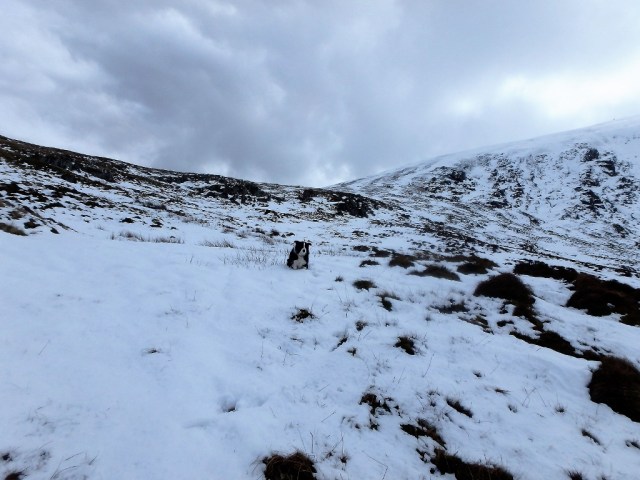
It’s about 4.3 Kms from the carpark to the shoreline of Llyn Anafon with a height gain of about 330 metres, so it’s hardly what you would regard as extreme.   The track follows the stream of the Afon Anafon in a deep valley, with the views beyond restricted, so it was some time before our objective, the 770 metres (2525 ft) summit of Drum, came into view.

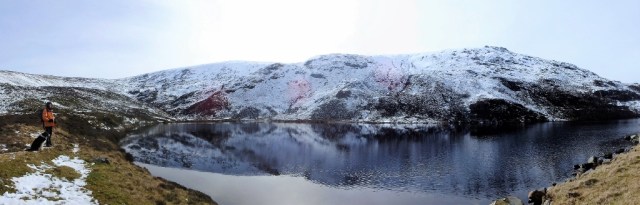
The ‘picnic site’ and the view across the lake of Llyn Anafon ….

…. with the picnic on the go ….

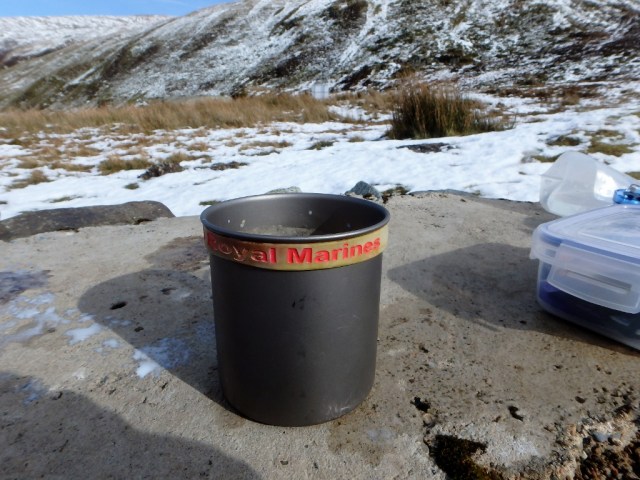
…. including the favourite mug!

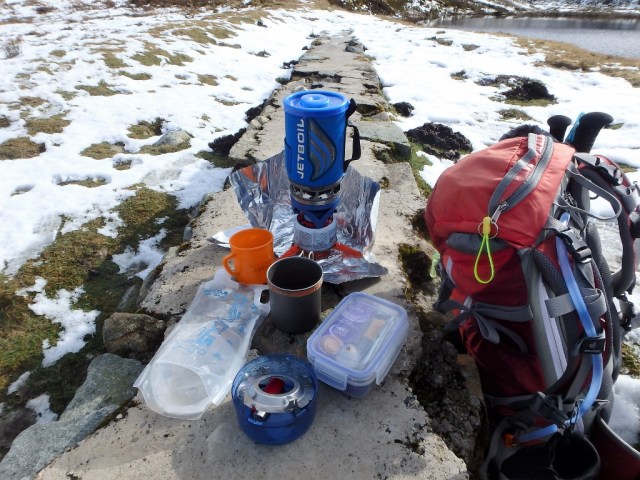
We weren’t in a rush and we can please ourselves nowadays as to how the day goes, so when we got to Llyn Anafon it was picnic time.   Out came the trusty ‘Jetboil’ stove and instead of an indifferent cup of coffee from a flask we had a fresh brew.   There might even have been a small nip of spiced rum (‘Sailor Jerry’ if you must know) from a different sort of flask, but as I said, we can please ourselves nowadays.

Leaving Llyn Anafon behind and heading up into the snow


The view across to Llwytmor

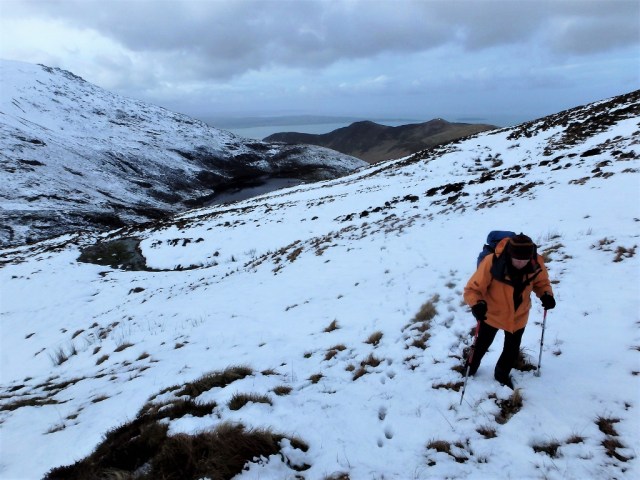
Having had a bit of a dawdle up from the car park, it was now time to put some effort in (Not TOO much, though – did I mention that we can please ourselves nowadays?)   We had a total height gain of almost 250 metres over 1.25 kms in front of us, which works out (roughly) as a 1-in-5 (20%) slope.

Things start to get steeper ….

…. but as usual, Border Collie ‘Mist’ is ahead and waiting

Things get steeper towards the top though, and there was a height gain of about 150 metres over the last 440 metres of distance, which comes out at about a 1-in-3 (33%) slope.  Added to that was an accumulation of soft, wet snow, so there much slithering about on the steeper stuff – things remained good humoured, but I’m sure I caught the dog laughing at us!

On the bwlch (col) at last – Foel Fras behind

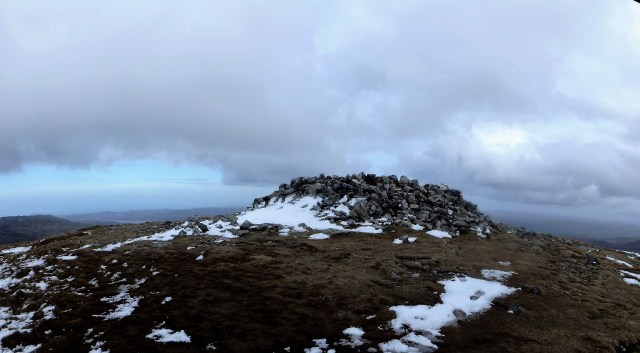
The ancient cairn on the summit of Drum

From the bwlch (col) above the slope, it was an easy stroll to the summit of Drum.   I had intended to get some pics of the what remains of the site of the radar station that had been located here in the mid 1950’s, and which I mentioned in post #217, but all was covered in snow.

*    *    *    *    *

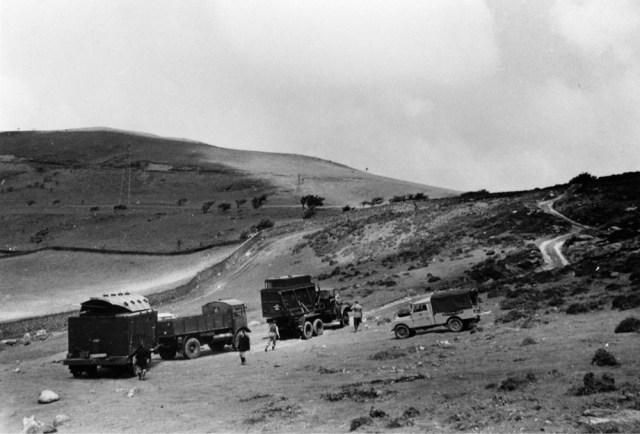
An AEC Matador truck hauling the radar cabins up the narrow lane from Abergwyngregyn

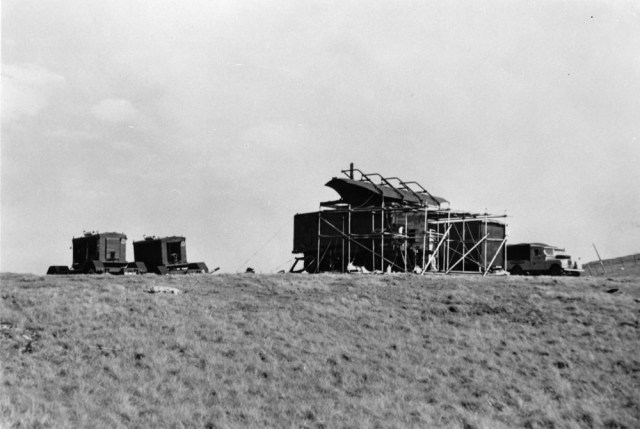
The system was code-named ‘Blue Joker’ and was designed to test radar signal processing from as high a point as was reasonably practical, in order to minimise sea wave interference.  The setup included two mobile cabins, of which one was a modified ‘Type 4 Mk 7 Mobile Radar Unit’ to house the equipment and the other a domestic unit for use by the staff.  In addition, there was a large diesel electric generator.

The convoy at the start of the mountain track

The Royal Electrical and Mechanical Engineers (REME) built the access road from Aber to the site assisted by local council employees, and contemporary photos show that the stone walls alongside the road near to the village were comprehensively trashed!  A heavy ‘AEC Matador’ truck was used to haul the radar cabin, with the domestic unit sitting on the back of an American ‘Diamond T’ tank transporter tractor unit.

'Diamond T' truck carrying the domestic unit and towing the Matador and one of the radar cabins

‘Diamond T’ truck carrying the domestic unit and towing the Matador and one of the radar cabins

It was during the radar trials that the ‘Canberra’ bomber was lost in December 1957 (post # 217).  Although the trials were a success, the Blue Joker project was wound up in the mid-1960’s when the perceived threat changed from manned Soviet bombers to Intercontinental Ballistic Missiles, which this type of radar could not track.

The mobile radar site at the summit of Drum

All that remains now is an area of hardcore that looks immediately out of place at an altitude of 750 metres on a Welsh mountain top – a bit more careful searching will reveal a couple of concrete blocks and a few heavy-duty steel stakes used to anchor the equipment down in the high winds – they had a lot of those!

*    *    *    *    *

The way down ….

…. with the track well ‘snowed in’

One legacy of the huge amount of work that was put in to build the access road is a good track down from the summit of Drum, which since then must have been trod by thousands of weary walkers heading down from the Carneddau – being easy and downhill, it may even have saved a few lives over the years, though the upper part was completely snowed in for our descent.   We still made good speed though – we had a hungry Border Collie to feed!

A last view of Llyn Anafon from the track heading down

As often happens on a day out in the mountains, I was already plotting the next trip out, but I wasn’t expecting to be back out here three days later on a very different mountain day – you can read about it here in a couple of weeks.

Time to head for home

Text and images © Paul Shorrock with the exception of the ‘Blue Joker’ images.

p.s. The ‘Blue Joker’ pics are especially for fellow blogger Mountain Coward, who may know much more about the radar equipment shown from her days in the Army, though the setup in the photos was probably well obsolete before her time.

Posted in 5. North Wales, Aircrash Sites | Tagged , , , , , , , , | 8 Comments

#218 – Dulyn and Melynllyn in winter and summer (From the archives)

Early March 2016 – snow on the Carneddau, on the way out to Dulyn

Early March 2016 – snow on the Carneddau, on the way out to Dulyn

Winter this year in North Wales has been fairly mild, with high winds and rain but less snow than usual.    Most people would find that good news, but outdoors types aren’t ‘most people’, and my ice axe and crampons haven’t been getting much use lately.    There’s still time though – the above photo was taken on an outing in March 2016, and the day after that I was out on skis in the same area.

Return trip in July 2016 (look closely and Border Collie 'Mist' is in the same place in both shots!)

Return trip in July 2016 (look closely and Border Collie ‘Mist’ is in the same place in both shots!)

On that outing in March 2016, Chris and I, plus Border Collie ‘Mist’, had taken a route out to the bothy at Dulyn in the mountains of the Carneddau (see post #197), the first time that Chris had been out this way.    Four months later (July 2016) it was T-shirt weather in the mountains, and a great opportunity for Chris to see what had been underneath all that white stuff.

Setting out from the car parking area at Cwm Eigiau

Setting out from the car parking area at Cwm Eigiau

Big open spaces ….

Big open spaces ….

…. and wide panoramas

…. and wide panoramas

Dulyn Bothy comes into view

Dulyn Bothy comes into view

For those not familiar with the Carneddau, it’s a lovely semi-wilderness in the mountains of North Wales.    There are traces of human activity, but the big open spaces and wide panoramas can hide most of the mess that we humans inflict on the landscape.  For mountain enthusiasts, one of the more welcome human intrusions in this landscape is the remote bothy near the lake of Dulyn.

The author and 'Mist' at the bothy in July 2016 ….

The author and ‘Mist’ at the bothy in July 2016 ….

…. but a bit colder four months earlier

…. but a bit colder four months earlier

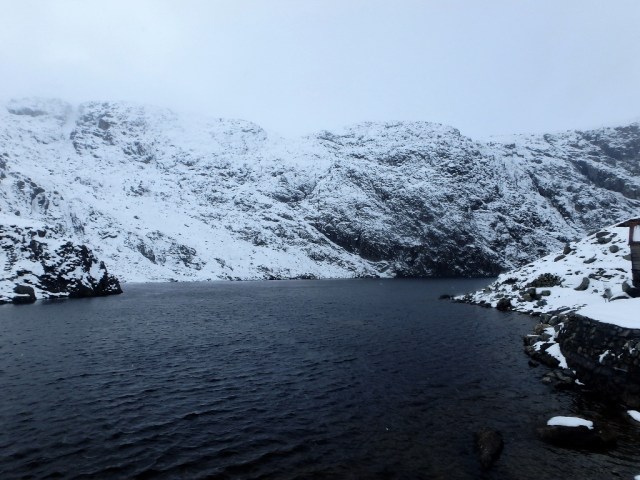
The lake at Dulyn in winter ….

The lake at Dulyn in winter ….

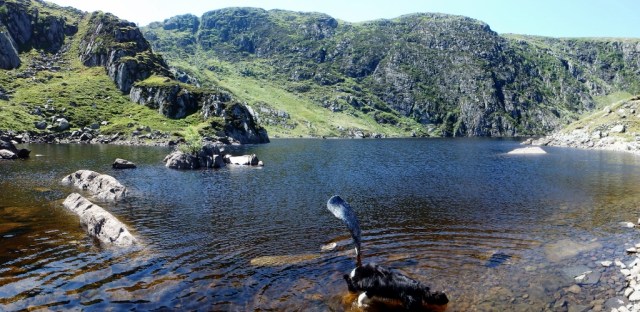
…. and summer (Note the aircraft propeller in the front centre)

…. and summer (Note the aircraft propeller in the front centre)

Although I’ve visited the location several times, I’ve still not spent a night at the bothy, something I must try to rectify this year, though I’ll probably aim for a summer trip to save carrying in wood and coal for the stove.    Slightly higher than the bothy is the small lake of Dulyn, which had looked bleak and gloomy in winter – the July photo shows a warmer scene in every sense.  (The propeller assembly is from a wartime air-crash whose story I told in post #197)

Some of the remains of the old quarry workings

Some of the remains of the old quarry workings

Heading up towards Melynllyn (the path can be made out just right of centre)

Heading up towards Melynllyn (the path can be made out just right of centre)

Border Collie ‘Mist’ herding the humans along ….

Border Collie ‘Mist’ herding the humans along ….

…. but for Chris, it seems there’s a lot of uphill ….

…. but for Chris, it seems there’s a lot of uphill ….

…. just as there had been a lot of uphill four months earlier

…. just as there had been a lot of uphill four months earlier

Nearly at the high point, with Dulyn behind

Nearly at the high point, with Dulyn behind

Looking back down the valley we walked to the Dulyn Bothy

Looking back down the valley we walked to the Dulyn Bothy

From Dulyn it was time for a bit of height gain, starting by old quarry workings near the lake.    We headed up towards the higher lake of Melynllyn, assisted by ‘Mist’ who, coming from a line of good herding dogs, likes to make sure that the humans stay on the right track.   It was warmer work on the July walk than it had been in March, but the height gain was just as steep – it’s fairly short though, and we were soon at the second lake.

Melynllyn in summer ….

Melynllyn in summer ….

…. and in winter

…. and in winter

The route out, with the track just visible in the distance

The route out, with the track just visible in the distance

Melynllyn is another beautiful spot, and it’s sometimes easy to forget that both Dulyn and Melynllyn are reservoirs – the two lakes have blended in to the surrounding countryside so well that they seem to have been there for ever.   In this case, humans may well have made a positive impact on the scenery for once.

Time to head for home ….

Time to head for home ….

…. with Cwm Eigiau coming into view

…. with Cwm Eigiau coming into view

Text and images © Paul Shorrock

p.s.   Winter 2017 has been such a washout (literally) up to now that quality mountain days worthy of a blog post have been few and far between – hopefully, this trip back to the archives will fill the gap for now!

Posted in 5. North Wales, Aircrash Sites, Bothy days | Tagged , , , , , , , , , | 3 Comments